
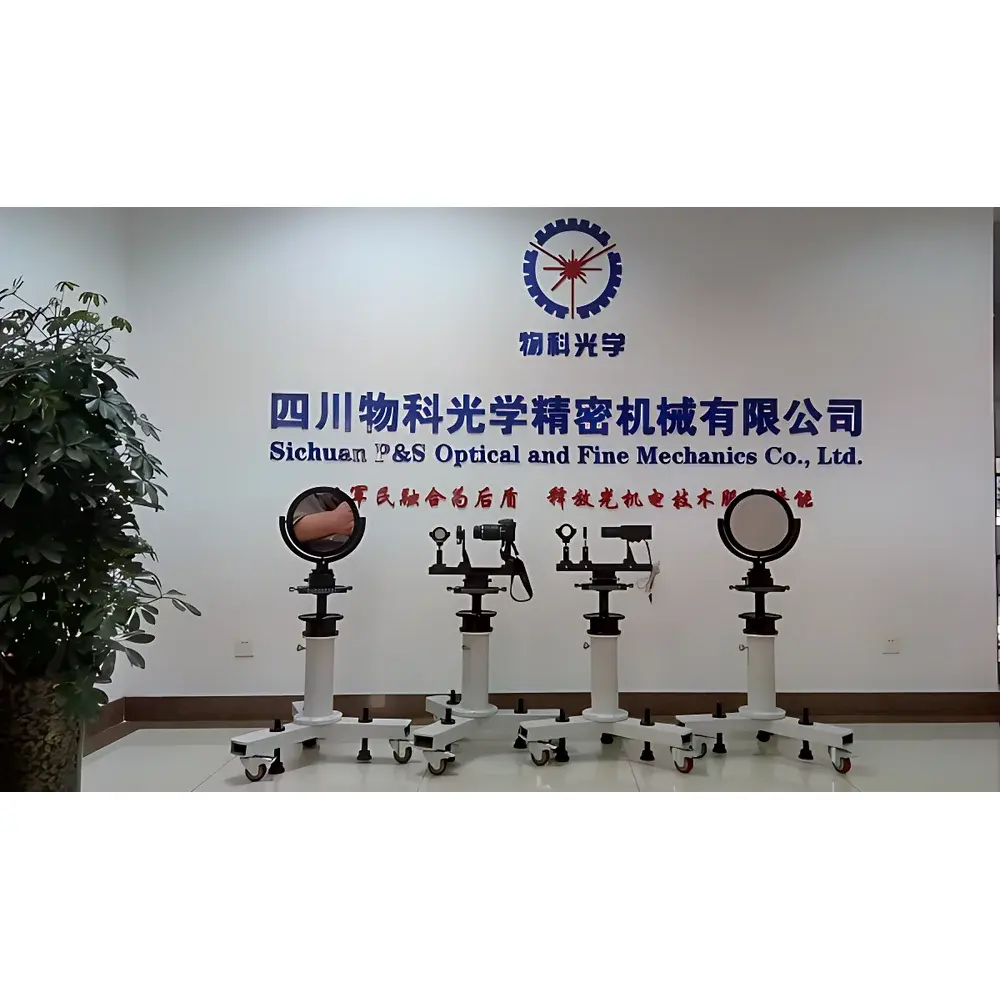
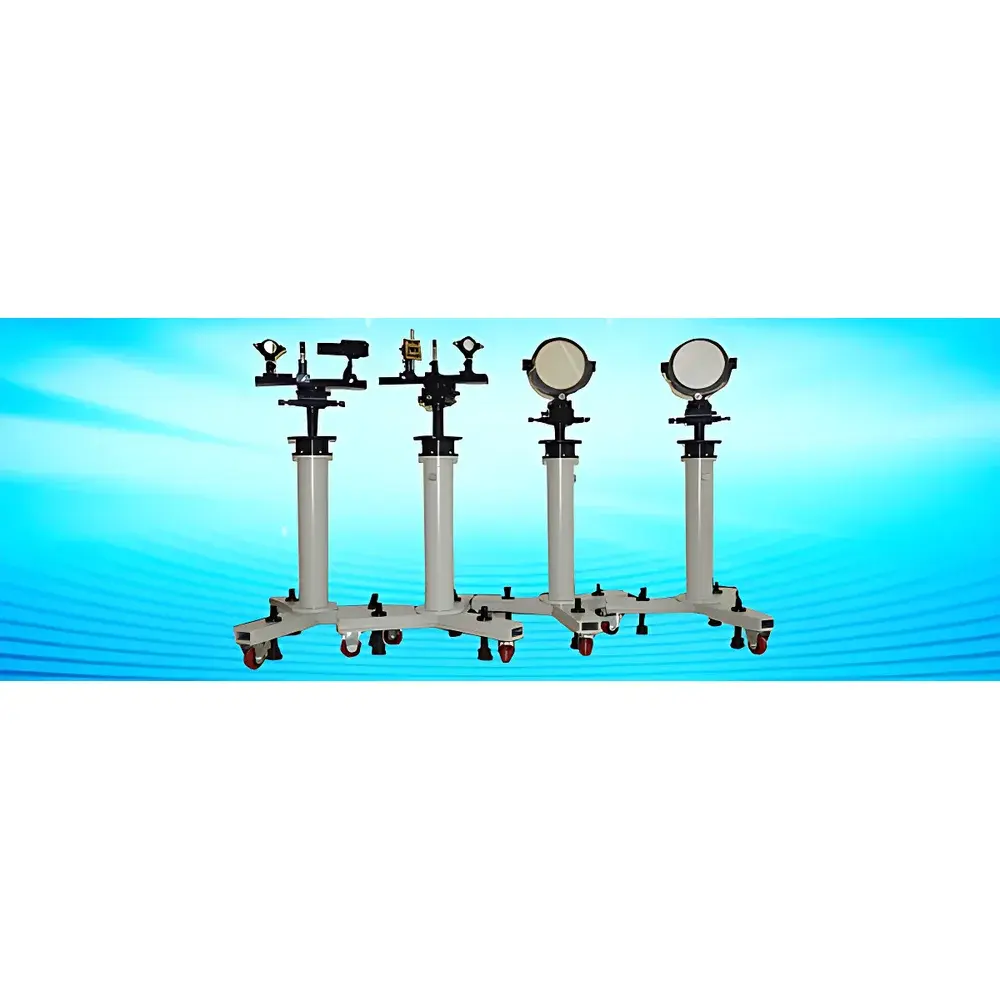
WK-OPTICS WKWY-300 Schlieren Instrument
| Brand | WK-OPTICS |
|---|---|
| Origin | Sichuan, China |
| Model | WKWY-300 |
| Clear Aperture | 300 mm |
| Resolution | ≥20 lp/mm |
| Field of View | Φ1000 mm (at working distance) |
| Relative Aperture | f/10 to f/20 |
| Primary Mirror Material | K9 optical glass |
| Surface Accuracy | < λ/10 RMS |
| Reflectivity | ≥90% (Al + SiO₂ coating) |
| Slit Options | Single slit, multi-slit, pinhole, dispersion prism/grating, colored circular/square aperture |
| Knife-edge Configurations | Single, dual, quad, grid, or circular edge |
| Structural Design | Modular, tubular, or planar optical bench architecture |
| Light Sources | Laser, LED, or tungsten-halogen |
| Imaging Sensors | DSLR, high-speed camera, or photographic plate |
| Compliance | ISO 10110-5 (optical surface quality), GB/T 28296-2012 (Chinese national standard for schlieren systems) |
Overview
The WK-OPTICS WKWY-300 Schlieren Instrument is a precision optical diagnostic system engineered for quantitative visualization and qualitative analysis of density gradients in transparent media. Based on the classical Toepler schlieren principle—first described in 1864—the instrument exploits the fact that spatial variations in refractive index (directly proportional to local density gradients in gases and liquids) induce minute angular deviations in collimated light. These deviations are converted into intensity modulations at a conjugate image plane via a precisely positioned knife-edge stop, enabling high-contrast, real-time observation of otherwise invisible flow structures. The WKWY-300 implements a dual-mirror, off-axis reflective configuration with two independently adjustable K9 spherical mirrors (primary and secondary), each featuring vacuum-deposited aluminum coatings protected by SiO₂ layers for long-term stability and >90% reflectance across the visible spectrum (400–700 nm). Its 300 mm clear aperture supports large-field, high-resolution imaging of transient phenomena in supersonic, hypersonic, combustion, and plasma environments—making it suitable for both fundamental research and applied aerodynamic development.
Key Features
- 300 mm diameter primary mirror with surface figure accuracy better than λ/10 RMS (measured at 632.8 nm), fabricated from stress-relieved K9 optical glass (stress birefringence ≤2 nm/cm)
- Modular optical bench architecture supporting rapid reconfiguration between single-knife, dual-knife, grid-knife, and circular-knife geometries for directional sensitivity control
- Interchangeable slit and aperture modules—including pinholes, dispersion prisms, diffraction gratings, and chromatic circular/square apertures—for implementation of monochromatic, color, or interferometric schlieren modes
- Adjustable f/10 to f/20 relative aperture range to balance depth of field, light throughput, and resolution requirements across diverse experimental scales
- Optimized for compatibility with industry-standard imaging platforms: full-frame DSLRs, scientific CMOS sensors, and ultra-high-speed cameras (up to 1 Mfps with external triggering)
- Integrated alignment fiducials and kinematic mirror mounts compliant with ISO 10110-5 surface quality and GD&T specifications for repeatable optical train setup
Sample Compatibility & Compliance
The WKWY-300 accommodates a broad range of transparent and semi-transparent media—including atmospheric air, nitrogen, helium, water, ethanol, and low-viscosity polymer solutions—without physical contact or perturbation. It is routinely deployed in wind tunnels (subsonic to Mach 5), laser-material interaction chambers, combustion test rigs, and shock tube facilities. The system conforms to GB/T 28296–2012 (Chinese National Standard for Schlieren Systems), and its optical design adheres to ISO 10110-5 for surface imperfection limits and ISO 9022-3 for environmental robustness under laboratory-grade temperature and humidity conditions. While not inherently FDA- or GLP-certified (as it is a non-invasive measurement tool without data acquisition software validation), the instrument’s optical traceability supports integration into ISO/IEC 17025-accredited laboratories when paired with calibrated cameras and NIST-traceable reference targets.
Software & Data Management
The WKWY-300 operates as a hardware platform requiring external imaging and analysis tools. It is fully compatible with third-party software ecosystems including MATLAB Image Processing Toolbox, Python-based OpenCV and scikit-image pipelines, and commercial packages such as DaVis (LaVision), Phantom Camera Control (Phantom), and ImageJ/Fiji with schlieren-specific plugins. Users may implement quantitative density reconstruction using standard Abel inversion or Tikhonov regularization techniques when axial symmetry is present. For time-resolved studies, the system supports hardware-triggered acquisition synchronized to pulsed lasers, spark gaps, or pressure transducers. Audit trails, metadata embedding (EXIF/XMP), and raw sensor data export (12–16 bit TIFF/RAW) are maintained through host-camera firmware—enabling compliance with internal QA protocols and retrospective calibration verification.
Applications
- Visualization and characterization of shock waves, expansion fans, and boundary layer transitions in compressible flow research
- In-situ monitoring of flame front propagation, soot formation zones, and thermal plume dynamics in premixed and diffusion flames
- Analysis of laser-induced breakdown, plasma channel evolution, and ablation plume expansion in laser-matter interaction experiments
- Quantitative assessment of heat transfer coefficients and natural convection patterns in thermal management studies
- Observation of acoustic wave propagation, cavitation inception, and interfacial instabilities in multiphase fluid systems
- Ballistic diagnostics including muzzle blast wave structure, propellant gas expansion, and projectile wake development in interior and exterior ballistics testing
FAQ
What is the minimum resolvable density gradient the WKWY-300 can detect?
The theoretical detection limit depends on illumination coherence, knife-edge sharpness, and sensor noise floor; under optimal laser illumination and with a 12-bit high-speed camera, gradients corresponding to Δn ≈ 1×10⁻⁶ refractive index change over 1 mm are routinely resolved.
Can the system be upgraded for quantitative density mapping?
Yes—when combined with calibrated background-oriented schlieren (BOS) targets or synchronized dual-view stereo configurations, the WKWY-300 serves as the optical core for tomographic or phase-retrieval-based quantitative density field reconstruction.
Is vacuum-compatible operation supported?
The optical bench and mirror mounts are mechanically stable under moderate vacuum (≤10⁻² mbar); however, standard K9 mirrors require optional MgF₂ overcoating for prolonged exposure to high-vacuum or corrosive environments.
Does the system include alignment aids or calibration standards?
Each unit ships with a set of NIST-traceable Ronchi rulings, knife-edge position gauges, and collimation lasers pre-aligned to the optical axis per ISO 10110-5 verification reports.
What maintenance is required for long-term optical performance?
Annual inspection of mirror coatings and recalibration of knife-edge positioning is recommended; no consumables are involved, and all optical surfaces are accessible for cleaning using ISO 10110-compliant protocols.




