
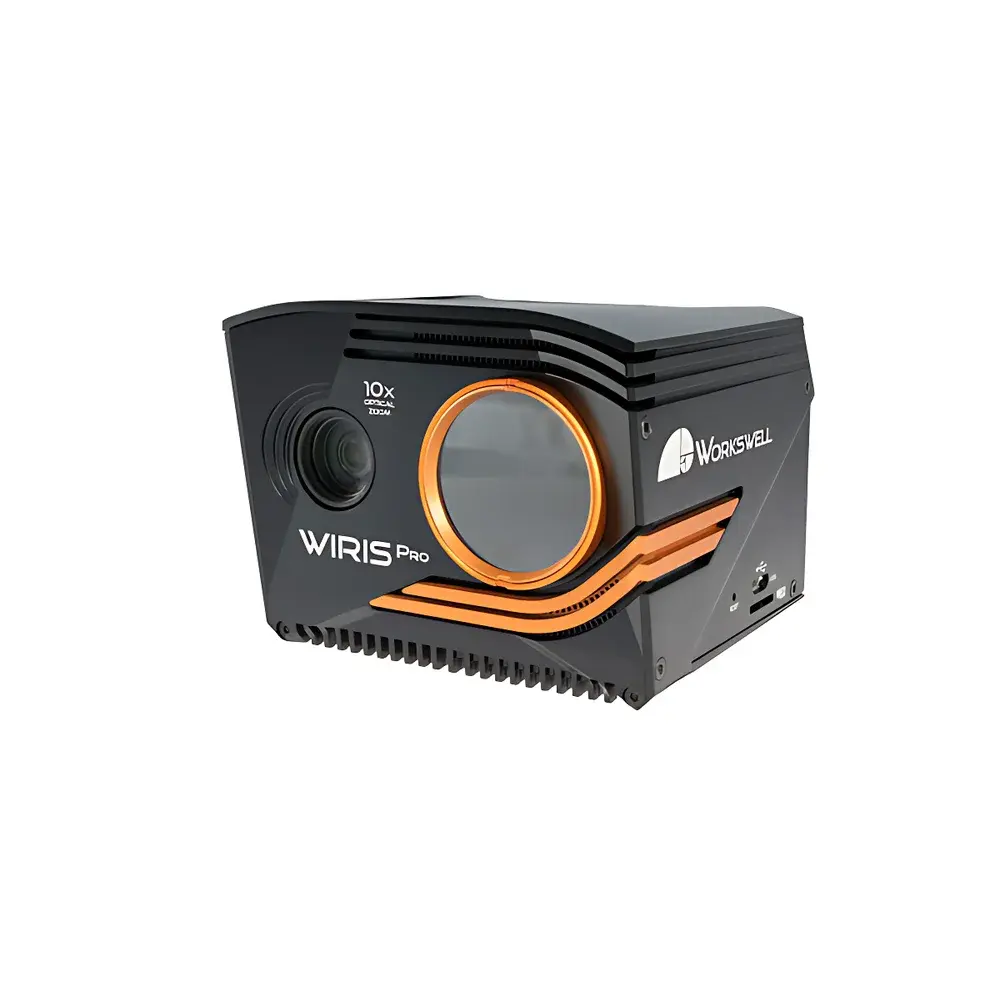
Workswell WIRIS Pro High-Performance Dual-Sensor Aerial Thermal Imaging Camera
| Brand | Workswell |
|---|---|
| Origin | Czech Republic |
| Model | WIRIS Pro |
| Detector Type | Uncooled Microbolometer |
| Spectral Range | 7.5–13.5 µm |
| Thermal Resolution | 1266 × 1010 px (1.3 MP) |
| NETD | ≤50 mK (optional ≤30 mK) |
| Temperature Range | −25 °C to +150 °C |
| optional filtered ranges | +50 °C to +1000 °C and +400 °C to +1500 °C |
| Accuracy | ±2% of reading or ±2 °C (typical measured error < ±1 °C) |
| Frame Rate | 9 Hz or 30 Hz (selectable) |
| Visible Camera Resolution | 1920 × 1080 px (FHD), 10× optical zoom with image stabilization and autofocus |
| Lens FOV Options | 18°, 32°, 45°, 69° (interchangeable) |
| Digital Zoom | 1–14× continuous |
| Interfaces | HDMI, CAN bus (DJI A3/M600 compatible), S.BUS (18-channel), PWM/TTL trigger, USB 2.0, microSD slot |
| Storage | Internal 128 GB or 256 GB SSD + external microSD/USB |
| Power Supply | 9–36 VDC, 12 W |
| Dimensions | 83 × 85 × 68 mm |
| Weight | <450 g |
| Operating Temperature | −20 °C to +55 °C |
| GPS Integration | External GPS data embedded in image/video metadata |
| Emissivity Correction | On-device and post-processing |
| Atmospheric & Reflected Temperature Compensation | Supported |
| Hot/Cold Spot Detection | Auto-detection with pixel-level temperature tagging |
Overview
The Workswell WIRIS Pro is a high-performance, dual-sensor aerial thermal imaging camera engineered for precision radiometric thermography in demanding field environments. Unlike conventional uncooled infrared cameras, the WIRIS Pro integrates a long-wave infrared (LWIR) microbolometer detector operating across the atmospheric transmission window of 7.5–13.5 µm—optimized for minimal absorption by water vapor and CO₂. Its core measurement principle relies on calibrated blackbody radiation modeling, applying Planck’s law with real-time compensation for emissivity, reflected ambient radiation, and atmospheric attenuation. Designed explicitly for UAV integration, it delivers synchronized LWIR and visible-light imagery with strict geometric registration—enabling pixel-accurate fusion for quantitative thermal analysis in geospatial contexts. The system supports both static and dynamic thermal profiling, making it suitable for applications ranging from industrial asset inspection and energy auditing to scientific field research and defense-related surveillance.
Key Features
- True radiometric LWIR imaging with 1266 × 1010 pixel resolution (1.3 MP), exceeding standard 640 × 512 sensors in spatial fidelity and thermal sampling density.
- Thermal sensitivity (NETD) ≤50 mK at 30 Hz; optional high-sensitivity configuration achieves ≤30 mK for low-contrast thermal differentiation.
- Dual-sensor architecture: Co-aligned 1920 × 1080 visible camera with 10× motorized optical zoom, optical image stabilization (OIS), and phase-detection autofocus—ensuring sharp visual reference under vibration-prone flight conditions.
- Configurable temperature ranges including extended high-temperature modes (+50 °C to +1000 °C and +400 °C to +1500 °C) enabled via interchangeable spectral filters, validated per ISO 18434-1 for condition monitoring.
- Comprehensive triggering and synchronization: native support for CAN bus (DJI A3, M600), S.BUS (18-channel), PWM, and TTL inputs—allowing hardware-locked acquisition aligned with GNSS timestamps or platform telemetry.
- Onboard 128 GB or 256 GB industrial-grade SSD with optional microSD expansion; all thermal and visible frames are stored with embedded EXIF metadata including GPS coordinates (when externally connected), UTC timestamps, and sensor calibration parameters.
Sample Compatibility & Compliance
The WIRIS Pro is designed for non-contact surface temperature measurement of solid, semi-solid, and certain high-emissivity liquid targets under ambient atmospheric conditions. It complies with IEC 62906-5-2 for infrared imaging equipment performance testing and adheres to the radiometric traceability framework outlined in ISO/IEC 17025 when operated with NIST-traceable blackbody references. Its spectral band (7.5–13.5 µm) ensures compatibility with ASTM E1933-19 for thermographic inspection of building envelopes and electrical systems. For regulated industries, raw thermal data export supports FDA 21 CFR Part 11-compliant audit trails when used with validated WIRIS software workflows. No sample preparation is required; however, accurate emissivity assignment (0.1–1.0 range) and ambient reflection correction are mandatory for quantitative accuracy—both configurable in-camera or during post-processing.
Software & Data Management
The WIRIS Suite provides a complete desktop application for calibration management, batch radiometric analysis, and georeferenced thermal mapping. It supports multi-frame temporal averaging, isotherm overlay, spot/area/min/max temperature extraction, and emissivity-matrix correction grids. Export formats include TIFF (with embedded radiometric metadata), CSV (per-pixel temperature matrices), and GeoTIFF for GIS integration. An open-source SDK (C/C++, Python, MATLAB) enables custom algorithm development, UAV autopilot integration (e.g., PX4, ArduPilot), and real-time streaming over Wi-Fi (H.264-encoded video + thermal metadata). All firmware updates and calibration files are digitally signed and version-controlled, ensuring reproducibility across deployments. Data integrity is preserved via SHA-256 checksums for every recorded frame and log file.
Applications
- Power infrastructure inspection: Detection of hotspots in transformers, insulators, and conductor joints per IEEE 1557-2017 guidelines.
- Renewable energy monitoring: Thermal anomaly mapping of photovoltaic arrays and wind turbine gearboxes.
- Industrial predictive maintenance: Bearing temperature trending, refractory wear assessment, and furnace lining integrity verification.
- Environmental science: Surface temperature profiling of volcanic features, wetland evapotranspiration studies, and wildfire perimeter tracking.
- Search and rescue (SAR): Human detection in low-visibility scenarios using differential thermal contrast algorithms.
- Academic research: Validation of CFD thermal models, material emissivity characterization, and boundary-layer heat transfer experiments.
FAQ
Is the WIRIS Pro certified for use in regulated industries such as pharmaceuticals or aerospace?
The device itself is not CE-marked as a medical or safety-critical system; however, its radiometric output meets ISO/IEC 17025 requirements when used with documented calibration procedures and traceable references—making it suitable for GxP-aligned thermal validation tasks.
Can thermal and visible images be precisely co-registered for photogrammetric analysis?
Yes—factory-applied rigid-body transformation matrices ensure sub-pixel alignment between LWIR and RGB sensors. These matrices are embedded in image headers and applied automatically in WIRIS Suite and third-party photogrammetry tools supporting custom sensor models.
What level of radiometric uncertainty can be expected under field conditions?
When configured with proper emissivity input, ambient temperature, and distance settings—and validated against a calibrated blackbody source—the typical absolute uncertainty remains below ±1.0 °C across the −25 °C to +150 °C range, consistent with ISO 18434-1 Class II performance criteria.
Does the system support real-time radiometric video streaming over Wi-Fi?
Yes—Wi-Fi streaming delivers H.264-encoded thermal video with embedded temperature metadata at up to 30 Hz. Latency is typically <120 ms end-to-end, enabling remote pilot-assisted thermal targeting.
How is calibration maintained over time and temperature drift?
The WIRIS Pro performs non-uniformity correction (NUC) automatically before each recording session and supports scheduled shutter-based recalibration. Long-term stability is verified annually using a two-point blackbody calibration protocol compliant with ASTM E1256-21.




