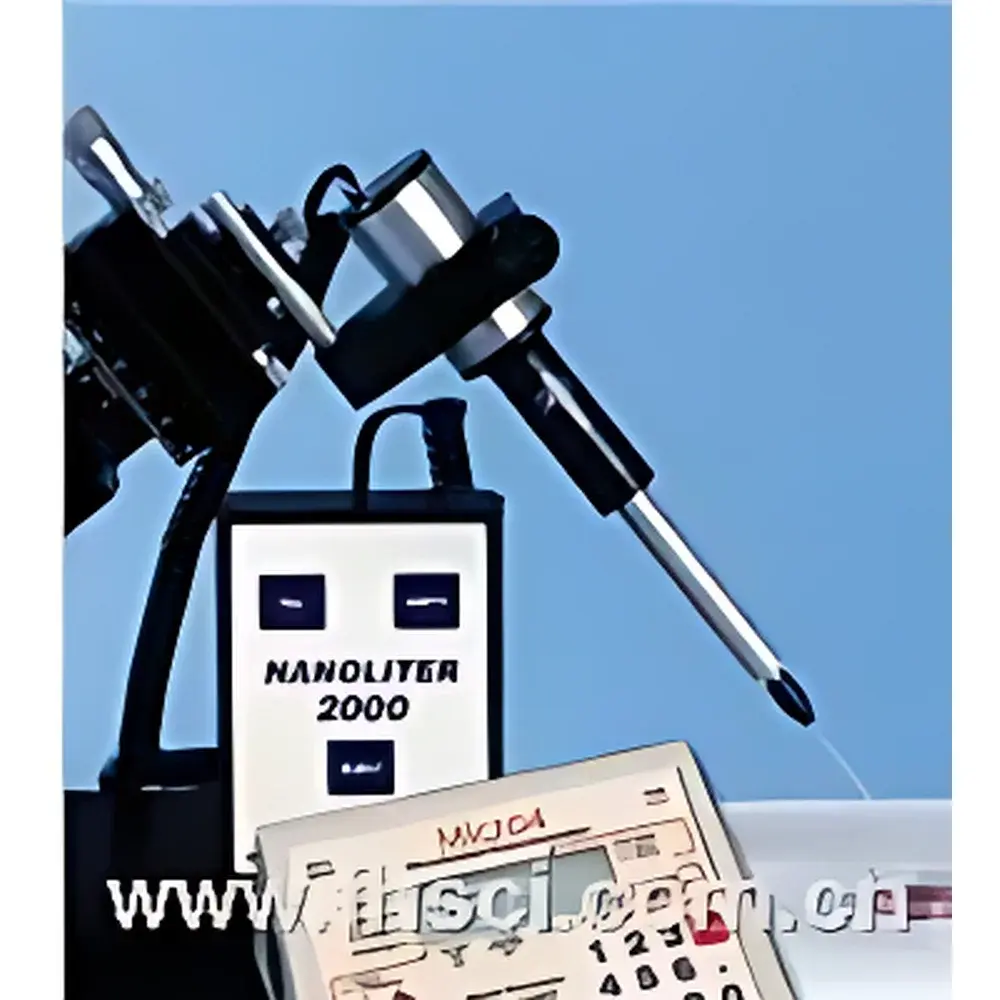
WPI Nanoliter2000 Nanoliter Microinjector
| Origin | USA |
|---|---|
| Manufacturer Type | Authorized Distributor |
| Origin Category | Imported |
| Model | Nanoliter2000 |
| Pricing | Upon Request |
Overview
The WPI Nanoliter2000 is a precision-engineered nanoliter-scale microinjector designed for highly controlled, low-volume fluid delivery in electrophysiology, developmental biology, and single-cell manipulation applications. It operates on a direct piston displacement principle—eliminating compressible air or fluid columns—and delivers volumetric accuracy through mechanical translation of a calibrated micrometer-driven plunger. This architecture ensures silent, vibration-free operation critical for intracellular injection into fragile specimens such as Xenopus laevis oocytes, zebrafish embryos, or cultured neurons. With a maximum dispensing capacity of 5 µL per fill and programmable step volumes ranging from 2.3 nL to 69 nL (in 16 discrete increments via DIP-switch configuration), the Nanoliter2000 bridges the gap between manual capillary pipetting and motorized microinjection systems—offering reproducible, operator-independent dosing without reliance on pressure transients or syringe pump dynamics.
Key Features
- Direct piston displacement mechanism for high volumetric fidelity and zero compressibility error
- Quiet, non-vibratory actuation—ideal for live-cell and patch-clamp-compatible workflows
- Capillary fill rate: 23 nL/s; injection rate: 46 nL/s; emptying rate: up to 230 nL/s
- DIP-switch selectable injection volumes (2.3–69 nL) across 16 fixed steps—no software required for basic operation
- Up to 100 injections per full capillary fill (5 µL total capacity)
- Compatible with standard borosilicate glass capillaries (OD 1.14 mm, ID 0.5 mm); each unit includes ≥300 pullable capillaries
- Integrated Micro4 intelligent controller option (supports up to four Nanoliter2000 units simultaneously)
- RS-232 serial interface enables integration with LabVIEW, MATLAB, or custom Python-based automation scripts under GLP-compliant audit trails
Sample Compatibility & Compliance
The Nanoliter2000 is routinely employed in regulatory-adjacent research environments including preclinical toxicology, CRISPR-Cas9 RNP delivery validation, and mRNA transfection studies. Its mechanical design avoids fluidic memory effects and thermal drift—key requirements for ISO/IEC 17025-accredited testing laboratories performing method validation per ICH Q5A(R2). Capillary compatibility extends to filamented and coated borosilicate tubing (e.g., Sutter BF150-86-10), enabling consistent tip geometry for repeatable penetration force profiles. All supplied consumables—including MF34G reverse-fill needles and pre-pulled μTip™ micropipettes—are manufactured under cleanroom conditions compliant with ASTM F2621-22 (Standard Guide for Characterization of Micropipettes).
Software & Data Management
When paired with the optional Micro4 controller, the Nanoliter2000 supports fully traceable parameter logging. The LCD interface stores user-defined protocols—including fill volume, injection speed, direction (infuse/withdraw), and inter-injector synchronization flags—with non-volatile memory retention across power cycles. RS-232 communication permits remote command execution using ASCII-based SCPI-like syntax (e.g., “INFUSE 46nL”, “SYNC START”), enabling integration into LIMS-managed workflows. For FDA 21 CFR Part 11 compliance, third-party middleware (e.g., TIBCO Spotfire or LabArchives ELN) can capture timestamped command logs, operator IDs, and system status flags—satisfying electronic record integrity requirements in GMP-aligned cell therapy process development.
Applications
- Intracytoplasmic injection of morpholinos, siRNA, or Cas9 ribonucleoprotein complexes into Xenopus oocytes (targeting ≥1%–10% of 500 µL oocyte volume per step)
- Calibrated loading of fluorescent dyes (e.g., Fluo-4 AM, Alexa Fluor hydrazides) into primary neuronal cultures without osmotic shock
- Microvolume calibration standards preparation for LC-MS/MS bioanalysis (e.g., spiking 5–50 nL of IS solution into 10 µL plasma aliquots)
- Delivery of CRISPR guide RNA libraries into organoid models for pooled functional screening
- Controlled release of neurotransmitters (e.g., glutamate, GABA) in acute brain slice electrophysiology
FAQ
What is the minimum resolvable injection volume?
The smallest discrete step is 2.3 nL, set via hardware DIP switches—no software dependency required.
Can the Nanoliter2000 be integrated into automated robotic workstations?
Yes—via RS-232 serial control with TTL-level trigger support; compatible with Hamilton Vantage, Tecan Fluent, and Opentrons OT-2 platforms using custom Python drivers.
Is calibration traceable to NIST standards?
While the device itself is not NIST-certified, volumetric verification is achievable using gravimetric methods per USP <1058> with certified analytical balances (0.1 µg resolution) and Class A volumetric glassware.
What maintenance is required for long-term precision?
Annual replacement of O-rings and periodic cleaning of the piston chamber with ethanol/isopropanol is recommended; no recalibration is needed under normal use conditions.
Does the system support bidirectional flow (infusion + withdrawal) during a single sequence?
Yes—the Micro4 controller enables programmable infuse-withdraw cycles with independent speed and volume settings for each phase.
Related Products