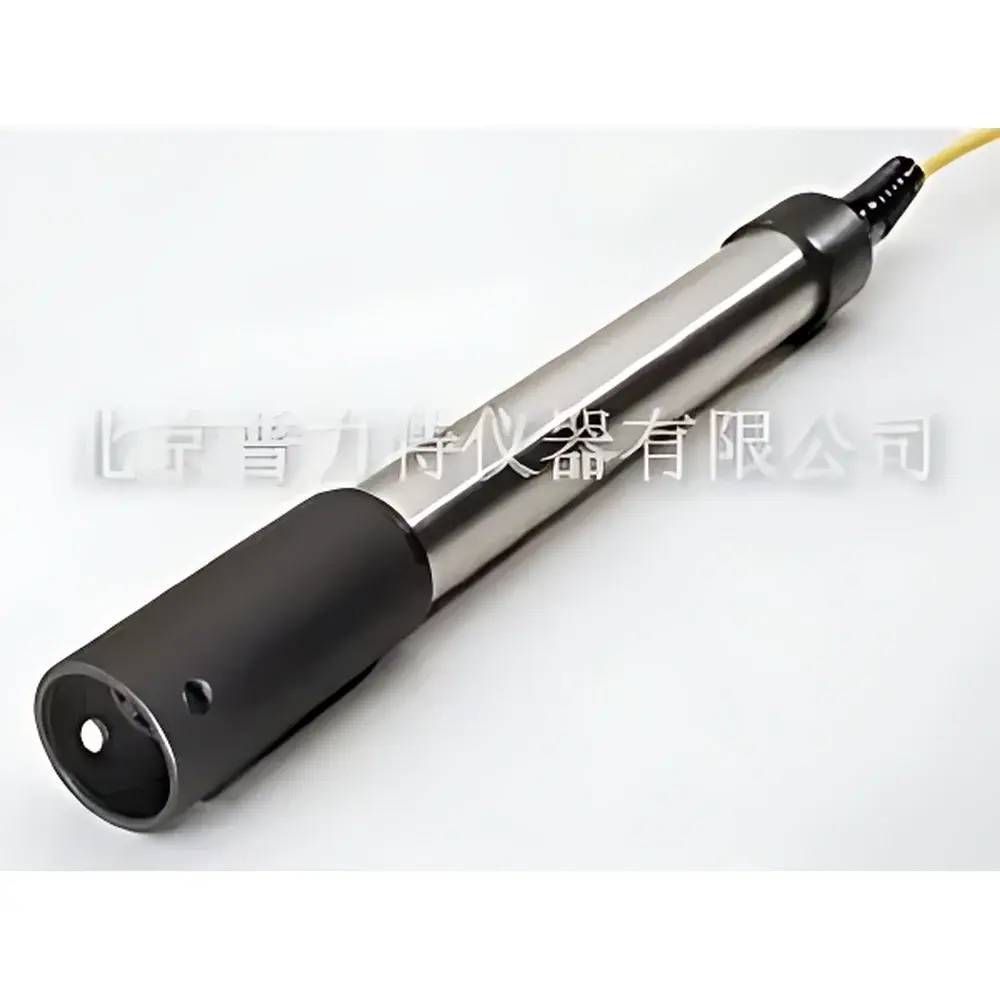
WQ401 Membrane-Based Dissolved Oxygen Sensor
| Origin | USA |
|---|---|
| Manufacturer Type | Authorized Distributor |
| Origin Category | Imported |
| Model | WQ401 |
| Pricing | Upon Request |
Overview
The WQ401 Membrane-Based Dissolved Oxygen Sensor is an industrial-grade, electrochemical Clark-type sensor engineered for continuous, in-situ measurement of dissolved oxygen (DO) concentration in aqueous environments. It operates on the principle of amperometric detection: molecular oxygen diffuses through a gas-permeable FEP membrane into an electrolyte-filled cathode chamber, where it undergoes reduction at a polarized platinum cathode, generating a current linearly proportional to the partial pressure of oxygen. This current is converted and conditioned into a robust 4–20 mA analog output signal, fully temperature-compensated to 25 °C using an integrated thermistor. Designed for long-term deployment in demanding marine, wastewater, aquaculture, and process water applications, the WQ401 features a hermetically sealed electronics module potted in marine-grade epoxy resin and housed in corrosion-resistant 316 stainless steel—ensuring mechanical integrity and electrical isolation under high-humidity or submerged conditions.
Key Features
- Robust marine-rated construction with 316 stainless steel housing and epoxy-potted electronics for IP68-rated submersion up to 40 psi (≈28 m H₂O)
- Field-replaceable DO sensing element and protective guard cap—enabling rapid maintenance without instrument recalibration
- Standard 7.6 m marine-grade cable with optional extension up to 150 m; designed for high tensile strength and low capacitance over extended runs
- Wide operating temperature range: –40 °C to +55 °C, supporting deployment in arctic outfalls and tropical recirculating aquaculture systems (RAS)
- Low-power DC operation (10–36 VDC), typical current draw of 15.5 mA plus loop output current—compatible with solar-powered telemetry nodes and battery-backed controllers
- Fast thermal stabilization: <10 s warm-up time ensures rapid commissioning during system start-up or sensor swap
Sample Compatibility & Compliance
The WQ401 is validated for use in natural waters (freshwater, seawater, brackish), activated sludge effluents, bioreactor media, and clean process streams. Its FEP (fluorinated ethylene propylene) membrane—0.001 inch thick—provides excellent chemical resistance to chlorination, hydrogen sulfide, and organic solvents while maintaining consistent O₂ permeability. The sensor complies with ASTM D888-22 (Standard Test Methods for Dissolved Oxygen in Water) for field-deployable amperometric sensors and supports GLP/GMP data integrity requirements when integrated with compliant controllers (e.g., PC320) or data loggers (e.g., GL500) featuring audit-trail-capable firmware. While not intrinsically safe, it meets IEC 61000-6-2/6-4 for electromagnetic immunity in industrial environments.
Software & Data Management
The WQ401 functions as a stand-alone 4–20 mA transducer and requires no embedded firmware or configuration software. Signal conditioning, scaling, and alarm logic are implemented externally via compatible receiving devices—including the PC320 programmable controller (supporting pump control, relay outputs, and 4–20 mA setpoint tracking) and GL500 multi-parameter data logger (offering timestamped CSV export, SD card storage, and Modbus RTU communication). When deployed in regulated environments, users may configure external SCADA or DCS systems to enforce FDA 21 CFR Part 11-compliant electronic record retention—provided the host platform implements user authentication, audit trails, and electronic signatures.
Applications
- Real-time DO monitoring in municipal wastewater treatment plants (aeration basins, secondary clarifiers, disinfection contact tanks)
- Process control in pharmaceutical water-for-injection (WFI) loops and biotech fermentation vessels
- Environmental compliance monitoring at NPDES discharge points and watershed restoration sites
- Automated oxygen dosing in recirculating aquaculture systems (RAS) and marine hatcheries
- Long-term deployment on moored buoys, riverbed observatories, and offshore platforms
FAQ
What calibration protocols are recommended for the WQ401?
Zero-point calibration is performed in sodium sulfite solution; span calibration uses air-saturated water at known temperature and barometric pressure. Field verification against a portable optical DO meter is advised every 30–90 days depending on fouling risk.
Can the WQ401 be used in high-salinity or sulfide-rich environments?
Yes—the FEP membrane resists chloride ion penetration and H₂S adsorption. However, periodic cleaning with dilute HCl (0.1 N) is recommended if biofilm or metal sulfide deposits accumulate on the membrane surface.
Is temperature compensation automatic or configurable?
Temperature compensation is fixed to 25 °C per the internal thermistor and cannot be reconfigured; this aligns with standard DO reporting conventions in environmental and process regulations.
Does the sensor require periodic electrolyte refilling?
No—the WQ401 employs a sealed, gelified electrolyte system with no user-serviceable fluid reservoirs; only membrane and cathode replacement are required during routine maintenance.
How does cable length affect signal accuracy?
Signal attenuation is negligible up to 150 m when using shielded, twisted-pair cable rated for 4–20 mA loops; proper grounding at the receiving end is essential to avoid common-mode noise in electrically noisy plants.
Related Products