
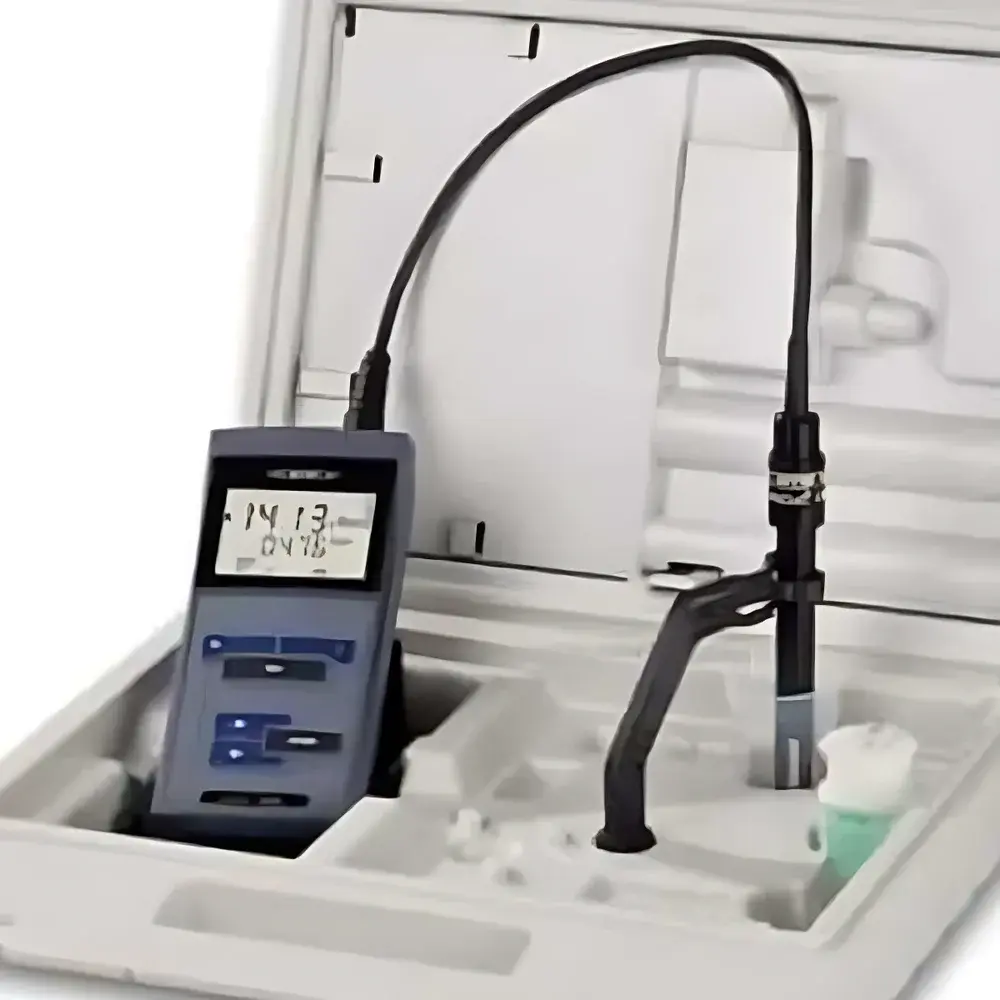
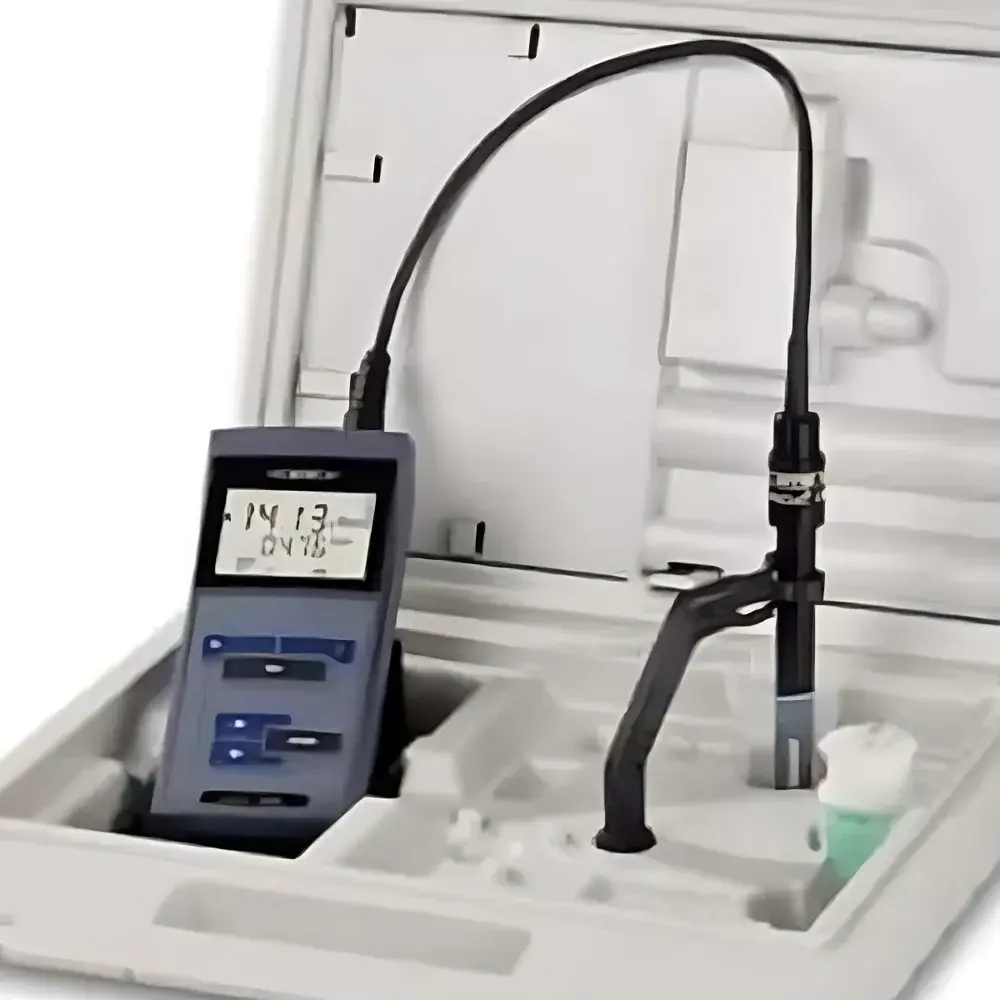
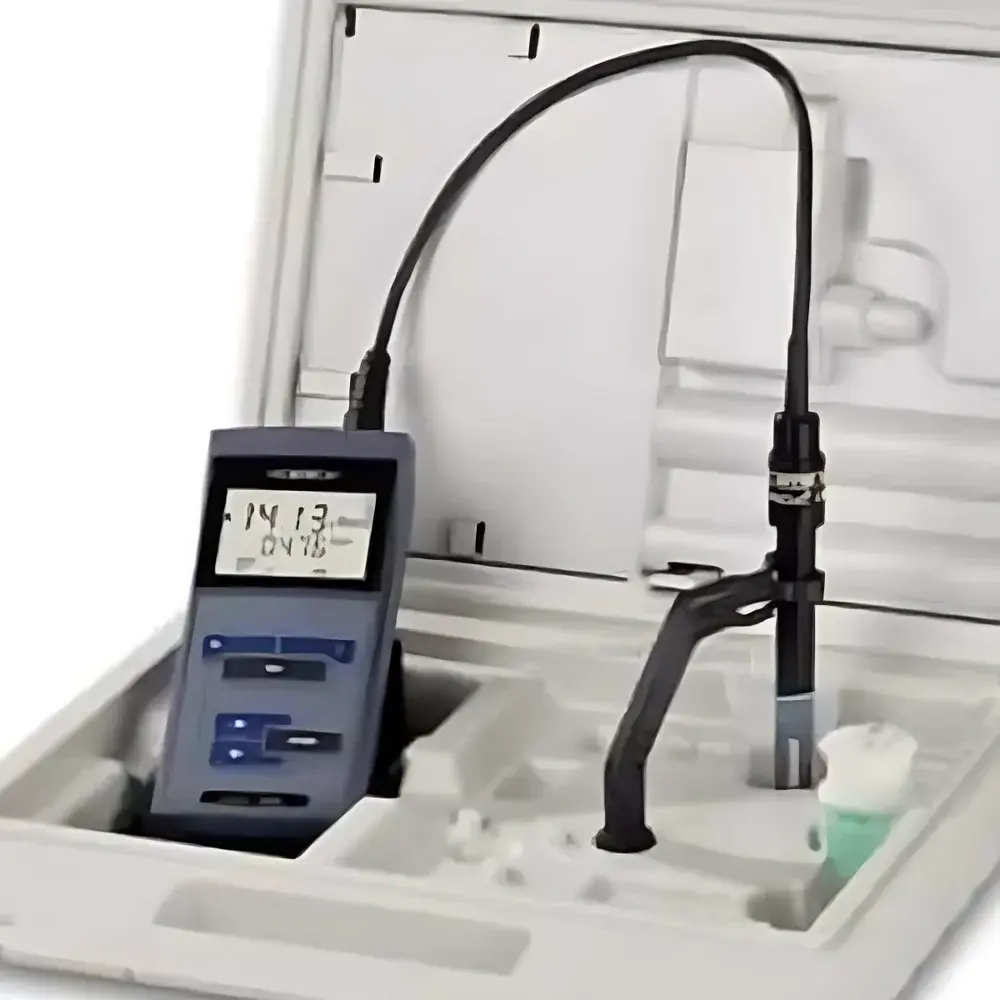
WTW Cond 3110 Portable Conductivity Meter
| Brand | WTW |
|---|---|
| Origin | Germany |
| Model | Cond 3110 |
| Portability | Portable |
| Application | Laboratory & Field Use |
| Conductivity Range | 0.0–1000 mS/cm |
| Resistivity Range | 0.00–999 MΩ·cm |
| Salinity Range | 0.0–70.0 (based on IOT) |
| Temperature Range | –5.0–105.0 °C |
| Accuracy | ±0.5% of reading |
| Minimum Resolution | 0.1 µS/cm |
| Temperature Accuracy | ±0.1 °C |
| Electrode Constants Supported | Fixed 0.475 cm⁻¹, 1.0 cm⁻¹ |
| ATC | Automatic Temperature Compensation (nLF algorithm) |
| Display | 7-segment LCD with high-contrast, large-font readability |
| IP Rating | IP66/IP67 |
| Battery Life | Up to 2500 h (alkaline) / 1000 h continuous (rechargeable NiMH) |
| Power | 4 × 1.5 V AA or 4 × 1.2 V NiMH |
| Data Logging | Internal storage with calibration history and electrode status tracking |
| Compliance | Designed for GLP-compliant workflows |
Overview
The WTW Cond 3110 is a precision-engineered portable conductivity meter developed in Germany for reliable, field-deployable and laboratory-grade measurements of electrical conductivity, resistivity, salinity, and temperature in aqueous solutions. Based on four-electrode (or two-electrode, depending on configuration) conductometric principles, the instrument applies alternating current excitation to eliminate polarization effects and electrode fouling—ensuring long-term stability and high reproducibility across diverse sample matrices. Its core measurement architecture adheres to standardized electrochemical fundamentals defined in ISO 7888 and ASTM D1125, enabling traceable, comparable results across regulatory and research environments. The Cond 3110 is purpose-built for users requiring robustness without compromise: its dual IP66/IP67 ingress protection, sealed silicone keypad, and ruggedized polycarbonate housing allow uninterrupted operation in harsh outdoor conditions—including rain, dust, splash exposure, and temperature extremes from –5 °C to +105 °C.
Key Features
- High-contrast 7-segment LCD display with oversized digits optimized for rapid visual interpretation under variable lighting—including direct sunlight and low-illumination field settings.
- Full IP66/IP67-rated enclosure ensures operational integrity during extended outdoor deployment, submersion up to 1 m for 30 minutes (per IEC 60529), and resistance to chemical splashes common in wastewater or industrial process monitoring.
- Tactile feedback keypad with 100% waterproof silicone membrane enables precise, error-resistant operation even with gloves or wet hands—critical for field technicians and QA personnel working in dynamic environments.
- Integrated calibration timer and automatic electrode status indicator provide real-time verification of sensor health post-calibration, supporting documented quality assurance practices.
- Intelligent Automatic Temperature Compensation (ATC) using nonlinear (nLF) algorithms compensates for solution-specific temperature dependencies—particularly essential for high-ionic-strength samples where linear compensation introduces systematic bias.
- Extended battery life: up to 2500 hours with standard alkaline AA cells or 1000 hours of continuous operation with rechargeable NiMH batteries—minimizing downtime and logistical overhead in remote deployments.
- Modular electrode constant support: accommodates fixed-cell sensors (0.475 cm⁻¹, 1.0 cm⁻¹) and user-adjustable electrodes spanning 0.450–1200 cm⁻¹, enabling accurate measurement across ultra-pure water (µS/cm) to concentrated brines (1000 mS/cm).
Sample Compatibility & Compliance
The Cond 3110 is validated for use with potable water, surface water (rivers, lakes, seawater), groundwater, wastewater effluents, aquaculture systems, pharmaceutical process streams, food & beverage formulations, and swimming pool management. It complies with fundamental metrological requirements outlined in ISO/IEC 17025 for testing laboratories and supports Good Laboratory Practice (GLP) documentation through timestamped calibration records, electrode diagnostics, and user-accessible calibration history. While not inherently 21 CFR Part 11 compliant as a standalone device, its data output and logging behavior are compatible with validated LIMS or ELN systems that enforce electronic signature and audit trail requirements. All measurements align with internationally accepted definitions of conductivity (SI unit: S/m), resistivity (Ω·m), and salinity (dimensionless IOT scale per UNESCO Technical Papers in Marine Science No. 37).
Software & Data Management
The Cond 3110 operates autonomously without external software dependency. All calibration parameters—including date/time stamps, electrode constant, reference temperature (20 °C or 25 °C), and measured cell offset—are stored internally and retrievable via the front-panel interface. No proprietary drivers or PC connectivity are required for routine use; however, optional infrared or RS232 interfaces (via accessory modules) enable integration into centralized data acquisition platforms. Calibration data retention supports retrospective review during internal audits or regulatory inspections. The instrument enforces calibration validity windows via built-in timers—preventing unintended use beyond recommended recalibration intervals (typically 24–72 h depending on application severity)—thereby reinforcing measurement integrity.
Applications
- Environmental monitoring: Real-time assessment of conductivity anomalies in rivers, estuaries, and coastal zones as indicators of pollution events, saltwater intrusion, or seasonal runoff dynamics.
- Wastewater treatment: Routine verification of influent/effluent ionic load, desalination pre-treatment screening, and membrane system performance evaluation.
- Pharmaceutical manufacturing: USP compliant conductivity verification of purified water (PW) and water for injection (WFI) at distribution points.
- Aquaculture and hydroponics: Continuous tracking of salinity and total dissolved solids (TDS) to maintain optimal osmotic conditions for species-specific growth protocols.
- Food & beverage QC: Batch-to-batch consistency checks for brine concentration, syrup conductivity, or cleaning-in-place (CIP) rinse water purity.
- Swimming pool & spa maintenance: Rapid verification of salt levels in chlorine-generating systems and conductivity-based TDS estimation for bather load assessment.
FAQ
Does the Cond 3110 support automatic endpoint detection for conductivity readings?
Yes—it features Auto-Read functionality that locks the displayed value once stability criteria (±0.1% over 3 seconds) are met, eliminating subjective judgment in manual recording.
Can the instrument store multiple calibration profiles for different electrode types?
It retains the most recent calibration parameters per electrode constant setting; switching between fixed and adjustable cells requires re-calibration but preserves historical timestamps for traceability.
Is temperature compensation configurable to non-standard reference temperatures?
No—the instrument defaults to 20 °C or 25 °C per ISO/ASTM conventions; custom reference temperatures are not supported to ensure inter-laboratory comparability.
What maintenance is required for long-term accuracy?
Regular electrode cleaning with mild detergent and periodic verification against certified KCl standards (e.g., 0.01 mol/kg, 0.1 mol/kg) are recommended every 3–6 months depending on usage frequency and sample fouling potential.
How does the nLF temperature compensation differ from linear compensation?
nLF applies empirically derived polynomial correction based on solution composition, significantly reducing error in high-conductivity samples (>100 mS/cm) where linear models deviate by >2% relative to true conductivity.





