
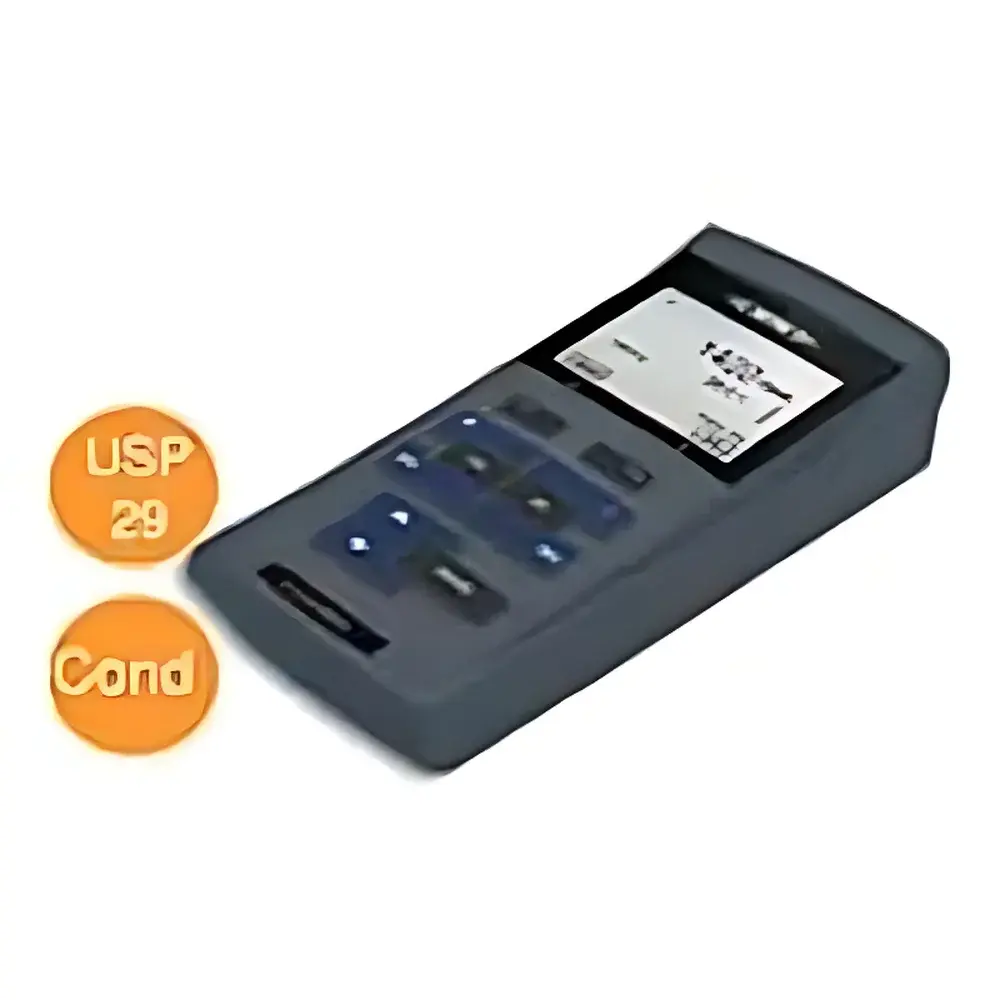
WTW Cond 3310 Portable Conductivity Meter
| Origin | Imported |
|---|---|
| Manufacturer Type | Authorized Distributor |
| Model | Cond 3310 |
| Portability | Handheld |
| Conductivity Range | 0–1000 µS/cm (extendable to 1000 mS/cm) |
| TDS Range | 0–2000 mg/L |
| Resistivity Range | 0–100 MΩ·cm |
| Salinity Range | 0–20 ppm |
| Temperature Range | 0–60 °C |
| Accuracy | ±0.05 % of full scale |
| Minimum Resolution | 0.001 µS/cm |
| Calibration | 1–5 point, auto-recognition of 16 DIN/NIST buffer standards |
| Protection Rating | IP66/IP67 |
| Data Storage | 5000 automatic / 200 manual entries |
| Battery Life | Up to 1000 h (50 h with backlight on) |
| Interface | Waterproof USB |
| Auto-Temperature Compensation (ATC) | Yes |
| Electrode Status Indication | Yes |
| CMC (Continuous Measurement Control) | Yes |
Overview
The WTW Cond 3310 is a high-precision, handheld conductivity meter engineered for field-deployable and laboratory-grade electrochemical analysis of aqueous solutions. It operates on the principle of two-electrode or four-electrode conductometric measurement—applying an alternating current across platinum or stainless-steel electrodes to determine solution conductivity without polarization error. The instrument adheres to standardized electrochemical methodology defined in ISO 7888, ASTM D1125, and EN 27888, ensuring traceable, reproducible results across environmental monitoring, wastewater treatment, and process control applications. Its dual-range capability (0–1000 µS/cm base range, extendable up to 1000 mS/cm) supports both low-conductivity ultrapure water assessment and high-salinity industrial effluent characterization. Built-in ATC (Automatic Temperature Compensation) uses either linear (nlF) or programmable β-coefficient compensation (0.000–10.00 %/K), aligning measurements to 25 °C per IUPAC conventions.
Key Features
- Rugged, IP66/IP67-rated housing with silicone keypad—resistant to dust, rain, immersion, and mechanical shock for all-weather outdoor operation
- Backlit graphical LCD display with intuitive text-based menu navigation—optimized for readability under low-light or direct sunlight conditions
- Continuous Measurement Control (CMC) algorithm monitors electrode performance in real time; alerts users when measured values fall outside calibrated tolerance bands
- Integrated calibration timer and electrode health indicator—displays residual electrode resistance and cell constant deviation post-calibration
- Five-point calibration support with automatic recognition of 16 certified DIN and NIST conductivity standards (e.g., KCl 0.01 mol/L, 0.1 mol/L)
- Waterproof USB interface compliant with USB 2.0 specifications—enables secure, cable-based data export to Windows/Linux PCs without requiring proprietary docking stations
- Extended battery life: up to 1000 hours on two AA alkaline cells (50 hours with continuous backlight use); low-power sleep mode activates after 10 min of inactivity
Sample Compatibility & Compliance
The Cond 3310 accommodates standard WTW conductivity cells (e.g., TetraCon® 325, LR 325, or KLD 325 series) with cell constants from 0.01 to 10 cm⁻¹, enabling accurate measurement across ultrapure water (≥18.2 MΩ·cm), drinking water, brackish estuaries, and industrial cooling loops. All measurement modes—including conductivity, TDS (calculated via NaCl or user-defined conversion factor), resistivity, and salinity (ppm)—are traceable to national metrology institutes. The device meets electromagnetic compatibility requirements per EN 61326-1 and safety standards per EN 61010-1. For regulated environments, audit trails, user access control, and electronic signature readiness can be implemented via optional WTW LabX™ Lite software integration—supporting GLP/GMP workflows aligned with FDA 21 CFR Part 11 principles.
Software & Data Management
Raw measurement data—including timestamped conductivity, temperature, TDS, resistivity, and salinity—are stored internally with full metadata (operator ID, calibration history, electrode serial number). The 5000-entry automatic logging buffer supports unattended long-term deployment (e.g., river monitoring campaigns or effluent discharge compliance tracking). Export occurs in CSV or XLSX format via USB; no cloud dependency or vendor-specific drivers required. When paired with WTW’s PC-based LabX Lite software (sold separately), users gain advanced features: statistical trend analysis, customizable report templates, automated calibration certificate generation, and synchronized multi-instrument fleet management. All exported files retain embedded ISO/IEC 17025-compliant uncertainty annotations where applicable.
Applications
- Environmental field surveys: real-time profiling of surface water, groundwater, and wastewater influent/effluent streams
- Drinking water quality assurance: verification of desalination output, distribution network integrity, and disinfection byproduct precursor screening
- Pharmaceutical water systems: conductivity verification per USP Purified Water and Water for Injection specifications
- Academic and teaching labs: student experiments in electrolyte behavior, ion mobility, and temperature-dependent conductivity modeling
- Industrial process control: boiler feedwater monitoring, rinse bath concentration tracking, and electroplating bath stability assessment
FAQ
Does the Cond 3310 support four-electrode conductivity measurement?
Yes—it is compatible with WTW’s four-electrode sensors (e.g., TetraCon® 325) for high-accuracy, polarization-free measurement in conductive or fouling-prone media.
Can calibration data be exported for audit purposes?
Yes—calibration events, including date/time, standard used, slope, offset, and cell constant, are logged and exportable alongside measurement data.
Is the instrument suitable for ISO 17025-accredited laboratories?
When used with certified reference materials, documented procedures, and validated software workflows (e.g., LabX Lite), the Cond 3310 supports method validation and uncertainty budgeting per ISO/IEC 17025:2017 Clause 7.7.
What is the maximum cable length supported for remote probe operation?
Standard configurations support up to 5 m; extended versions (e.g., with TA197 submersible module) operate reliably at 100 m depth using shielded, IP67-rated coaxial cabling.
How does CMC (Continuous Measurement Control) enhance measurement reliability?
CMC continuously validates signal stability, electrode contact integrity, and thermal equilibrium—suppressing spurious readings caused by air bubbles, coating, or transient thermal gradients.
Related Products




