
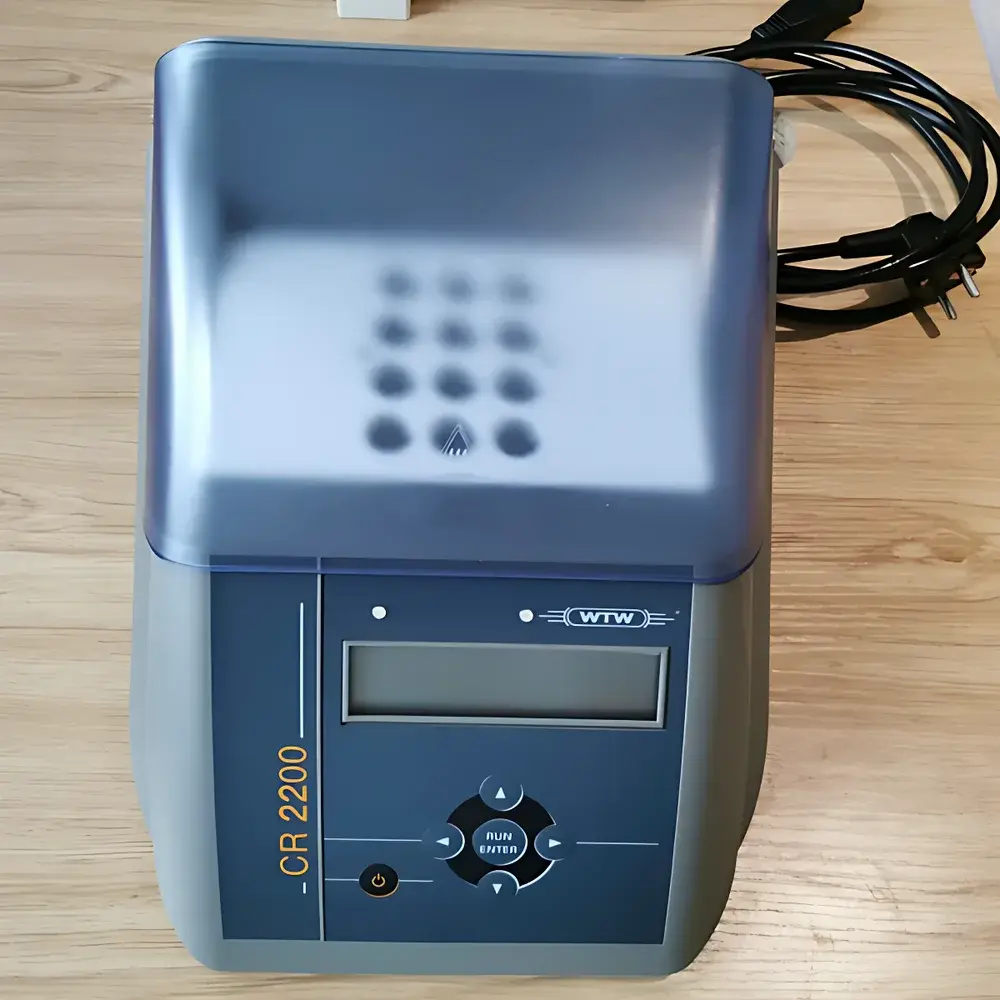
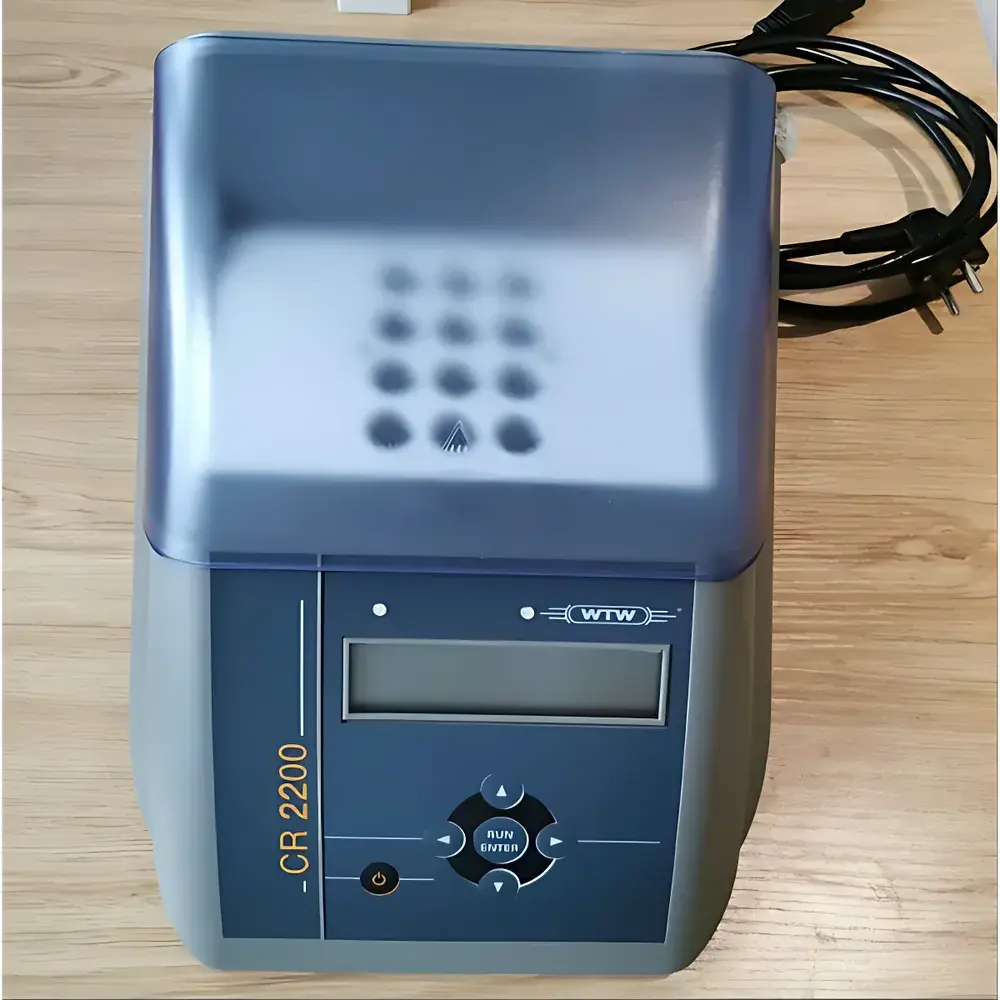
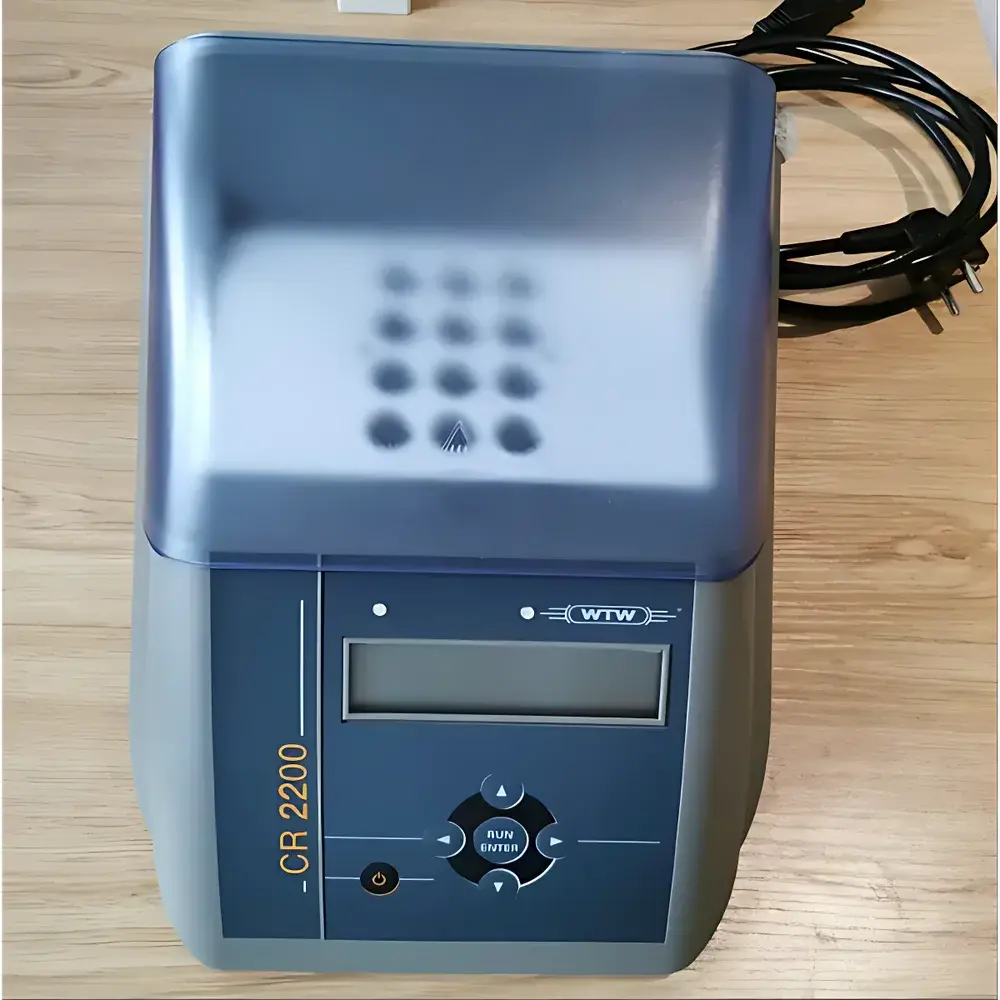
WTW CR 2200 Electric Heating Digestion Block
| Brand | WTW |
|---|---|
| Origin | Germany |
| Model | CR 2200 |
| Digestion Positions | 12 |
| Max. Heating Temperature | 170 °C |
| Temperature Accuracy | ±1 °C |
| Heating Principle | Electric heating via aluminum alloy heating block |
| Power Supply | 230 VAC 50 Hz ±15% or 115 VAC 60 Hz ±15% |
| Max. Power Consumption | 280 W |
| Safety Certifications | CE, cETLus, GS |
| Dimensions (W×H×D) | 256 × 185 × 315 mm |
| Weight | 2.85 kg |
| Predefined Programs | 5 (100 °C/60 min |
| Auto-Start & Auto-Shutdown | Yes |
| Built-in Safety Shield | Yes |
| Tube Compatibility | 16 mm OD glass or PTFE digestion tubes |
Overview
The WTW CR 2200 Electric Heating Digestion Block is a precision-engineered thermal reaction system designed for standardized wet chemical digestion in environmental, wastewater, and regulatory laboratory workflows. It operates on the principle of conductive heating through a thermally uniform aluminum alloy heating block, ensuring stable and reproducible temperature profiles across all 12 digestion positions. The instrument is optimized for common regulatory digestion protocols—particularly those defined in ISO 6060 (COD), ISO 11908 (total phosphorus), and ISO 11909 (total nitrogen)—where precise thermal control, repeatability, and operator safety are non-negotiable. Unlike open-flame or oil-bath systems, the CR 2200 eliminates variability from ambient drafts, uneven heat distribution, or reagent volatility, delivering consistent thermal energy directly to sample vessels. Its fixed-temperature program architecture enables rapid deployment of validated methods without manual parameter entry, reducing procedural error and supporting compliance with GLP and ISO/IEC 17025 requirements.
Key Features
- 12-position digestion block accommodating standard 16 mm outer diameter digestion tubes (glass or PTFE)
- Five factory-preset digestion programs covering critical environmental test conditions: 100 °C/60 min, 120 °C/30 min, 120 °C/60 min, 120 °C/120 min, and 148 °C/120 min
- High-accuracy digital temperature control with ±1 °C tolerance across the full operating range (25–170 °C)
- Fast thermal ramp: reaches 100 °C in ~5 minutes, 120 °C in ~7 minutes, and 148 °C in ~10 minutes
- Integrated safety shield prevents accidental contact with hot surfaces and contains potential splashes from tube rupture
- Auto-start function initiates heating upon lid closure; auto-shutdown activates after program completion or user-defined idle timeout
- LED status indicators and clear LCD display provide real-time feedback on setpoint, actual temperature, and remaining time
- Compliant with DIN VDE 0700 Part 1 (11/90) safety standards for household and similar electrical appliances (Safety Class I)
Sample Compatibility & Compliance
The CR 2200 supports standard 16 mm OD digestion tubes used in EPA Method 410.4 (COD), ASTM D5129 (total phosphorus), and ISO 15681-2 (orthophosphate). Its uniform block geometry ensures minimal inter-position temperature deviation (<0.5 °C), critical for multi-sample batch processing under QA/QC protocols. All units undergo factory calibration verification and carry CE, cETLus (UL 61010-1), and GS marks—certifying conformance with EU Machinery Directive 2006/42/EC, Low Voltage Directive 2014/35/EU, and North American electrical safety standards. The device meets essential requirements for use in laboratories operating under ISO/IEC 17025:2017, supporting documented method validation and equipment qualification (IQ/OQ). While the CR 2200 does not include built-in data logging, its thermal stability and repeatability support traceable calibration using external NIST-traceable reference thermometers.
Software & Data Management
The CR 2200 operates as a standalone benchtop instrument with no embedded software or network interface. All control logic resides in firmware, eliminating dependency on host computers or proprietary drivers. Temperature setpoints, program selection, and runtime are managed exclusively via front-panel buttons and LCD. For laboratories requiring audit-ready records, optional external temperature validation—using a calibrated PT100 probe inserted into designated monitoring ports—enables manual documentation of thermal performance against predefined acceptance criteria. Though lacking RS232 output (a feature reserved for CR3200/CR4200 models), the CR 2200’s deterministic behavior, fixed program structure, and mechanical reliability make it suitable for routine applications where electronic data capture is not mandated by internal SOPs or regulatory frameworks such as FDA 21 CFR Part 11.
Applications
The CR 2200 is routinely deployed in municipal wastewater treatment labs, environmental testing facilities, and industrial effluent monitoring programs. Primary applications include: COD determination per ISO 6060 and EPA 410.4; total phosphorus digestion prior to spectrophotometric analysis (ISO 11908); total nitrogen oxidation using alkaline persulfate (ISO 11909); and heavy metal leaching procedures (e.g., TCLP preparation per EPA Method 1311). Its compact footprint (256 × 185 × 315 mm) and low power draw (≤280 W) allow integration into fume hoods or shared analytical workstations without thermal load concerns. The unit’s robust construction—featuring an anodized aluminum heating block and corrosion-resistant housing—ensures long-term stability in high-humidity or chemically aggressive environments typical of digestion prep areas.
FAQ
What safety certifications does the CR 2200 hold?
The instrument carries CE, cETLus (UL 61010-1), and GS marks, confirming compliance with European and North American electrical safety and electromagnetic compatibility directives.
Can the CR 2200 be used for EPA-compliant COD analysis?
Yes—it supports the 150 °C/2-hour digestion protocol referenced in EPA Method 410.4 when configured via the 148 °C preset program, within acceptable method tolerance limits.
Is temperature calibration traceable to national standards?
While the CR 2200 lacks built-in calibration memory, users may perform periodic verification using an external NIST-traceable thermometer inserted into the designated sensor port.
Does the CR 2200 support custom temperature/time profiles?
No—only five fixed programs are available; programmable ramping or variable dwell times require the CR3200 or CR4200 models.
What tube types are compatible with the 12-position block?
Standard 16 mm outer diameter digestion tubes made of borosilicate glass or PTFE; maximum recommended tube height is 150 mm to ensure full immersion in the heating zone.



