
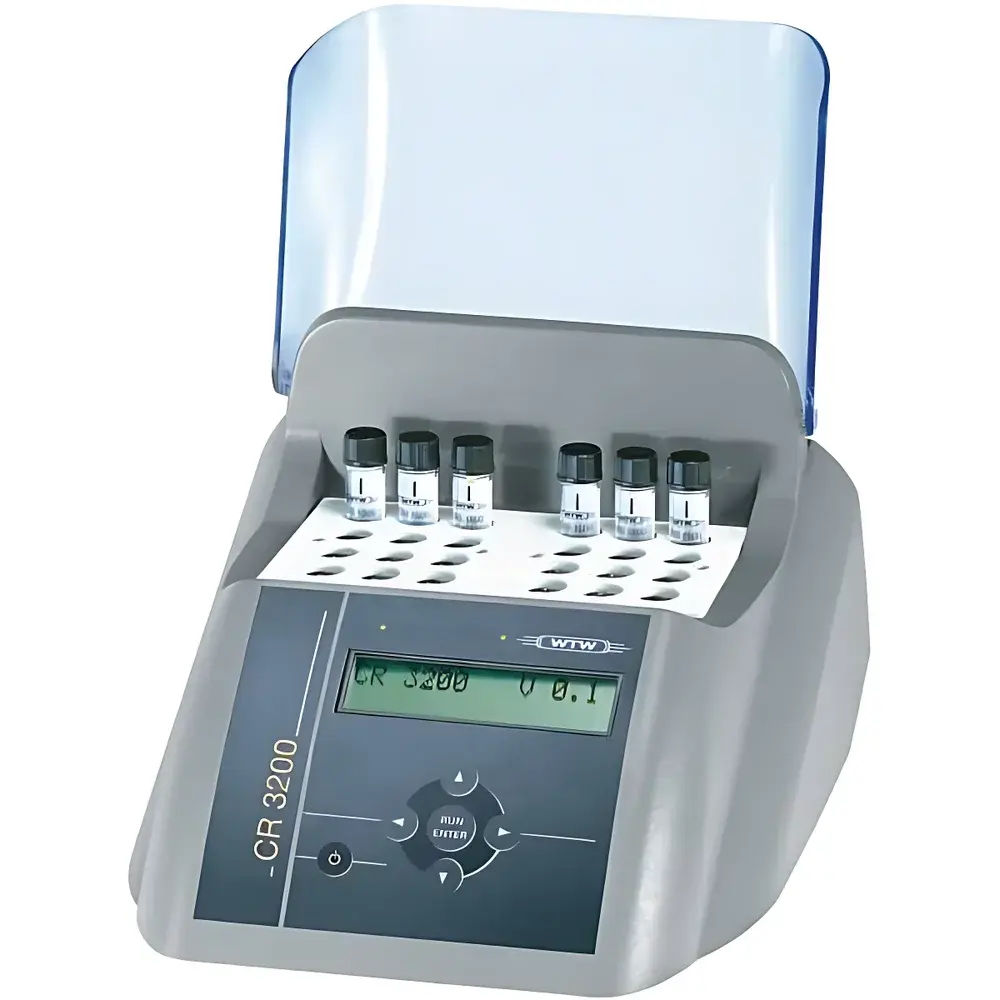
WTW CR3200 Advanced Programmable COD Digestion Block
| Brand | WTW |
|---|---|
| Origin | Germany |
| Model | CR3200 |
| Digestion Method | Rapid Thermal Digestion |
| Heating Module | Single Aluminum Block |
| Batch Capacity | 24 × 16 mm Reaction Tubes |
| Temperature Range | Adjustable from Ambient to 170 °C in 1 °C Increments |
| Temperature Accuracy | ±1 °C ±1 Digit |
| Power Supply | 230 VAC 50 Hz ±15% / 115 VAC 60 Hz ±15% |
| Max. Power Consumption | 560 W |
| Safety Compliance | DIN VDE 0700 Part 1 (11/90), CE, cETLus, GS |
| Dimensions (W×D×H) | 256 × 185 × 315 mm |
| Weight | Approx. 3.6 kg |
| Interface | RS232 Serial Port + 2 Banana Sockets (for TFK/AK CR/P or CR/PC Sensors) |
| Predefined Programs | 8 Fixed + 8 User-Defined (0–180 min, Ambient–170 °C) |
Overview
The WTW CR3200 Advanced Programmable COD Digestion Block is a precision-engineered thermal digestion system designed for standardized, reproducible oxidation of organic matter in water and wastewater samples—primarily for Chemical Oxygen Demand (COD), total phosphorus (TP), and total nitrogen (TN) analysis. It operates on the principle of closed-vessel, controlled-temperature acid digestion using potassium dichromate (K₂Cr₂O₇) under strongly acidic conditions (e.g., H₂SO₄), enabling complete oxidation of organic compounds within defined time–temperature profiles. As an essential pre-analytical module in compliance-driven environmental laboratories, the CR3200 ensures adherence to internationally recognized digestion protocols—including ISO 6060 (water quality – determination of chemical oxygen demand), ASTM D1252 (Standard Test Methods for Chemical Oxygen Demand), and EPA Method 410.4—by delivering stable, uniform heating across all 24 reaction positions with minimal inter-tube temperature deviation (<±0.8 °C at steady state).
Key Features
- Single high-mass aluminum heating block engineered for rapid thermal equilibration and exceptional temperature homogeneity across all 24 positions
- Digitally controlled temperature regulation from ambient to 170 °C in precise 1 °C increments, with real-time LED display and status indicators
- 16 programmable digestion cycles: eight factory-default methods (e.g., 100 °C/60 min, 120 °C/120 min, 148 °C/20 min) aligned with standard COD and nutrient test kits, plus eight user-defined profiles (0–180 min duration, ambient–170 °C)
- Automatic start/stop functionality with audible and visual end-of-cycle alerts, eliminating manual timing errors
- Integrated thermal safety shield and overtemperature cut-off circuitry compliant with DIN VDE 0700 Part 1 (11/90) and IEC 61010-1
- RS232 serial interface for optional integration with LIMS or data logging systems; dual banana sockets support connection to external temperature verification probes (e.g., TFK series) for routine calibration checks
- Compact benchtop footprint (256 × 185 × 315 mm) and lightweight aluminum construction (3.6 kg) optimized for space-constrained QA/QC labs
Sample Compatibility & Compliance
The CR3200 accommodates standard 16 mm outer-diameter glass or quartz digestion tubes (e.g., Hach, Lovibond, or Merck-certified vessels), supporting both open-reflux and sealed-vessel digestion formats. Its consistent thermal profile meets the stringent spatial uniformity requirements of ISO/IEC 17025-accredited laboratories performing environmental testing under GLP or regulatory frameworks such as EU Water Framework Directive (2000/60/EC) and US EPA Clean Water Act reporting. When used with certified reagent kits (e.g., WTW’s own COD LR/HR test kits or equivalent), the system supports full traceability through documented temperature validation logs—facilitating audit readiness for FDA 21 CFR Part 11–compliant environments when paired with validated software.
Software & Data Management
While the CR3200 operates as a standalone instrument, its RS232 port enables bidirectional communication with third-party laboratory software platforms via ASCII protocol. Users may export timestamped cycle parameters (setpoint, actual temperature, duration, program ID) to CSV or database formats for electronic record retention. Optional temperature probe interfaces allow periodic in-situ calibration verification—critical for maintaining metrological traceability per ISO/IEC 17025 Clause 6.4.2. No proprietary software is required; integration is compatible with common LIMS vendors (e.g., LabWare, Thermo Fisher SampleManager) when configured with appropriate drivers.
Applications
- Routine COD determination in municipal wastewater influent/effluent, industrial discharges, and surface water monitoring programs
- Simultaneous digestion for TP and TN analysis using molybdate blue and persulfate UV digestion methods, respectively
- Preparation of samples for spectrophotometric, titrimetric, or ICP-OES analysis following standardized digestion protocols
- Method validation studies requiring precise thermal ramping and dwell control (e.g., optimization of digestion efficiency vs. time–temperature curves)
- Training and proficiency testing in environmental chemistry education and certification labs (e.g., NELAC, UKAS)
FAQ
What standards does the CR3200 support for COD analysis?
It is fully compatible with ISO 6060, ASTM D1252 (Methods A and B), and EPA Method 410.4 when used with appropriate reagents and tube types.
Can the CR3200 be calibrated independently?
Yes—optional PT100-compatible temperature probes (e.g., WTW TFK series) can be inserted into designated ports for routine accuracy verification against NIST-traceable references.
Is the CR3200 suitable for total nitrogen digestion?
Yes, its 170 °C maximum temperature and programmable dwell times meet the thermal requirements for alkaline persulfate oxidation (ISO 11908, EN 15937).
How does the CR3200 ensure uniform heating across all 24 positions?
Through finite-element-optimized aluminum block geometry, embedded PID-controlled heating elements, and passive thermal mass stabilization—validated by internal thermal mapping per ISO/IEC 17025 Annex A.3.
Does the unit include documentation for quality audits?
Yes—each unit ships with CE, cETLus, and GS declarations of conformity; calibration certificates and IQ/OQ templates are available upon request for GxP-aligned installations.







