
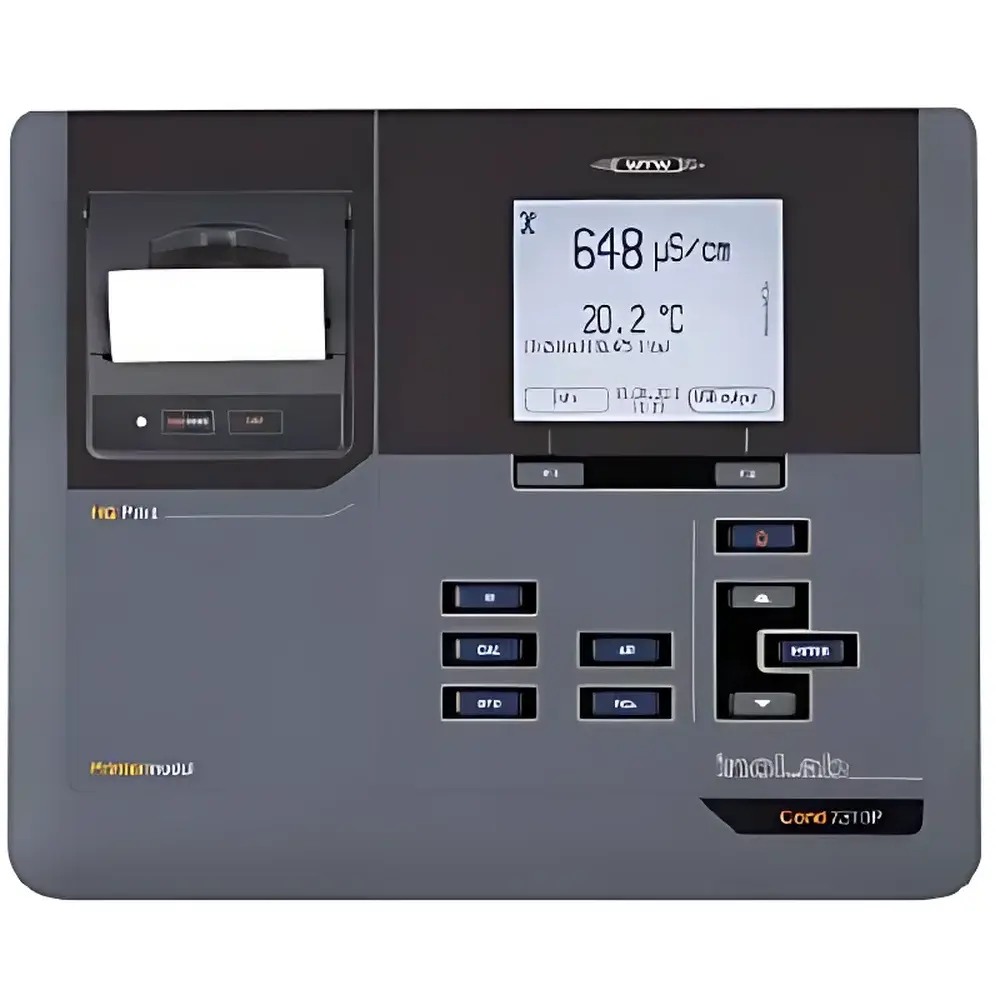
WTW inoLab pH 7310 Benchtop pH Meter
| Origin | Imported |
|---|---|
| Manufacturer Type | Authorized Distributor |
| Instrument Type | Benchtop |
| Model | inoLab pH 7310 |
| Measurement Parameters | Single (pH) |
| pH Range | –2.0 to 20.0 |
| Resolution | 0.1 / 0.01 / 0.005 pH (selectable) |
| Accuracy | ±0.005 pH (at 25 °C, calibrated with traceable buffers) |
| mV Range | ±1200.0 mV (±0.3 mV), ±2500 mV (±1 mV) |
| Temperature Range | –5.0 to +105.0 °C (±0.1 °C) |
| Calibration | Up to 5-point, DIN/NIST/WTW TEC buffer support (20 pre-programmed standards) |
| Memory Capacity | 500 manual entries / 5000 automatic logs |
| Data Output | USB 2.0 micro-B interface, CSV format |
| Compliance | GLP-compliant data logging with timestamp, operator ID, electrode serial number, and calibration history |
| Optional | Integrated thermal printer (58 mm width) |
Overview
The WTW inoLab pH 7310 is a high-precision benchtop pH meter engineered for laboratories requiring rigorous documentation, regulatory traceability, and metrological reliability in routine and quality-critical electrochemical measurements. Based on potentiometric measurement principles using glass electrode systems, the instrument delivers stable, reproducible pH readings across an extended range of –2.0 to 20.0 pH — accommodating highly acidic, neutral, and strongly alkaline aqueous and non-aqueous samples common in pharmaceutical process control, environmental monitoring, and industrial wastewater analysis. Its dual-range resolution architecture (0.1 / 0.01 / 0.005 pH) enables users to select appropriate precision levels depending on application demands, while integrated temperature compensation (–5.0 to +105.0 °C, ±0.1 °C) ensures accurate thermally corrected results without external probes.
Key Features
- GLP-compliant embedded data logger storing up to 5000 automatic or 500 manual measurements — each tagged with date, time, operator ID, electrode serial number, and calibration status
- CMC (Calibration Management Check) function providing real-time visual feedback on whether measured pH values fall within the validated calibration window — critical for audit readiness
- Multi-standard calibration support: 1–5 point calibration with 20 preloaded buffer sets including DIN, NIST, and WTW TEC standards; automatic recognition of standard type via electrode plug detection (DIN/BNC/4-mm banana)
- Backlit graphical LCD display with intuitive icon-based navigation and real-time trend plotting for pH and temperature
- USB 2.0 micro-B interface enabling direct transfer of CSV-formatted datasets to PCs for integration into LIMS, ELN, or Excel-based QA/QC workflows
- Optional integrated thermal printer (58 mm width) for immediate hardcopy generation of measurements, calibration reports, and system diagnostics
- Flexible power options: AC adapter included; alternatively powered by four AA alkaline (1.5 V), rechargeable NiMH (1.2 V), or optional battery pack for portable operation
Sample Compatibility & Compliance
The inoLab pH 7310 is designed for use with standard combination pH electrodes (e.g., SenTix® series) and reference electrodes compatible with DIN, BNC, or 4-mm banana connectors. It supports measurements in aqueous solutions, low-ionic-strength buffers, organic solvents (with appropriate electrode selection), and high-salinity media. All data handling and storage functions comply with Good Laboratory Practice (GLP) requirements as defined in OECD Principles of GLP and EU Directive 2004/10/EC. The device maintains full audit trails — including calibration timestamps, buffer lot numbers, electrode identification, and user-defined IDs — satisfying internal QA protocols and external inspections under ISO/IEC 17025, USP , and FDA 21 CFR Part 11 (when used with validated software and access controls).
Software & Data Management
No proprietary software installation is required: raw data exports directly as comma-separated values (CSV) files readable by Microsoft Excel, LibreOffice Calc, MATLAB, or laboratory information management systems (LIMS). Each record contains structured fields: measurement timestamp (YYYY-MM-DD HH:MM:SS), sample ID, operator code, electrode serial number, temperature, pH/mV reading, calibration status flag, and buffer used. The built-in memory retains the last 10 calibrations with full parameter logs (slope, offset, asymmetry potential, response time), supporting root cause analysis during method validation or out-of-specification (OOS) investigations. AutoRead mode eliminates subjective endpoint judgment by detecting signal stability per IUPAC-recommended criteria.
Applications
- Pharmaceutical QC labs performing dissolution testing, buffer preparation verification, and cleaning validation per USP and EP 2.2.3
- Environmental testing laboratories conducting surface water, groundwater, and effluent pH analysis in accordance with ISO 10523 and EPA Method 150.1
- Food & beverage R&D and production facilities monitoring fermentation pH, brine stability, and acidulant titration endpoints
- Academic research labs requiring traceable, publication-grade pH data for kinetic studies, enzyme activity assays, and colloidal stability experiments
- Chemical manufacturing sites validating neutralization reactions, catalyst performance, and corrosion inhibitor efficacy
FAQ
Does the inoLab pH 7310 support compliance with 21 CFR Part 11?
Yes — when operated with documented procedures, controlled user access, and electronic records stored in unalterable CSV format with full metadata (timestamp, operator ID, electrode ID), it meets foundational requirements for electronic signatures and audit trails. Full Part 11 compliance depends on site-specific validation and procedural controls.
Can the instrument store calibration data from multiple electrodes?
Yes — each calibration event is associated with the connected electrode’s serial number (manually entered or auto-detected), enabling electrode-specific performance tracking and lifetime management.
Is temperature measurement mandatory for pH readings?
No — temperature compensation is configurable: users may enable automatic ATC (with integrated Pt1000 sensor), manual input, or disable compensation entirely for specialized applications.
What buffer standards are supported beyond DIN and NIST?
The meter includes WTW TEC (Traceable Electrochemical Calibration) buffers and allows custom buffer definition with user-entered pH vs. temperature tables.
How is data integrity ensured during USB transfer?
The CSV export is a direct memory dump with no intermediate processing; file checksums can be generated externally to verify bit-for-bit fidelity between instrument and host system.
Related Products




