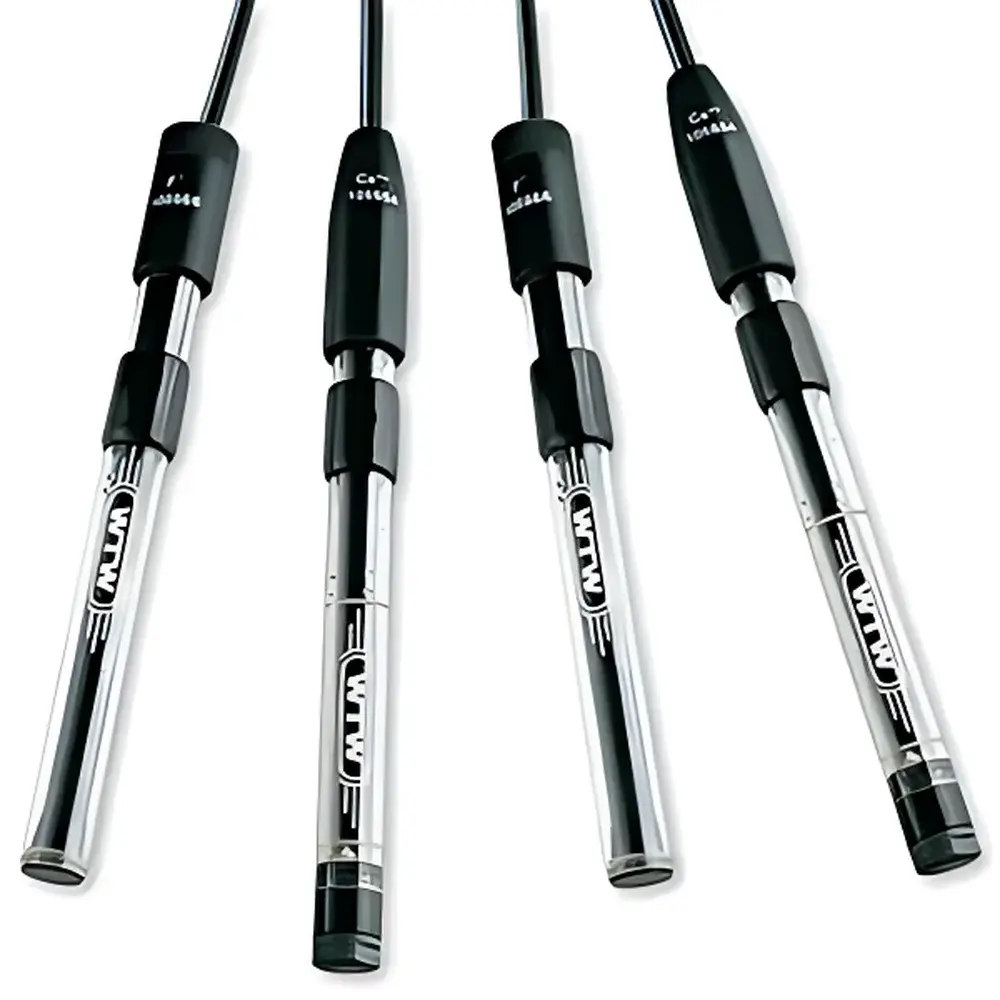
WTW ISE Series Ion-Selective Electrodes
| Brand | WTW |
|---|---|
| Origin | Germany |
| Type | Ion-Selective Electrode (ISE) |
| Series | 500 (Half-Cell) and 800 (All-in-One Composite) |
| Connector Options | BNC or DIN |
| Measurement Range | Ion-specific, spanning from sub-ppb to saturated concentrations (e.g., F⁻: 0.02 mg/L to saturation |
| NH₄⁺ | 0.02–900 mg/L |
| NO₃⁻ | 0.4–62,000 mg/L) |
| Compliance | Designed for ASTM D1293, ISO 10523, USP <781>, and EPA Method 9056A applications |
Overview
The WTW ISE Series Ion-Selective Electrodes are precision electrochemical sensors engineered for direct potentiometric measurement of specific ionic species in aqueous solutions. Based on the Nernst equation principle, these electrodes generate a stable, logarithmically proportional voltage response to the activity (not concentration) of target ions—enabling accurate quantification across wide dynamic ranges. Manufactured in Germany to stringent quality standards, the ISE portfolio comprises two architecture families: the modular 500 Series (requiring external reference electrodes and optimized for laboratory flexibility) and the integrated 800 Series (self-contained composite design with built-in reference junctions, ideal for routine analysis, field deployment, and low-volume sample testing). All electrodes feature robust glass or polymer membrane technologies, temperature-compensated response, and compatibility with WTW’s multi-parameter meters (e.g., pH/ION 780, inoLab® pH/ION) and third-party potentiometers supporting mV or ion concentration output modes.
Key Features
- Two-platform architecture: 500 Series half-cells for maximum configurability and method validation; 800 Series all-in-one composite electrodes for operational simplicity and reduced setup error.
- Wide ion coverage: Certified performance for 16 analytes including NH₄⁺, Pb²⁺, Br⁻, Cd²⁺, Ca²⁺, Cl⁻, CN⁻, F⁻, I⁻, K⁺, Cu²⁺, Na⁺, NO₃⁻, Ag⁺, S²⁻—each validated per IUPAC-recommended selectivity coefficient (log Kij) criteria.
- Flexible connectivity: Dual-interface support (BNC and DIN) ensures seamless integration with benchtop meters, portable analyzers, and automated sampling systems.
- Engineered for reproducibility: Membranes fabricated using proprietary ionophore-doped polymeric or crystalline materials deliver high selectivity, low detection limits (e.g., Cu²⁺ down to 0.0006 mg/L), and minimal drift (<0.5 mV/h).
- Modular maintenance: 800 Series electrodes include replaceable sensing elements (e.g., CA 800/AT, K 800/AT), extending service life and reducing total cost of ownership.
Sample Compatibility & Compliance
WTW ISE electrodes are validated for use in environmental water (surface, groundwater, wastewater), industrial process streams, food extracts, pharmaceutical buffers, and biological matrices (e.g., cell culture supernatants, urine). Sample pH must be controlled within specified ranges (e.g., F⁻ measurements require TISAB buffer at pH 5.0–5.5; CN⁻ requires alkaline conditioning). The system complies with critical regulatory frameworks: ASTM D1293 (pH and ion measurement in water), ISO 10523 (water quality — pH determination), USP <781> (ion-selective electrodes in pharmaceutical analysis), and EPA Method 9056A (fluoride in drinking water). When paired with WTW’s GLP-compliant meters featuring audit trail logging and user access control, the platform supports 21 CFR Part 11–aligned workflows for regulated laboratories.
Software & Data Management
Electrodes interface directly with WTW’s LabX® software via USB or Bluetooth, enabling automated calibration curve generation (single-point, two-point, or multi-point), real-time slope monitoring, and automatic temperature compensation (ATC). LabX stores full metadata—including electrode ID, calibration history, operator signature, timestamped readings, and raw mV data—for traceability. Export options include CSV, PDF reports, and direct LIMS integration via OPC UA. For high-throughput labs, the system supports batch processing of up to 99 samples with customizable pass/fail criteria based on ISE-specific uncertainty thresholds (e.g., ±5% RSD for Cl⁻ at 100 mg/L).
Applications
- Environmental monitoring: Nitrate and ammonium profiling in agricultural runoff; fluoride compliance testing in municipal drinking water; cyanide screening in industrial effluents per ISO 6703-1.
- Pharmaceutical QC: Sodium and potassium content verification in parenteral solutions (USP <781>); chloride assay in active pharmaceutical ingredients (APIs).
- Food & beverage: Salt (NaCl) quantification in sauces and dairy products; nitrate/nitrite monitoring in cured meats per EU Regulation (EC) No 1333/2008.
- Academic research: Real-time ion flux studies in microelectrode array (MEA)–coupled electrophysiology setups; calcium signaling kinetics in live-cell imaging experiments.
- Industrial process control: Lead and cadmium monitoring in electroplating baths; silver ion tracking in photographic developer recycling.
FAQ
What is the difference between the 500 and 800 Series electrodes?
The 500 Series are half-cells requiring a separate reference electrode (e.g., R 503/P or R 503/D) and offer maximum flexibility for method development and interference studies. The 800 Series integrate the reference junction and liquid membrane into a single probe—reducing setup complexity, minimizing junction clogging, and enabling reliable measurements in turbid or low-volume (<5 mL) samples. Do I need to use ionic strength adjusters (ISA) for every measurement?
Yes—consistent ionic strength is essential for Nernstian response. ISA solutions (e.g., TISAB for F⁻, MZ/NH₃/CN for CN⁻, ISA/Ca for Ca²⁺) maintain constant background electrolyte activity and suppress interfering hydroxide or hydrogen ion effects. Omission invalidates calibration linearity and introduces systematic bias.
Can these electrodes be used with non-WTW meters?
Yes—provided the meter accepts standard mV input (±2000 mV range), supports ion concentration mode with programmable slope and intercept, and offers temperature compensation. DIN and BNC connectors ensure broad interoperability with Thermo Orion, Metrohm, and Hanna instruments.
How often should I recalibrate?
Calibrate before each analytical session and after every 10–15 samples—or immediately following measurement of high-concentration standards—to verify slope stability (>95% of theoretical Nernst slope) and zero potential drift (<±2 mV). Are replacement membranes or sensing elements available?
Yes—select 800 Series electrodes (e.g., CA 800/AT, K 800/AT, NO 800/AT) support field-replaceable sensing modules, eliminating full-probe replacement and ensuring long-term cost efficiency.