
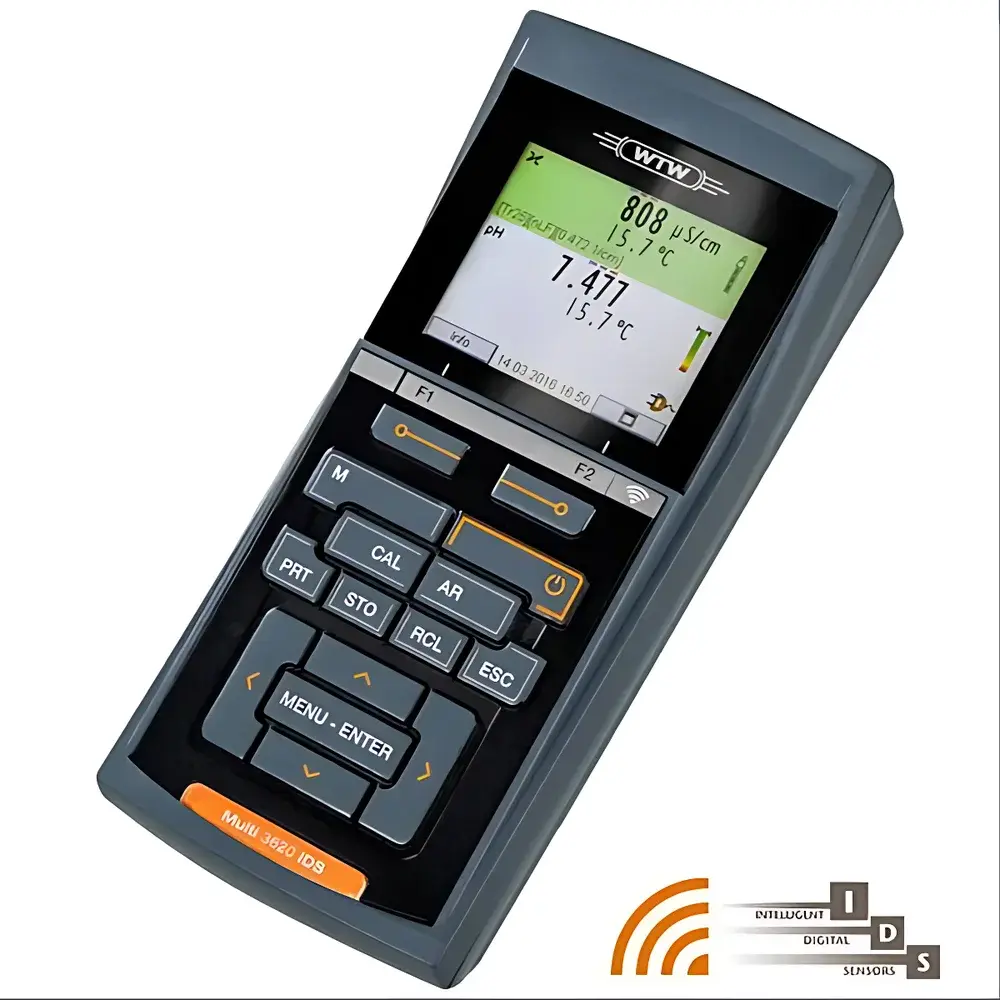
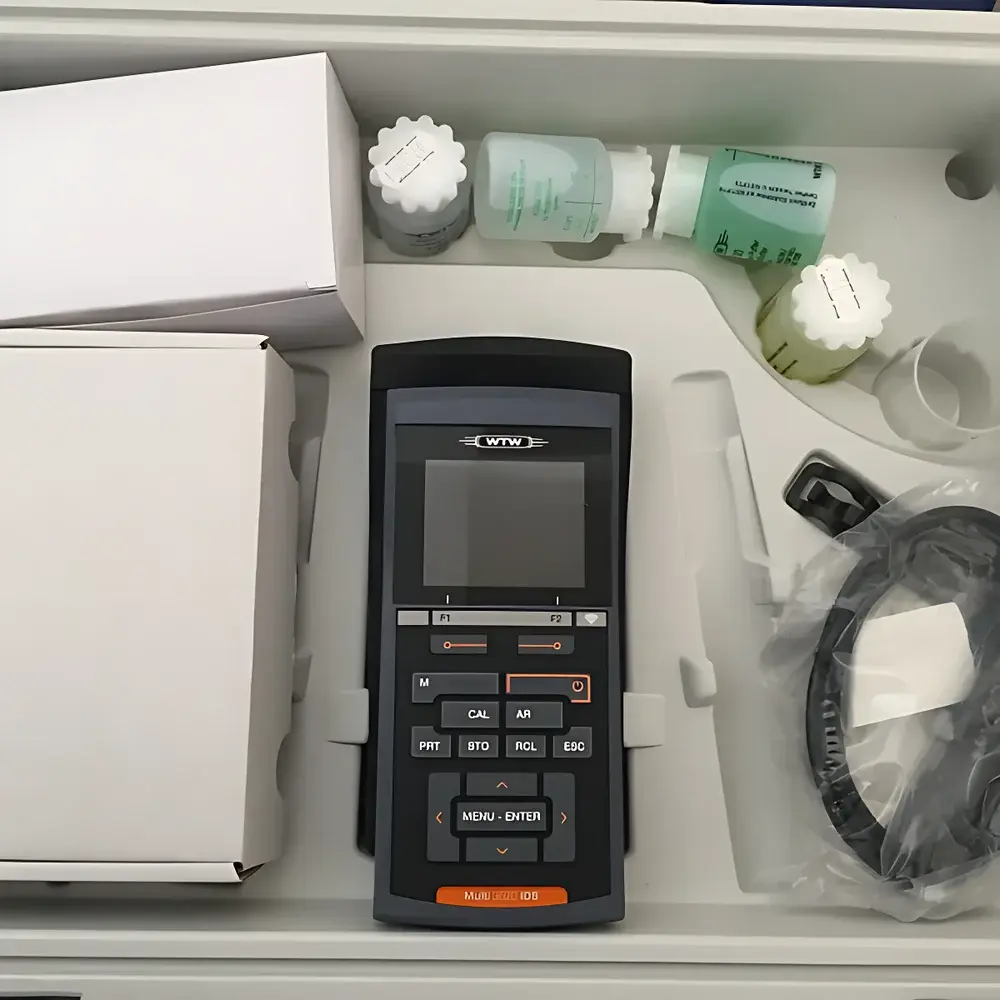
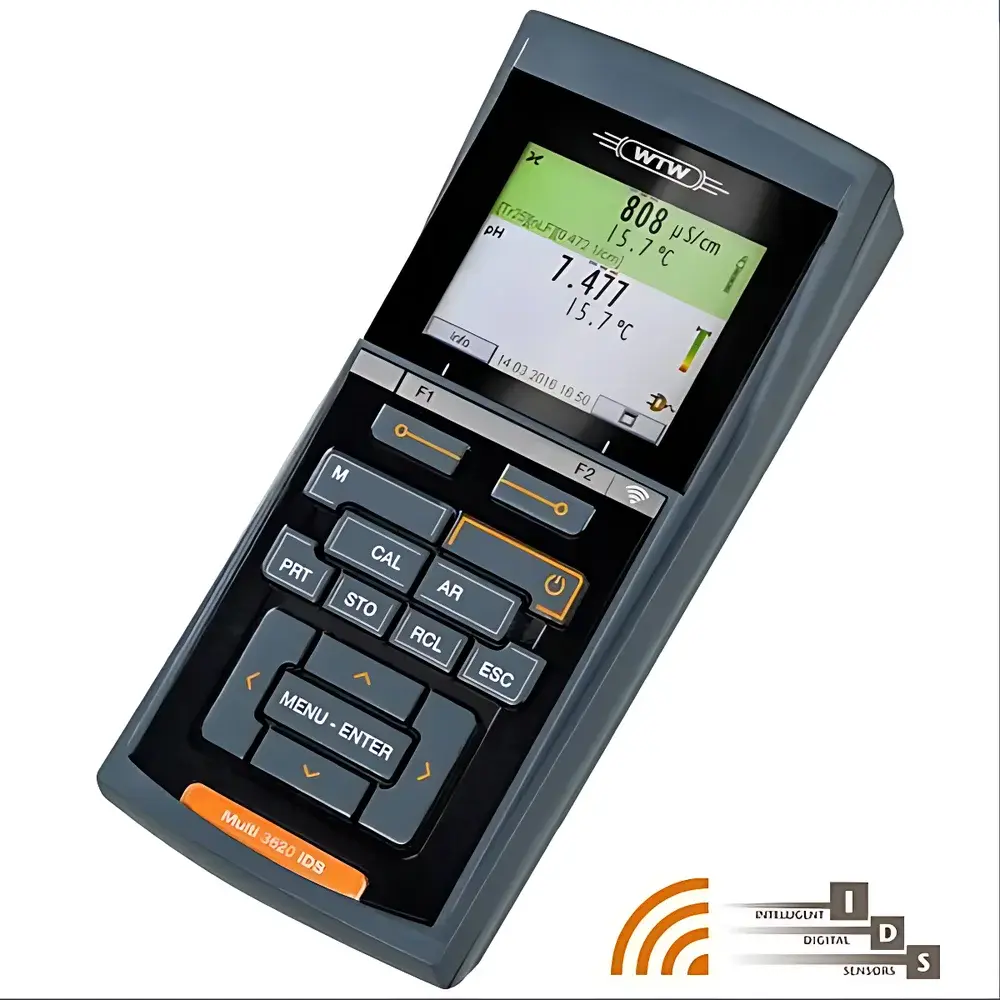
WTW Multi 3620 Portable Multi-Parameter Water Quality Analyzer
| Brand | WTW |
|---|---|
| Origin | Germany |
| Model | Multi 3620 |
| Instrument Type | Portable / Handheld Water Quality Analyzer |
| Detection Parameters | pH, ORP, Dissolved Oxygen (DO), Oxygen Saturation, Partial Pressure of Oxygen (pO₂), Conductivity, Resistivity, Salinity, TDS, Turbidity |
| Measurement Range (Dissolved Oxygen) | 0–50 mg/L |
| Display | Graphical LCD |
| Data Storage Capacity | Up to 10,000 datasets (manual + automatic) |
| Protection Rating | IP67 |
| Power Supply | 4×1.5 V AA alkaline or 4×1.2 V NiMH rechargeable batteries, or USB-powered operation |
| Interface | Micro-USB-B, USB-A (for memory card and printer connectivity) |
| Probe Communication | Digital IDS (Intelligent Digital Sensor) interface with wireless-capable probe pairing |
| Sensor Compatibility | MPP 910 IDS (single-parameter), MPP 930 IDS (triple-parameter, including depth measurement up to 100 m with pressure & density compensation for seawater) |
| Depth Resolution | 0.05 m |
| Depth Accuracy | ±0.25 m |
| Housing Material | POM polymer and stainless steel |
Overview
The WTW Multi 3620 is a high-precision, field-deployable multi-parameter water quality analyzer engineered for rigorous environmental monitoring in diverse aquatic environments—from freshwater streams and wastewater treatment plants to coastal marine zones and industrial effluent discharge points. Built upon WTW’s Intelligent Digital Sensor (IDS) platform, the instrument employs digital sensor communication architecture to eliminate analog signal degradation, ensuring metrological traceability and long-term stability across repeated field deployments. Unlike conventional analog meters, the Multi 3620 performs real-time digital signal acquisition directly at the probe tip, enabling automatic sensor identification, embedded calibration history storage, and full parameter configuration retention within each IDS probe. Its measurement principle integrates potentiometric (pH/ORP), electrochemical (Clark-type or optical DO), conductometric (conductivity/resistivity/salinity/TDS), and nephelometric (turbidity) methodologies—each compliant with standardized test protocols defined in ISO 7888 (conductivity), ISO 5814 (electrochemical DO), EN ISO 15839 (turbidity), and ASTM D1293 (pH). The device operates without external cabling between meter and probe when using compatible wireless IDS probes—significantly reducing setup time and mechanical failure risk in rugged terrain or submerged sampling scenarios.
Key Features
- Digital IDS architecture with plug-and-play probe recognition and on-board calibration data storage per sensor
- Wireless probe connectivity option (via optional IDS transceiver modules), eliminating cable management constraints during vertical profiling or rapid site surveys
- Triple-channel simultaneous measurement capability (e.g., pH + DO + conductivity via MPP 930 IDS probe)
- IP67-rated housing certified for dust-tight operation and immersion resistance up to 1 m for 30 minutes
- Extended data logging: up to 10,000 measurement sets with configurable manual or time-based recording intervals (1 s to 24 h)
- Integrated depth sensing (MPP 930 IDS only) with automatic pressure and seawater density compensation for accurate hydrostatic depth calculation (0.05–100 m range)
- Current-isolated sensor electronics to suppress electromagnetic interference in electrically noisy environments (e.g., near pumps, inverters, or power substations)
- Flexible power options: standard alkaline AA cells, rechargeable NiMH battery pack, or continuous USB bus power for extended lab-based analysis
Sample Compatibility & Compliance
The Multi 3620 supports direct in-situ measurements in natural waters (rivers, lakes, estuaries), treated effluents, groundwater, seawater, and process streams across municipal, industrial, and research applications. All IDS probes are constructed from chemically inert materials—POM (polyoxymethylene) housings and 316 stainless steel wetted parts—ensuring compatibility with aggressive matrices including brackish water, chlorinated disinfectant residuals, and low-pH acid mine drainage. The system complies with key regulatory frameworks for environmental data integrity: calibration logs and measurement metadata are timestamped and stored immutably in internal memory, supporting audit readiness under EPA Method 160.1 (pH), EPA Method 360.1 (conductivity), and ISO/IEC 17025-accredited laboratory practices. While not FDA 21 CFR Part 11-certified out-of-the-box, its structured data export format (CSV/Excel-compatible) facilitates integration into validated LIMS environments where electronic signature and audit trail requirements apply.
Software & Data Management
Data transfer is performed via micro-USB-B port to PC or mobile workstation using WTW’s proprietary LabX® Light software (Windows/macOS compatible), which enables batch calibration verification, statistical trend analysis, and automated report generation per ISO 5725 repeatability criteria. USB-A host functionality allows direct connection to USB flash drives (FAT32 formatted) or thermal printers for on-site hardcopy output without laptop dependency. All logged datasets include embedded metadata: sensor ID, calibration date/stamp, temperature compensation status, GPS coordinates (when paired with optional Bluetooth GNSS module), and operator-defined sample IDs. Internal memory retains full audit trails—including any parameter modification events—supporting GLP-aligned documentation workflows in contract environmental laboratories.
Applications
- Routine compliance monitoring of wastewater discharge permits (e.g., NPDES, EU Urban Wastewater Treatment Directive)
- Vertical profiling of stratified reservoirs and coastal zones using depth-compensated MPP 930 IDS probes
- Emergency response assessments following chemical spills or algal bloom events
- Calibration validation and field verification of fixed online analyzers (e.g., SCADA-integrated DO or conductivity sensors)
- Educational fieldwork and undergraduate environmental science laboratories requiring NIST-traceable instrumentation
- Long-term ecological studies requiring high-reproducibility longitudinal datasets across seasonal cycles
FAQ
Does the Multi 3620 support automatic temperature compensation for all measured parameters?
Yes—each IDS probe incorporates a built-in Pt1000 temperature sensor, enabling real-time, parameter-specific temperature compensation algorithms per ISO standards.
Can I use non-WTW probes with the Multi 3620?
No—the instrument exclusively communicates with WTW-branded IDS digital probes; analog or third-party sensors are incompatible due to proprietary digital handshake protocol.
What is the maximum depth rating for the MPP 930 IDS probe?
The probe is rated for continuous operation to 100 m depth in seawater, with automatic correction for hydrostatic pressure and local water density.
Is firmware upgrade supported in the field?
Yes—firmware updates are delivered via USB-connected PC using LabX Light software and require no hardware service intervention.
How is data security handled during USB transfer?
No encryption is applied internally; users deploying in regulated settings should implement organizational-level file encryption policies prior to data archival or transmission.
Related Products







