
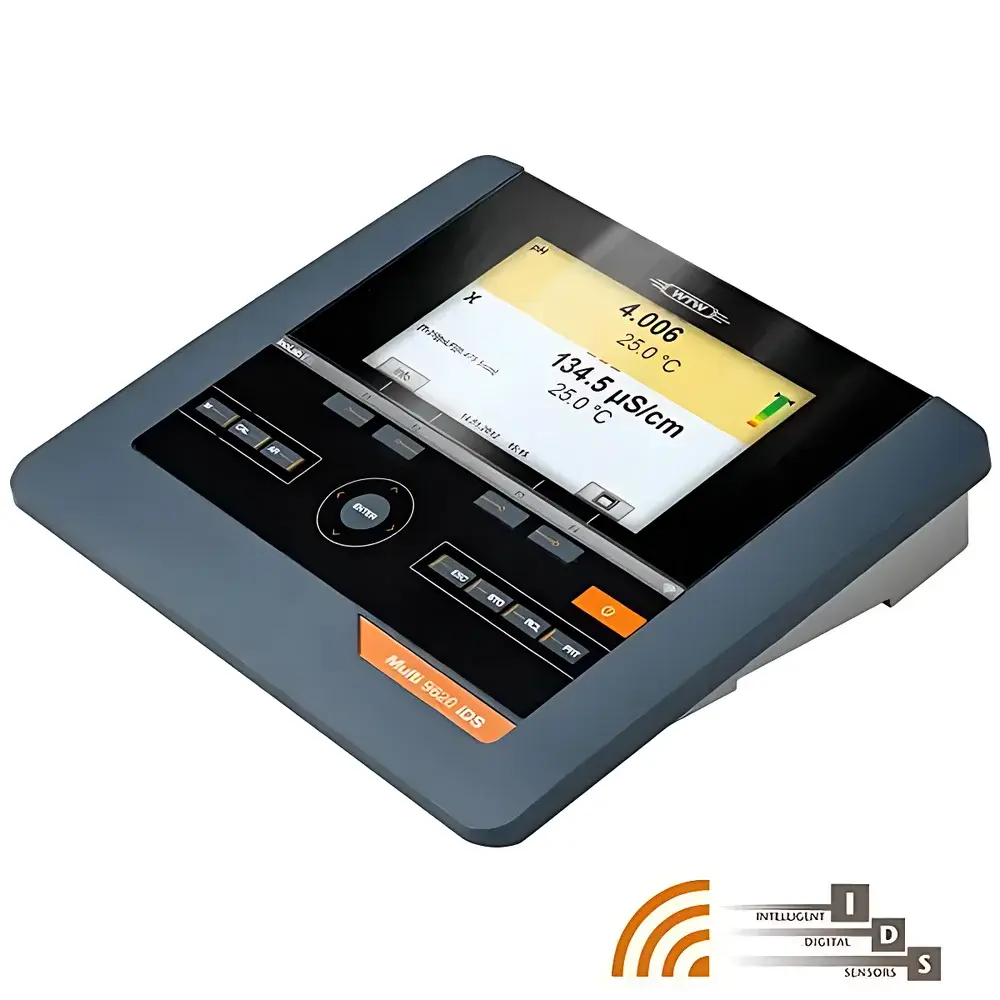
WTW Multi 9620 IDS Laboratory Multi-Parameter Water Quality Analyzer
| Brand | WTW |
|---|---|
| Origin | Germany |
| Model | Multi 9620 IDS |
| Instrument Type | Benchtop Laboratory Multi-Parameter Analyzer |
| Measurement Principle | Electrochemical (pH, ORP, Conductivity, DO) + Optical (Turbidity) |
| Parameters | pH, ORP, Dissolved Oxygen (DO), Oxygen Saturation (%), Partial Pressure of Oxygen (pO₂), Conductivity, Resistivity, Salinity, TDS, Turbidity |
| Display | Graphical LCD with Backlight |
| Data Storage | 500 Manual / 10,000 Automatic Records |
| Measurement Channels | 2 Simultaneous |
| Probe Interface | Digital IDS (Intelligent Digital Sensor) Protocol |
| Connectivity | Micro-USB-B, USB-A (for USB flash drive or thermal printer), Optional Wireless Module (via Bluetooth-enabled IDS probes) |
| Compliance | CE, RoHS, ISO/IEC 17025-compatible operation |
| Power Supply | 4 × AA batteries (1.5 V) or USB-B bus power |
| Protection Class | IP43 |
| QSC (Quality Sensor Control) & CMC (Calibration Management Center) | Yes |
| Software Export Format | CSV and Excel-compatible (.xlsx) via USB storage |
Overview
The WTW Multi 9620 IDS is a high-precision, benchtop multi-parameter water quality analyzer engineered for routine and regulatory laboratory applications in environmental monitoring, drinking water treatment, wastewater management, and academic research. Built upon WTW’s Intelligent Digital Sensor (IDS) platform, the instrument employs digital signal transmission between probe and analyzer—eliminating analog noise, cable-length limitations, and calibration drift associated with conventional analog electrodes. Its dual-channel architecture supports simultaneous real-time measurement of two independent parameters (e.g., pH + DO, or conductivity + turbidity), while its electrochemical and optical sensing modules adhere to internationally recognized measurement principles: potentiometric detection for pH/ORP/ISE, galvanic or optical luminescence-based dissolved oxygen determination, four-electrode conductivity measurement for high accuracy across wide salinity ranges, and ISO 7027-compliant nephelometric turbidity detection at 860 nm. Designed and manufactured in Germany, the Multi 9620 IDS complies with stringent quality and electromagnetic compatibility standards (CE, RoHS), and its operational traceability aligns with ISO/IEC 17025 requirements for accredited testing laboratories.
Key Features
- Dual-channel IDS interface enabling concurrent measurement of two digitally encoded parameters with automatic probe recognition and embedded calibration history
- Graphical LCD display with intuitive icon-based navigation, backlighting, and antimicrobial keypad for hygienic lab environments
- Integrated Quality Sensor Control (QSC) algorithm that continuously evaluates sensor health—including membrane integrity, electrolyte level, and response time—and provides real-time status alerts
- Calibration Management Center (CMC) for secure, timestamped storage of calibration data, user ID logging, and full audit trail generation
- Onboard data storage supporting up to 10,000 automated readings (time-stamped, parameter-tagged) plus 500 manual entries; exportable via USB-A to standard USB flash drives in native Excel (.xlsx) and CSV formats
- Flexible connectivity: micro-USB-B for PC synchronization and firmware updates; USB-A host port for direct printing (58 mm thermal printer, optional) or mass storage device integration
- Power versatility: operates on four AA alkaline batteries (up to 1,000 hours typical use) or continuous USB-B bus power—ideal for both stationary lab benches and mobile field-deployed setups
Sample Compatibility & Compliance
The Multi 9620 IDS is validated for analysis of freshwater, seawater, wastewater effluents, process water, and potable water matrices. Its IDS probes—such as the SenTix 940 pH electrode, FDO 925 optical DO sensor, TetraCon 925 conductivity cell, and Turb 925 turbidity sensor—are individually certified to meet DIN EN ISO 5667-3 (water sampling), DIN EN ISO 5815-1 (DO in water), DIN EN 27888 (conductivity), and DIN EN ISO 7027-1 (turbidity). When used with documented SOPs and calibrated per manufacturer specifications, the system supports data integrity frameworks required under GLP (Good Laboratory Practice) and can be configured to meet FDA 21 CFR Part 11 compliance when paired with WTW’s LabX® software (via optional PC interface). All sensor-specific certificates of conformance and calibration reports are stored internally and retrievable per measurement record.
Software & Data Management
Data acquisition, review, and reporting are streamlined through the instrument’s embedded firmware—no external software required for basic operation. Each stored measurement includes parameter value, temperature, date/time stamp, operator ID (assignable), probe serial number, and QSC diagnostic flags. For advanced traceability, users may connect the Multi 9620 IDS to WTW’s LabX® Light software (Windows-based, optional license) to enable electronic signatures, role-based access control, automated report generation (PDF/Excel), and long-term database archiving. All exported files contain embedded metadata compliant with ISO/IEC 17025 clause 7.5.2 (technical records), including uncertainty estimates derived from probe-specific accuracy specifications and calibration intervals.
Applications
- Regulatory compliance testing for municipal water utilities (EPA Method 180.1 for turbidity, ASTM D859 for chloride ISE, ISO 5815-1 for DO)
- Benchmarking and validation of online process analyzers in WWTPs and desalination plants
- Research-grade water chemistry profiling in limnology, marine biology, and ecotoxicology studies
- Educational laboratory instruction for analytical environmental chemistry courses
- QA/QC verification of bottled water, pharmaceutical water (PW/WFI), and cleanroom rinse water
FAQ
Does the Multi 9620 IDS support analog electrodes?
Yes—when equipped with the optional ADA 94 adapter (pH/IDS DIN or pH/IDS BNC), the instrument can interface with legacy analog pH, ORP, and ISE electrodes while retaining digital display and data logging functionality.
Can turbidity and conductivity be measured simultaneously?
Yes—the dual-channel design allows one IDS turbidity probe and one IDS conductivity probe to operate concurrently without cross-talk or signal interference.
Is firmware update supported in the field?
Yes—updates are delivered via micro-USB-B connection using WTW’s official firmware updater tool; version history and release notes are publicly available on WTW’s global support portal.
What is the maximum allowable sample temperature for IDS probes?
Standard IDS probes are rated for continuous operation up to 50 °C; high-temperature variants (e.g., TetraCon HT 925) extend this to 105 °C for industrial process applications.
How is measurement uncertainty reported?
Uncertainty is calculated per ISO/IEC Guide 98-3 (GUM) using probe-specific accuracy tolerances, temperature compensation residuals, and calibration standard uncertainties—displayed as ±X% or ±Y units in the “Measurement Info” menu for each reading.
Related Products







