
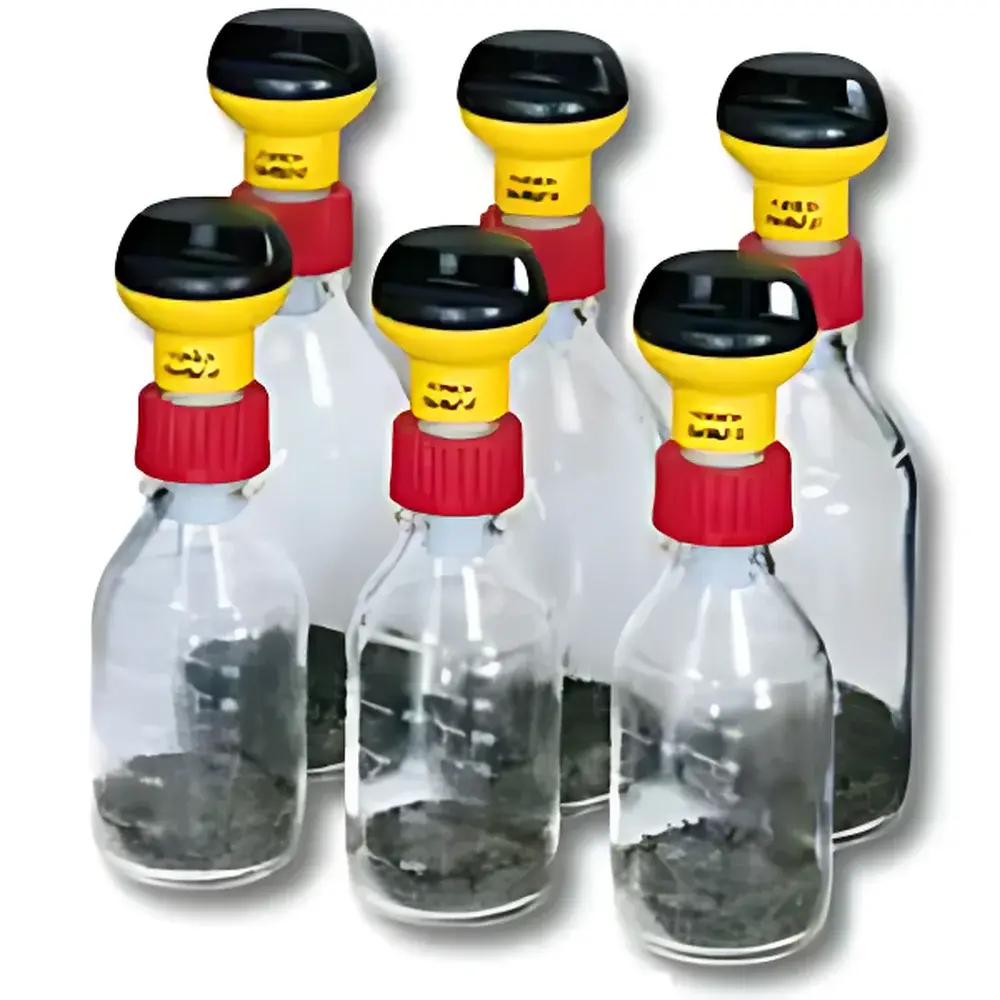
WTW OxiTop® Control B/BM Soil Respiration Analyzer
| Brand | WTW |
|---|---|
| Origin | Germany |
| Model | OxiTop® Control B/BM Soil Respiration Analyzer |
| Measurement Principle | Pressure-based CO₂ consumption/respiration monitoring via headspace oxygen depletion |
| Container Options | MG 1.0 (1000 mL) or PF 45/500 (500 mL) sealed vials with integrated OxiTop®-C stoppers or AD/SK adapters |
| Data Logging | Autonomous, battery-powered, up to 60 days continuous measurement per cycle |
| Output | mg O₂/L·d or µmol CO₂/g soil·h (calculated) |
| Compliance | Designed for ISO 11274, ISO 17402, OECD 207, ASTM D5988, and EU Regulation (EC) No 1107/2009 biodegradation testing protocols |
Overview
The WTW OxiTop® Control B/BM Soil Respiration Analyzer is a fully autonomous, pressure-differential based system engineered for precise, long-term quantification of aerobic microbial respiration in soil and solid-phase environmental samples. Unlike optical or infrared CO₂ sensors, the OxiTop® platform measures oxygen consumption indirectly—via real-time pressure decline in hermetically sealed vessels—enabling highly reproducible calculation of CO₂ production rates under standardized incubation conditions. This principle aligns with internationally recognized biodegradation and ecotoxicity test guidelines, including OECD 207 (Earthworm Acute Toxicity), ISO 11274 (Soil Quality – Determination of Water Retention Characteristics), and ASTM D5988 (Standard Test Method for Determining Aerobic Biodegradation of Plastic Materials in Soil). The system supports both static and dynamic respirometry configurations, making it suitable for regulatory-compliant studies of pesticide persistence, fertilizer mineralization kinetics, and bioremediation efficiency assessment.
Key Features
- Autonomous operation: Integrated microprocessor, rechargeable battery, and non-volatile memory enable unattended logging for up to 60 days without external power or PC connection.
- Dual-platform flexibility: Supports two validated vessel formats—OxiTop® Control B6 with six PF 45/500 Duran glass vials (500 mL) and AD/SK adapters, or OxiTop® Control BM6 with six MG 1.0 measurement bottles (1000 mL) and OxiTop®-C stoppers—optimized for high-CO₂-yield or low-biomass samples respectively.
- Pressure-based transduction: High-stability piezoresistive sensor (±0.1 mbar resolution) ensures robust performance across temperature gradients (10–30 °C operating range) and eliminates interference from humidity or volatile organic compounds.
- Pre-calibrated, zero-maintenance design: No gas calibration gases, no consumable electrodes, and no routine sensor replacement—reducing total cost of ownership and operator dependency.
- GLP-ready data integrity: Each measurement cycle stores timestamped pressure profiles with device ID, user ID, and incubation parameters—fully traceable for audit trails under ISO/IEC 17025 and FDA 21 CFR Part 11 compliant workflows when paired with optional software validation packages.
Sample Compatibility & Compliance
The OxiTop® Control B/BM accommodates heterogeneous solid matrices—including agricultural soils, contaminated sediments, compost amendments, and biochar-amended substrates—without homogenization or filtration. Vessel headspace-to-sample ratios are configurable to meet OECD 207 (1:10 w/v) or ISO 17402 (soil moisture control at pF 2.0–2.5) requirements. All components comply with EU RoHS Directive 2011/65/EU and are manufactured in accordance with ISO 9001-certified processes at WTW’s Weilheim, Germany facility. The system is routinely deployed in accredited laboratories conducting GLP-compliant studies for EFSA, EPA, and ECHA submissions related to active substance registration under Regulation (EC) No 1107/2009.
Software & Data Management
Data retrieval is performed via USB interface using the OxiTop® Control Software (v4.3+), which supports automated conversion of pressure decay curves into standardized respiration units (e.g., mg O₂/kg soil·d or µmol CO₂/g dry weight·h). The software generates ISO-aligned reports with embedded metadata, statistical summaries (mean, SD, CV%), and customizable export to CSV, PDF, or LIMS-compatible XML. Audit trail functionality records all user actions—including parameter edits, data exports, and report generation—with electronic signatures and time-stamped logs. Optional 21 CFR Part 11 compliance modules provide role-based access control, electronic signature validation, and immutable archive storage.
Applications
- Regulatory biodegradation testing of agrochemicals (herbicides, fungicides, insecticides) per OECD 301 series and ISO 14852.
- Soil health assessment through basal and substrate-induced respiration (SIR) indices.
- Monitoring aerobic degradation kinetics during ex situ bioremediation of hydrocarbon- or chlorinated solvent-contaminated soils.
- Toxicity screening in earthworm and microbial inhibition assays (OECD 207, ISO 11268).
- Validation of compost stability and maturity via cumulative CO₂ evolution thresholds (CEN/TR 15374).
FAQ
How does the OxiTop® Control B/BM differ from IR-based CO₂ analyzers?
It measures oxygen depletion-induced pressure drop—not CO₂ concentration—eliminating cross-sensitivity to water vapor, methane, or VOCs and enabling stable operation in high-humidity soil headspaces.
Can the system be used for anaerobic respiration studies?
No—the OxiTop® Control B/BM is designed exclusively for aerobic respirometry; anaerobic applications require complementary systems such as WTW’s pH/Redox-capable Multi 3630 IDS with gas-tight septum vials.
What is the minimum detectable respiration rate?
Under standard conditions (20 °C, 100 g soil, 1000 mL MG 1.0 bottle), the limit of detection is 0.05 mg O₂/kg soil·h, corresponding to ~0.12 µmol CO₂/g dry weight·h.
Is calibration required before each use?
No—factory calibration is stable for ≥24 months; users perform only a one-time zero-point verification using an empty, sealed reference vessel prior to batch deployment.
Are the MG 1.0 and PF 45/500 vessels interchangeable between B6 and BM6 units?
Yes—both vessel types are mechanically and electronically compatible with either base unit; selection depends solely on sample volume, expected CO₂ flux, and regulatory protocol requirements.
Related Products







