
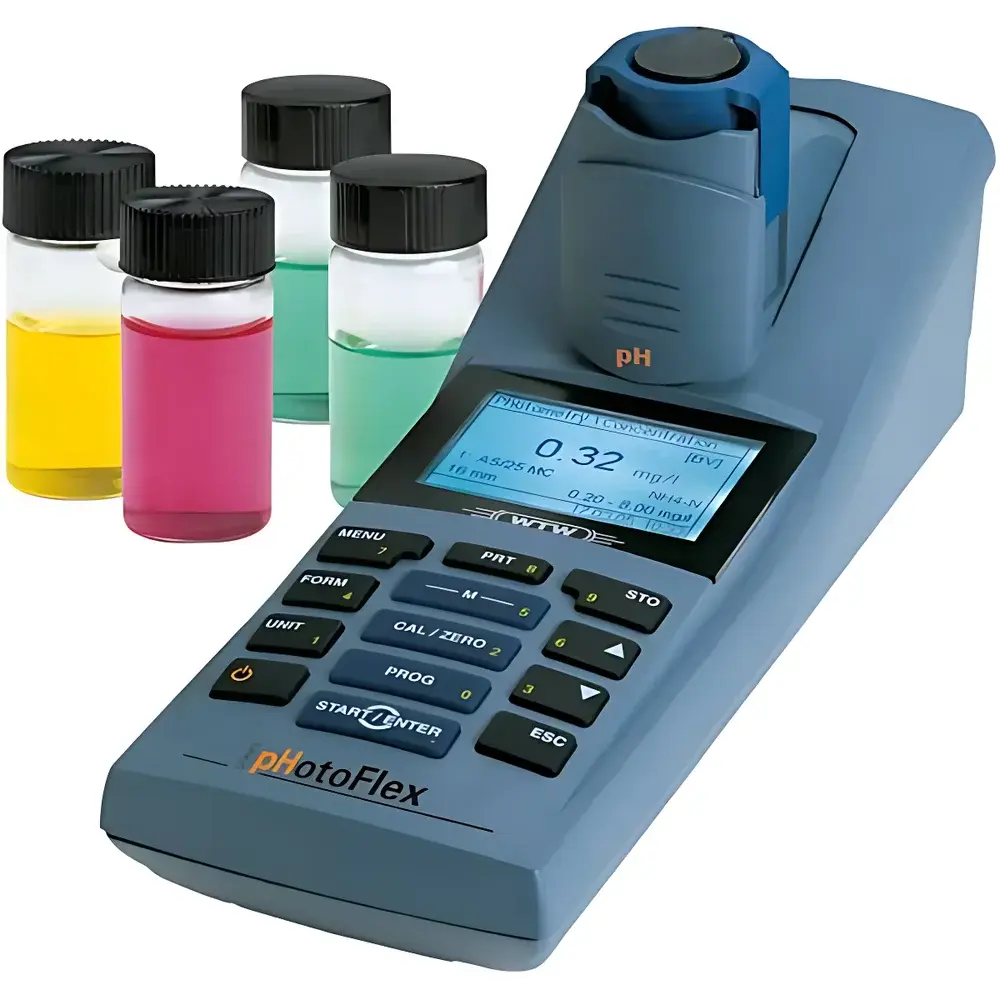
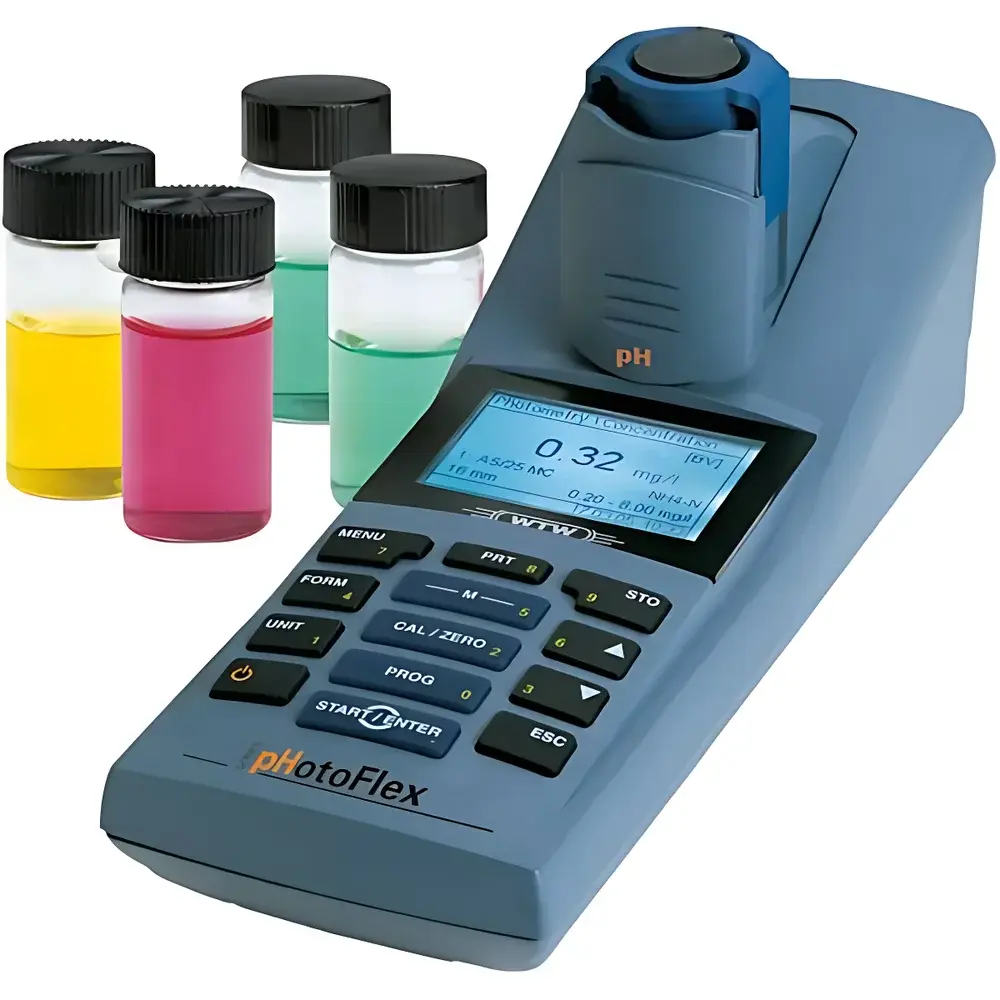
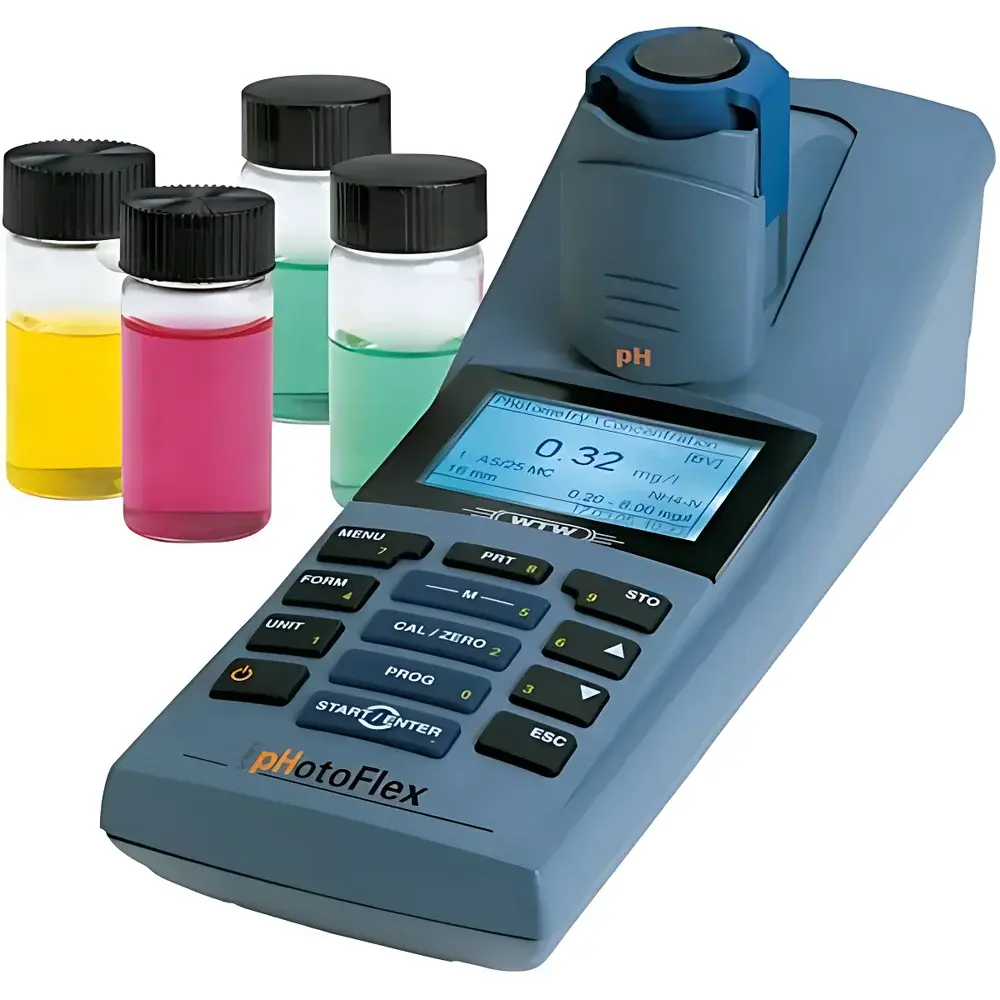
WTW pHotoFlex pH Portable Colorimeter
| Brand | WTW |
|---|---|
| Origin | Germany |
| Model | pHotoFlex pH |
| Wavelength Accuracy | < 2 nm |
| Wavelengths | 436, 517, 557, 594, 610, 690 nm |
| Photometric Range | Absorbance –2.00 to +2.00 A |
| pH Measurement Range | 0.00–16.00 |
| Accuracy | ±0.01 pH |
| Data Storage | 1000 measurement records + 100 user-defined methods |
| Auto-zero | Yes (on power-up) |
| Calibration | 3-point pH calibration |
| Interface | RS232 (USB optional) |
| Protection Rating | IP67 |
| Power Supply | 4 × AA alkaline batteries (≥3000 measurements) or optional rechargeable pack |
| Dimensions | 236 × 86 × 117 mm |
| Weight | 0.6 kg (without batteries) |
| Compliance | cETLus certified |
Overview
The WTW pHotoFlex pH Portable Colorimeter is a field-deployable, dual-function analytical instrument engineered for simultaneous photometric quantification and high-precision pH measurement in environmental, industrial, and laboratory settings. Unlike conventional single-mode colorimeters, the pHotoFlex pH integrates a stable LED-based optical system with a DIN-compliant pH electrode interface—enabling traceable, metrologically sound analysis without requiring separate instrumentation. Its optical architecture employs fixed-wavelength LED sources coupled with precision interference filters, delivering wavelength accuracy better than ±2 nm across six discrete bands (436, 517, 557, 594, 610, and 690 nm), optimized for common colorimetric assays including ammonia, nitrate, phosphate, iron, and chlorine. The pH module utilizes a calibrated glass electrode input with automatic temperature compensation (ATC) support, meeting ISO 7888 and ASTM D1293 requirements for aqueous pH determination. Designed for rugged portability, the unit conforms to IP67 ingress protection and operates reliably under variable ambient conditions—from wastewater treatment plants to remote groundwater monitoring stations.
Key Features
- Dual-mode operation: integrated photometry and pH measurement in one handheld platform
- Six fixed-wavelength LED channels with spectral stability and drift-free performance over time
- High-resolution pH measurement (0.00–16.00, ±0.01 pH) with 3-point calibration and DIN 19262-compliant electrode interface
- Automatic zeroing at startup and real-time dark-current compensation for photometric reproducibility
- Onboard storage for up to 1000 measurement records and 100 user-defined test methods—including custom calibration curves and calculation formulas
- RS232 serial interface standard; USB adapter available for direct PC connectivity and firmware updates
- IP67-rated enclosure resistant to dust, immersion (up to 1 m for 30 min), and mechanical shock per IEC 60068-2-64
- Extended battery life: ≥3000 measurements on four AA alkaline cells; optional rechargeable NiMH pack available
Sample Compatibility & Compliance
The pHotoFlex pH accommodates both 16 mm and 28 mm round cuvettes via its modular adapter system, supporting standard DIN/ISO-compliant glass, quartz, and disposable plastic cuvettes. For pH measurements, it accepts any DIN 19262–compatible combination electrode with BNC or DIN connector. All photometric assays comply with relevant EPA, ISO, and DIN standard methods (e.g., ISO 6226 for nitrate, ISO 6227 for phosphate). The device is certified to cETLus safety standards (UL 61010-1, CSA C22.2 No. 61010-1), ensuring safe operation in Class I, Division 2 hazardous locations. Its data integrity framework supports audit-ready workflows compliant with GLP and ISO/IEC 17025 documentation requirements.
Software & Data Management
Instrument configuration, method deployment, and data export are managed via WTW’s proprietary LabX Lite software (Windows-compatible), which enables secure transfer of measurement logs, calibration histories, and user-defined protocols. Firmware upgrades—including new photometric methods and regulatory-compliant validation templates—are delivered free-of-charge via WTW’s secure online portal. All stored data include timestamp, operator ID (assignable), measurement mode, wavelength/electrode status, and raw signal values. Export formats include CSV and PDF reports suitable for LIMS integration and 21 CFR Part 11–aligned environments when used with appropriate access controls and electronic signature modules.
Applications
- Field-based water quality assessment: drinking water, surface water, wastewater effluent, and groundwater
- Process control in municipal water treatment plants (coagulation monitoring, disinfectant residual verification)
- Environmental compliance testing for regulatory reporting (EPA Method 365.2, ISO 15704)
- Educational laboratories requiring robust, low-maintenance instrumentation for teaching spectrophotometric principles and acid-base chemistry
- Industrial hygiene and boiler water management where simultaneous pH and ion concentration tracking is critical
- Emergency response scenarios requiring rapid, battery-powered analysis without external power or lab infrastructure
FAQ
Does the pHotoFlex pH support GLP-compliant data logging?
Yes—when paired with LabX Lite and configured with user authentication and audit trail settings, it meets core GLP data integrity requirements including operator traceability, calibration history retention, and immutable record timestamps.
Can I import custom calibration curves from external sources?
Yes—the instrument accepts user-defined polynomial or linear calibration equations uploaded via LabX Lite, enabling adaptation to non-standard reagents or proprietary assay chemistries.
Is the pH electrode included with the base unit?
No—the pHotoFlex pH provides the DIN interface and measurement electronics only; compatible electrodes (e.g., SenTix® series) must be ordered separately.
What is the maximum allowable cuvette pathlength for accurate absorbance readings?
The optical design is optimized for standard 10 mm pathlength cuvettes; deviations beyond ±2 mm may require pathlength correction factors applied during method setup.
How often does the instrument require factory recalibration?
Annual verification against NIST-traceable standards is recommended; photometric linearity and pH electrode performance should be verified daily or per shift using certified reference materials.





