
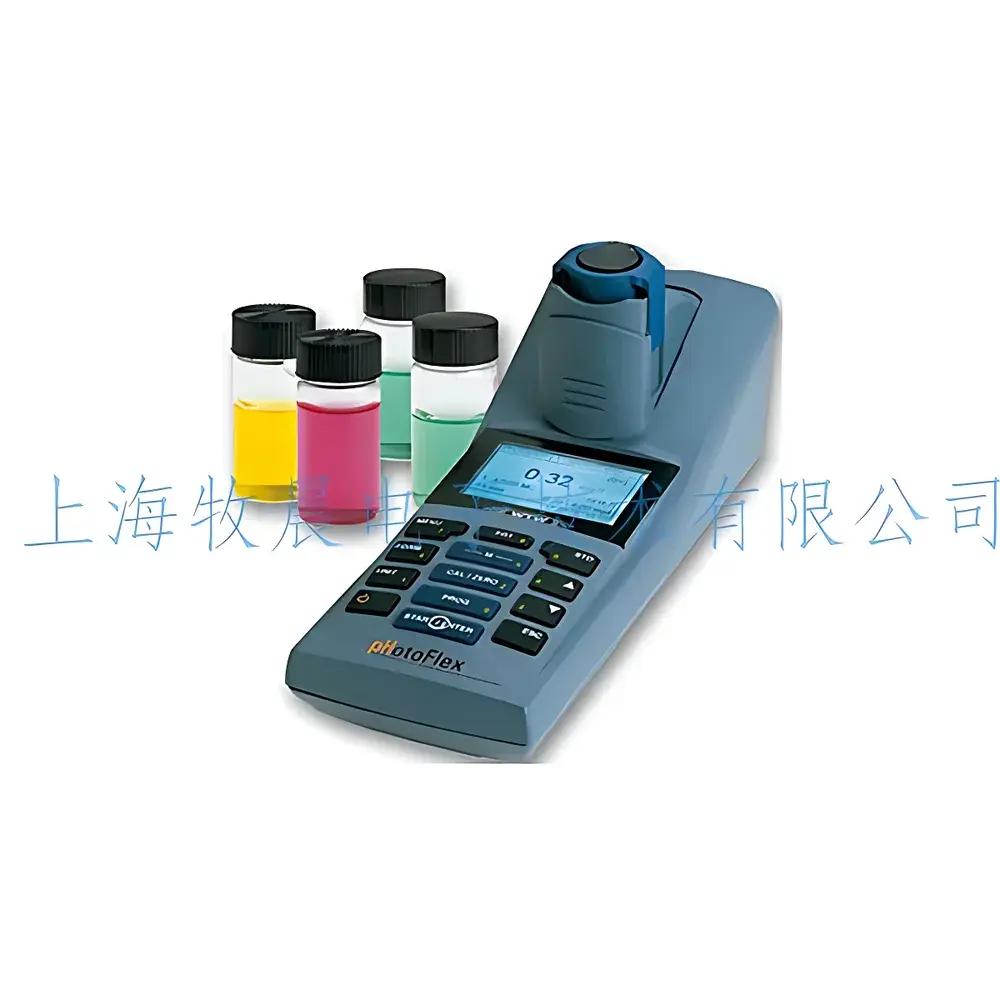
WTW pHotoFlex STD Portable Spectrophotometer
| Brand | WTW |
|---|---|
| Origin | Germany |
| Model | pHotoFlex STD |
| Wavelengths | 436, 517, 557, 594, 610, 690 nm |
| Wavelength Repeatability | ≤ 0.005 nm |
| Wavelength Accuracy | ±2 nm |
| Photometric Range | −2.000 A to +2.000 A |
| Protection Rating | IP67 |
| Dimensions | 236 × 86 × 117 mm |
| Weight | 0.6 kg (without batteries) |
| Power Supply | 4 × AA alkaline batteries (up to 3,000 measurements) |
| Data Storage | 100 measurement sets |
| Interface | RS232 |
| Software Upgrade | Free internet-based method updates |
| User-Defined Methods | Up to 50 |
| Built-in Calibration Curves | >140 pre-programmed for common water quality parameters |
Overview
The WTW pHotoFlex STD Portable Spectrophotometer is a field-deployable, LED-based photometric analyzer engineered for reliable, traceable quantitative analysis of water and wastewater samples in compliance with international standard methods. Operating on fixed-wavelength photometry—rather than scanning monochromators—the instrument utilizes six discrete high-stability LEDs at precisely defined wavelengths (436, 517, 557, 594, 610, and 690 nm), each optimized for specific colorimetric assays. This architecture ensures minimal spectral drift, high photometric reproducibility, and immunity to mechanical misalignment—critical attributes for unattended operation in variable environmental conditions. Designed for routine monitoring in municipal utilities, industrial effluent control, environmental field surveys, and emergency response, the pHotoFlex STD delivers laboratory-grade accuracy without requiring benchtop infrastructure. Its optical path accommodates both 16 mm and 28 mm round cuvettes, enabling flexibility across standardized test kits—including those conforming to DIN EN ISO 7888 (chlorine), DIN EN ISO 15681-1 (phosphate), and ASTM D1253 (residual chlorine).
Key Features
- Fixed-wavelength LED photometry with six factory-calibrated emission peaks ensuring long-term wavelength stability and eliminating lamp aging artifacts
- IP67-rated enclosure—fully dust-tight and submersible up to 1 m for 30 minutes—validated per IEC 60529 for use in harsh outdoor or wet-lab environments
- Integrated auto-zero function at power-on; no manual zeroing required prior to measurement
- Photometric range of −2.000 A to +2.000 A (equivalent to 0.01–150% transmittance), supporting both low-concentration trace analysis and high-absorbance turbid samples
- Onboard storage for 100 complete measurement records, each timestamped and including method ID, sample ID, and raw absorbance values
- RS232 serial interface compliant with EIA/TIA-232-F standards for direct connection to data loggers, printers, or PCs running Lsdata software
- Support for >140 preloaded calibration curves aligned with EPA, APHA, DIN, and ISO methods for parameters including free/total chlorine, nitrate, phosphate, COD (dichromate), iron, manganese, and ammonia
- Capacity for up to 50 user-defined calibration curves using generic reagents—enabling method validation under GLP or internal QA/QC protocols
Sample Compatibility & Compliance
The pHotoFlex STD accepts standard cylindrical glass or plastic cuvettes (16 mm and 28 mm diameters), compatible with widely available test kits from Hach, Merck, Palintest, and other ISO 17025-accredited suppliers. Its optical design minimizes stray light interference and maintains linearity across the full absorbance range, satisfying the photometric performance criteria outlined in ISO 8466-1 for calibration curve verification. While the device itself does not perform pH or turbidity measurements (unlike the pHotoFlex® pH or Turb variants), its photometric module complies with the essential requirements of Directive 2014/30/EU (EMC) and carries cETLus certification per UL 61010-1, confirming safety for use in North American and European regulated laboratories. All firmware and method updates are distributed via WTW’s secure web portal—ensuring traceability and version control in accordance with FDA 21 CFR Part 11 principles for electronic records.
Software & Data Management
Data export and method management are supported through WTW’s Lsdata desktop software (included with SET kits), which provides audit-trail-enabled data review, report generation (PDF/CSV), and batch calibration curve editing. The RS232 interface supports ASCII-based command protocols, allowing integration into custom SCADA or LIMS environments via standard terminal emulation. Firmware and analytical method libraries are updated remotely via HTTPS—each release signed with WTW’s digital certificate to prevent unauthorized modification. No cloud storage or telemetry is enabled by default; all data remain under user control unless explicitly exported. For field teams requiring extended deployment, optional rechargeable battery packs (RB Flex/430) and portable LabStation docking units (LS Flex/430) provide charging, data synchronization, and barcode-assisted sample logging—enhancing workflow integrity during multi-site campaigns.
Applications
The pHotoFlex STD is routinely deployed in applications demanding rapid, repeatable photometric quantification under non-laboratory conditions: routine chlorine residual monitoring at drinking water distribution points; nutrient screening (NO₃⁻-N, PO₄³⁻-P) in surface water bodies; COD determination in industrial pretreatment facilities; verification of disinfection byproduct formation potential; and emergency response testing following contamination events. Its robustness and battery endurance make it suitable for unpowered remote sites, mobile labs, and temporary field stations. Environmental consultants use it for baseline surveys and compliance reporting under EU Water Framework Directive Annex V or US Clean Water Act NPDES permit requirements—where documented method adherence and data traceability are mandatory.
FAQ
Does the pHotoFlex STD support wavelength scanning or only fixed-wavelength measurements?
It operates exclusively on fixed-wavelength LED photometry—six discrete wavelengths are hard-coded and cannot be scanned or tuned.
Can I validate my own calibration curves against reference standards?
Yes—up to 50 user-defined curves can be entered manually or imported via Lsdata; slope, intercept, and correlation coefficient are stored with each method.
Is the instrument compliant with FDA 21 CFR Part 11 for electronic records?
While the standalone device lacks electronic signature capability, its data export architecture and version-controlled method updates support Part 11 implementation when used within a validated LIMS or QA system.
What is the typical lifetime of the LED light sources?
LEDs are rated for ≥50,000 hours of operation—effectively exceeding the operational lifespan of the instrument under normal field use.
Are calibration standards included with the base unit?
No—calibration standards and reagents must be sourced separately; however, the device includes blank cuvettes and is compatible with certified reference materials traceable to NIST or BAM.





