
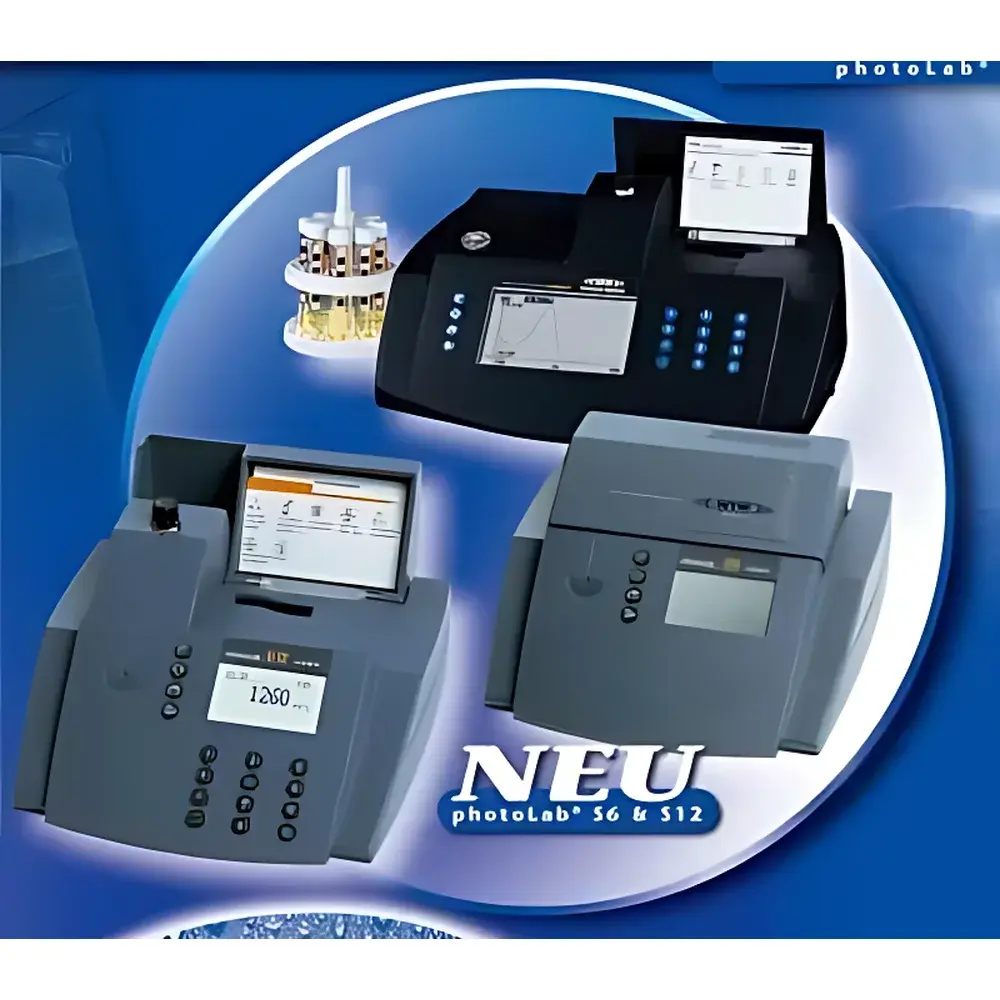
WTW PhotoLab® S6 / S12 / 6000 Series COD Analyzers – Advanced Photometric Chemical Oxygen Demand Analyzers for Laboratory and Field Use
| Origin | Imported |
|---|---|
| Type | Benchtop Laboratory Analyzer |
| Model | PhotoLab® S6, PhotoLab® S12, photoLab® 6000 Series |
| Measurement Principle | Rapid Digestion Photometry |
| Wavelength Range | 436 nm, 525 nm, 580 nm, 610 nm, 690 nm (S6) |
| Measurement Range | 0–1000 mg/L COD |
| Accuracy | ±5% of reading |
| Repeatability | ≤5% RSD |
| Detection Limit | 0.1 mg/L COD |
| Analysis Time | ≤30 min per batch |
| Batch Capacity | 15 samples |
| Cuvette Recognition | Automatic barcode-based identification for round and rectangular cuvettes (10 mm, 20 mm, 50 mm path lengths) |
| Compliance | Designed for ASTM D1252, ISO 6060, EN 1484, and US EPA Method 410.4 workflows |
Overview
The WTW PhotoLab® Series COD Analyzers are benchtop photometric instruments engineered for precise, rapid, and traceable determination of Chemical Oxygen Demand (COD) in water and wastewater samples. Based on standardized rapid digestion followed by spectrophotometric quantification—typically at 610 nm (for high-range) or 436 nm (for low-range)—these analyzers comply with internationally recognized methods including ISO 6060, ASTM D1252 (Method B), EN 1484, and US EPA Method 410.4. Unlike open-reflux titrimetric systems, the PhotoLab® platform integrates pre-validated digestion vials, fixed-wavelength optical detection, and reference-beam compensation to deliver reproducible results without manual calibration drift. The core architecture eliminates moving parts in the optical path—relying instead on high-stability interference filters and solid-state LED sources—ensuring long-term wavelength fidelity and minimal maintenance requirements across laboratory shifts or multi-year deployments.
Key Features
- Automatic cuvette recognition via integrated barcode scanner—supports both round (16 mm) and rectangular (10/20/50 mm path length) cuvettes, enabling seamless transition between standard vial kits and bulk reagent formats.
- AQA (Analytical Quality Assurance) framework with built-in instrument self-diagnosis, IQC (Instrument Quality Control) checks, and user-accessible validation protocols aligned with GLP and ISO/IEC 17025 documentation requirements.
- Dual-mode operation: pre-programmed method selection (e.g., “COD LR”, “COD HR”, “COD Ultra-Low”) and customizable method creation—including absorbance-to-concentration conversion curves, dilution factors, and unit normalization (mg/L, ppm, meq/L).
- Robust data integrity architecture: all measurements include timestamp, operator ID, cuvette ID, digestion lot number, and method version—supporting audit-ready export in CSV or XML format compatible with LIMS integration.
- PhotoLab® S12 and 6000 Series support dynamic spectral scanning (6000 only) and kinetic measurement modes—enabling method development for non-standard oxidizable organics or matrix-specific interferences.
Sample Compatibility & Compliance
The PhotoLab® analyzers accommodate a broad range of aqueous matrices: raw sewage, secondary effluent, drinking water sources, industrial process streams, and surface waters. All models accept standard 16-mm round vials (for pre-filled digestion tubes) and 10–50 mm rectangular cuvettes (for custom reagent preparation). Sample turbidity is compensated via dual-beam optics; chloride interference is mitigated through mercury-free digestion chemistry compliant with EU Directive 2000/60/EC. Instrument firmware includes method-specific validation reports required for ISO 17025-accredited laboratories and routine FDA 21 CFR Part 11 compliance when paired with WTW’s LabX® software (optional). Each system ships with traceable NIST-traceable calibration verification standards and documented uncertainty budgets per measurement range.
Software & Data Management
Data handling is governed by WTW’s LabX® Light software (included) and optional full LabX® Suite. LabX® Light enables local result review, PDF report generation with embedded method metadata, and USB-exported datasets with full audit trail (user actions, parameter changes, QC flagging). The full LabX® Suite adds role-based access control (administrator, analyst, reviewer), electronic signature support, automated backup to network drives, and direct interfacing with enterprise LIMS via HL7 or ODBC. All software modules maintain immutable records of method revisions, calibration history, and instrument error logs—satisfying ALCOA+ principles (Attributable, Legible, Contemporaneous, Original, Accurate, Complete, Consistent, Enduring, Available) for regulated environments.
Applications
These analyzers serve as primary COD measurement tools in municipal wastewater treatment plants (influent/effluent monitoring), drinking water utilities (source water screening), environmental testing laboratories (contract analysis per ISO 17025), academic research (kinetic studies of biodegradation), and industrial QA/QC labs (cooling tower, boiler feed, and discharge compliance). The PhotoLab® S6 suits intermittent testing workflows; the S12 supports high-throughput routine analysis with cost-efficient bulk reagents; the 6000 Series enables advanced method development, UV-Vis spectral deconvolution, and multi-parameter assays (e.g., nitrate + COD + phosphate in single run). pHotoFlex® portable variants extend this capability to field-deployed teams requiring concurrent pH, turbidity, and COD assessment under ISO 5667-3 field sampling protocols.
FAQ
What digestion protocol is required for PhotoLab® COD analysis?
Standardized 15-minute heated digestion using WTW-certified pre-filled vials (e.g., LCK 114, LCK 314) at 148 °C. No reflux apparatus or cooling step is needed.
Can I use third-party digestion reagents?
Only WTW-validated reagent kits ensure metrological traceability and method compliance. Non-certified reagents void AQA validation and may compromise accuracy.
Is method validation documentation provided?
Yes—each instrument ships with a Certificate of Conformance, method validation summary per ISO/IEC 17025 Annex A.1, and uncertainty budget templates for internal QA review.
How is data integrity ensured during power interruption?
All measurements are written to non-volatile memory before display; unsaved results persist through restart and auto-resume upon reboot.
Does the system support remote diagnostics or firmware updates?
Firmware updates are performed via USB drive with digital signature verification; remote diagnostics require optional WTW ServiceCloud subscription and TLS 1.2-secured connection.







