
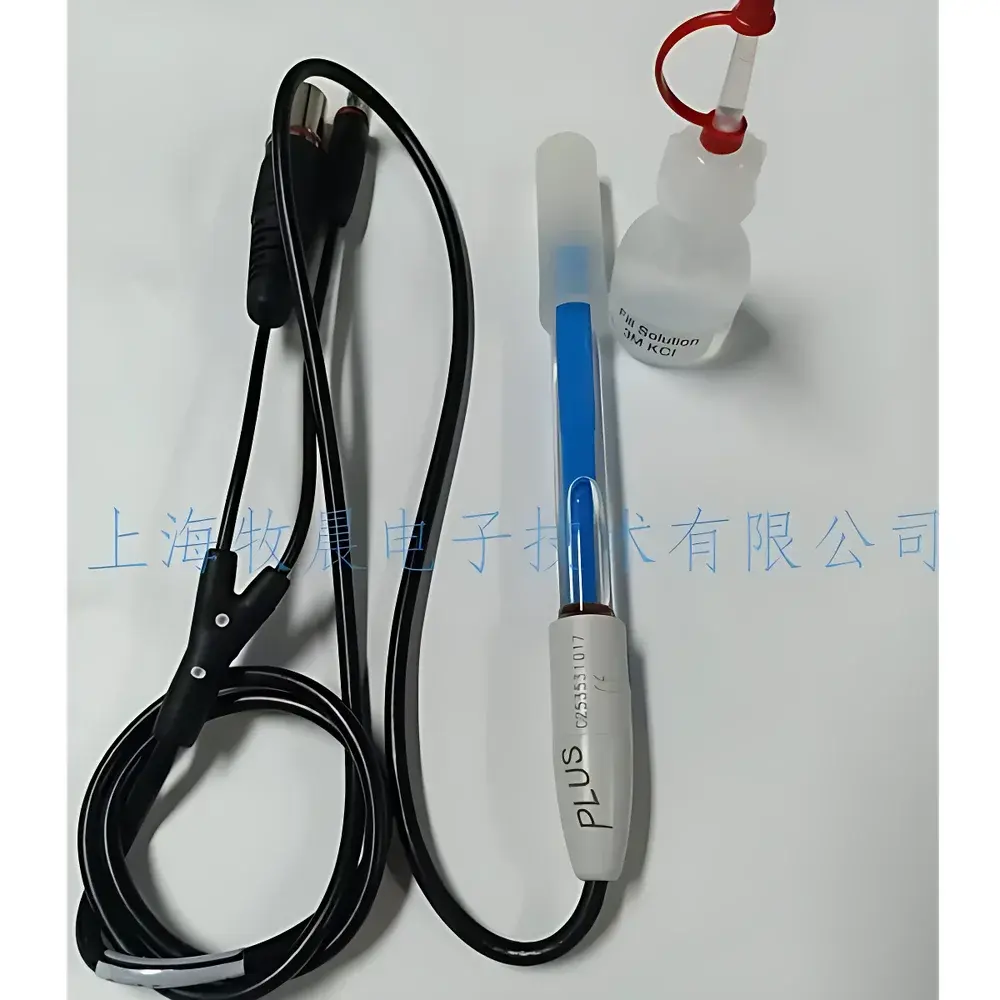
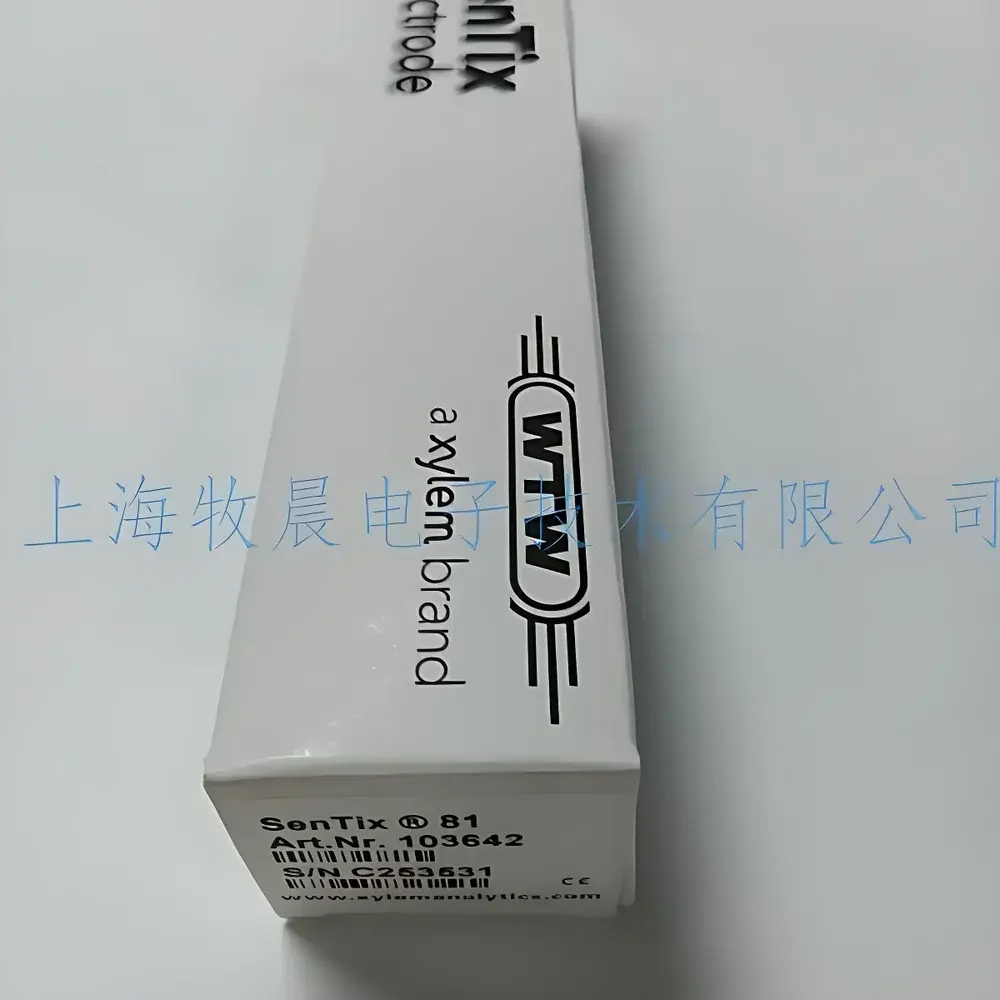
WTW SenTix 81 Glass pH Electrode
| Brand | WTW |
|---|---|
| Origin | Germany |
| Model | SenTix 81 |
| Measurement Range | 0–14 pH |
| Temperature Range | 0–100 °C |
| Reference Electrolyte | 3 M KCl, Ag⁺-free |
| Internal Buffer | pH 7.0 ± 0.25 |
| Glass Membrane Type | Conical, low-impedance |
| Membrane Impedance | 100 MΩ at 25 °C |
| Junction | Platinum wire |
| Electrode Body Material | Glass |
| Electrode Length | 120 ± 1 mm |
| Diameter | 12 ± 0.5 mm |
| Cable Length | 1 m |
| Connector Options | DIN or BNC |
| Integrated Temperature Sensor | NTC 30 kΩ |
Overview
The WTW SenTix 81 is a high-performance, conical-tip glass pH electrode engineered for precision and reliability in both laboratory and field applications. Designed according to classical potentiometric principles, it measures hydrogen ion activity via the Nernst potential developed across a pH-sensitive hydrated glass membrane relative to a stable internal reference system. Its low-impedance glass formulation enables rapid equilibration—particularly critical at sub-ambient temperatures—while maintaining electrochemical stability over extended use. The electrode integrates a built-in NTC temperature sensor (30 kΩ) for automatic temperature compensation (ATC), ensuring accurate pH readings across the full operational range of 0–100 °C. As part of WTW’s SenTix platform, the SenTix 81 complies with ISO 3696 (Grade 3 water), ASTM D1293 (pH of water), and supports GLP-compliant workflows when paired with WTW’s certified pH meters (e.g., Multi 3630, pH 3310, or portable pH 3110).
Key Features
- Conical glass membrane geometry optimized for immersion in small-volume samples, slurries, and semi-solid matrices—reducing response time and minimizing surface fouling.
- Low-impedance glass formulation (<100 MΩ at 25 °C) ensures stable signal output even at temperatures as low as 0 °C, eliminating drift commonly observed with standard high-impedance electrodes during cold-sample measurement.
- Ag⁺-free 3 mol/L KCl reference electrolyte prevents silver sulfide precipitation in sulfide-rich or proteinaceous samples—enhancing longevity and reproducibility in wastewater, food, and bioprocess applications.
- Platinum wire junction provides consistent electrolyte outflow rate across temperature gradients; unlike ceramic or wood-based junctions, it remains unblocked during thermal cycling or prolonged storage.
- Dual connector compatibility (DIN 19261 / BNC) allows seamless integration with WTW benchtop meters (e.g., pH 3310), portable units (e.g., pH 3110), and third-party analyzers meeting IEC 60651 or EN 61000-6-3 EMC standards.
- Rugged all-glass construction (12 mm diameter × 120 mm length) meets IP67-rated handling requirements when used with protective sleeves; shock-resistant design sustains repeated mechanical stress during routine field deployment.
Sample Compatibility & Compliance
The SenTix 81 demonstrates broad compatibility with aqueous matrices including drinking water, surface water, wastewater effluents, fermentation broths, dairy products, and pharmaceutical buffers. Its conical tip and open-junction architecture minimize clogging in samples containing suspended solids up to 5% w/v. For regulatory environments, the electrode supports 21 CFR Part 11–compliant data integrity when operated with WTW’s LabX® software-enabled instruments featuring electronic audit trails, user access control, and encrypted raw data logging. It conforms to ISO/IEC 17025:2017 clause 6.4.3 (equipment verification) and is validated per USP for pH measurement in non-aqueous and mixed-solvent systems when calibrated using traceable NIST SRM buffers.
Software & Data Management
When connected to WTW’s ecosystem—including the MultiLine® 3630 or pH 3310—the SenTix 81 enables automated calibration sequence execution (up to 5-point), slope/offset validation reporting, and real-time drift monitoring. All measurements are timestamped, sensor-ID-tagged, and stored with metadata (temperature, calibration history, operator ID). Raw mV and temperature values are exportable in CSV or XML format for LIMS integration. Firmware updates preserve metrological traceability, and calibration certificates include uncertainty budgets aligned with EURACHEM/CITAC Guide CG4.
Applications
- Environmental monitoring: Routine pH profiling in rivers, lakes, and wastewater treatment plants per EPA Method 150.1.
- Pharmaceutical QC: Final rinse water testing (USP ), buffer preparation verification, and stability-indicating assays.
- Food & beverage: Fermentation pH tracking in breweries and dairies; shelf-life studies requiring sub-0.02 pH unit repeatability.
- Academic research: Teaching labs emphasizing electrode theory, Nernst equation validation, and temperature-dependent kinetics.
- Industrial process control: Inline spot-checking of cleaning-in-place (CIP) solutions and chemical dosing verification.
FAQ
Is the SenTix 81 compatible with non-WTW meters?
Yes—provided the instrument accepts standard pH electrodes with either DIN or BNC connectors and supports external temperature input via NTC 30 kΩ.
What is the recommended storage solution?
Store upright in 3 M KCl solution; avoid distilled water or dry storage, which dehydrates the glass membrane and increases response time.
Can it be used for measuring pH in organic solvents?
Limited use only; performance degradation occurs in >20% v/v ethanol or acetonitrile—calibrate in matching solvent matrix and verify with secondary method (e.g., indicator titration).
How often should recalibration be performed?
Daily for regulated QC work; before each analytical batch in GLP environments; after exposure to extreme pH (12), high temperature (>80 °C), or proteinaceous media.
Does the electrode require maintenance beyond cleaning?
Yes—periodic junction cleaning with dilute HNO₃ (0.1 M) restores flow rate if clogging is suspected; membrane rehydration in pH 4 buffer for 2 hours recovers sluggish response.




