
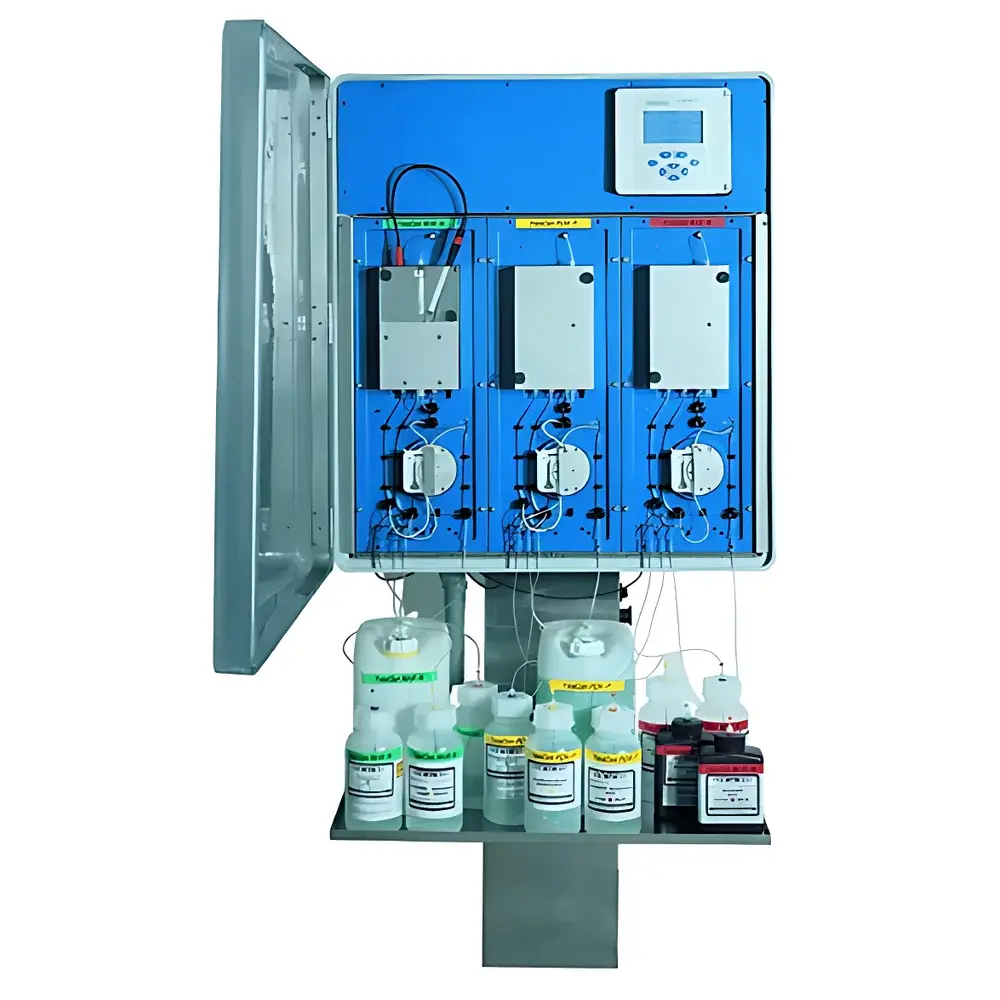
WTW TresCon A Online Multi-Parameter Water Quality Analyzer for Ammonia-N, Total Phosphorus, and Total Nitrogen
| Key | Origin: Imported |
|---|---|
| Manufacturer Type | Authorized Distributor |
| Model | TresCon A |
| Instrument Type | Online Water Quality Analyzer |
| Measured Parameters | Ammonia-N (NH₄⁺-N), Total Phosphorus (TP), Total Nitrogen (TN) |
| Module Capacity | Up to 3 Independent Analytical Modules |
| Compliance | Designed for ISO/IEC 17025-aligned operation, supports GLP/GMP data integrity requirements via audit-trail-enabled software |
| Communication | RS-485, Modbus RTU, optional analog 4–20 mA outputs and Ethernet/IP integration |
Overview
The WTW TresCon A is a modular, laboratory-grade online water quality analyzer engineered for continuous, high-reliability monitoring of key nutrient parameters—ammonia-nitrogen (NH₄⁺-N), total phosphorus (TP), and total nitrogen (TN)—in municipal wastewater treatment plants, industrial effluent streams, and surface water surveillance networks. Unlike single-parameter immersion sensors or benchtop analyzers requiring manual sampling, the TresCon A employs segmented wet-chemistry analysis based on standardized colorimetric methods (e.g., Nesslerization for ammonia, molybdenum blue for orthophosphate, and persulfate digestion followed by UV spectrophotometry for TN and TP). Each analytical module operates as an autonomous unit with integrated reagent delivery, reaction chamber temperature control, photometric detection, and waste management—ensuring metrological traceability and minimizing cross-contamination risk. The system’s architecture conforms to the functional safety principles outlined in IEC 61508 for process instrumentation, with fail-safe diagnostics embedded at both hardware and firmware levels.
Key Features
- Modular scalability: Supports up to three independent analytical modules—each physically and logically isolated—to enable concurrent measurement of NH₄⁺-N, TP, and TN from a single sample stream or distributed sampling points.
- Intelligent controller: Central processing unit features a 7-inch graphical LCD display, intuitive icon-based navigation, and context-sensitive prompts; automatically detects newly installed modules and restores prior calibration and configuration settings without manual reprogramming.
- AutoAdapt dynamic measurement scheduling: Adjusts sampling frequency in real time based on rate-of-change thresholds—reducing unnecessary reagent consumption while maintaining responsiveness during transient events (e.g., stormwater inflow).
- Integrated maintenance intelligence: Predictive alerts notify operators of upcoming consumable replacements (e.g., reagents, filters, tubing), cleaning cycles, or calibration due dates; all logs are timestamped and stored with user ID attribution.
- Color-coded fluidic architecture: Reagent bottles, peristaltic pump tubing, and connection ports use standardized color coding per DIN EN ISO 80000-10, minimizing misconnection errors during routine servicing.
- Robust environmental rating: Enclosure meets IP65 standards; designed for continuous operation in ambient temperatures ranging from 5 °C to 40 °C and relative humidity up to 90% non-condensing.
Sample Compatibility & Compliance
The TresCon A accepts raw or pre-filtered aqueous samples with suspended solids content ≤ 50 mg/L and turbidity < 100 NTU. It complies with core methodological references including ISO 7150-1 (ammonia), ISO 6878 (total phosphorus), and ISO 11905-1 (total nitrogen), and supports validation protocols aligned with EPA Method 350.1, ASTM D1426, and DIN 38405-D9. Its data handling architecture accommodates 21 CFR Part 11 compliance when paired with WTW’s optional LIMS-integrated software suite, providing electronic signatures, role-based access control, and immutable audit trails for calibration records, maintenance logs, and raw absorbance data.
Software & Data Management
The embedded firmware supports dual operating modes: standalone local control and networked supervisory operation via Modbus RTU or TCP/IP. All measurements—including raw photometric signals, temperature-compensated absorbance values, and calculated concentrations—are stored internally for up to 28 days with automatic rollover. Historical datasets can be exported in CSV format via USB or Ethernet. Optional WTW LabX Connect software enables remote firmware updates, batch calibration verification, and statistical process control (SPC) charting—including Shewhart X-bar/R charts for long-term stability assessment. System-generated reports include ISO/IEC 17025-compliant uncertainty statements derived from repeatability testing and reagent lot-specific calibration curves.
Applications
- Biological nutrient removal (BNR) process optimization in activated sludge systems—enabling real-time feedback control of internal recycle flows and carbon dosing.
- Compliance monitoring at wastewater discharge points subject to EU Urban Wastewater Treatment Directive (91/271/EEC) or U.S. NPDES permit limits for TN and TP.
- Source water quality trending in reservoirs and rivers where eutrophication risk assessment requires synchronized NH₄⁺-N, TP, and TN data.
- Industrial pretreatment verification for food processing, pharmaceutical, and chemical manufacturing facilities discharging to municipal sewers.
- Research-grade longitudinal studies requiring unattended, drift-corrected multi-parameter time-series acquisition over extended deployment periods.
FAQ
What sample preparation is required prior to analysis?
No filtration or centrifugation is mandatory if influent suspended solids remain below 50 mg/L. For higher-load applications, integration with WTW PurCon automated sampling and filtration units is recommended to ensure representative, clog-free sample delivery.
Can the TresCon A measure orthophosphate and nitrate separately within the same system?
Yes—by selecting OP210 (orthophosphate) and ON210 (nitrate) modules alongside the base controller, users configure a three-parameter system that measures PO₄-P, NO₃-N, and NH₄⁺-N simultaneously.
How does the system handle matrix interferences such as chloride or heavy metals?
Each module incorporates AutoKorr background compensation using dual-wavelength photometry and proprietary spectral deconvolution algorithms; additionally, built-in masking agents (e.g., tartaric acid for chloride interference in ammonia assays) are delivered automatically during reagent dosing.
Is remote diagnostic support available?
Yes—the controller supports modem-based dial-up connectivity for secure remote troubleshooting, firmware patching, and configuration backup/restore operations under ITAR-compliant encryption protocols.
What is the typical reagent consumption rate for continuous operation?
At standard 60-minute measurement intervals, annual reagent volume averages 18 L per module—optimized via programmable dilution factors and adaptive sampling logic to extend shelf life and reduce hazardous waste generation.
Related Products







