
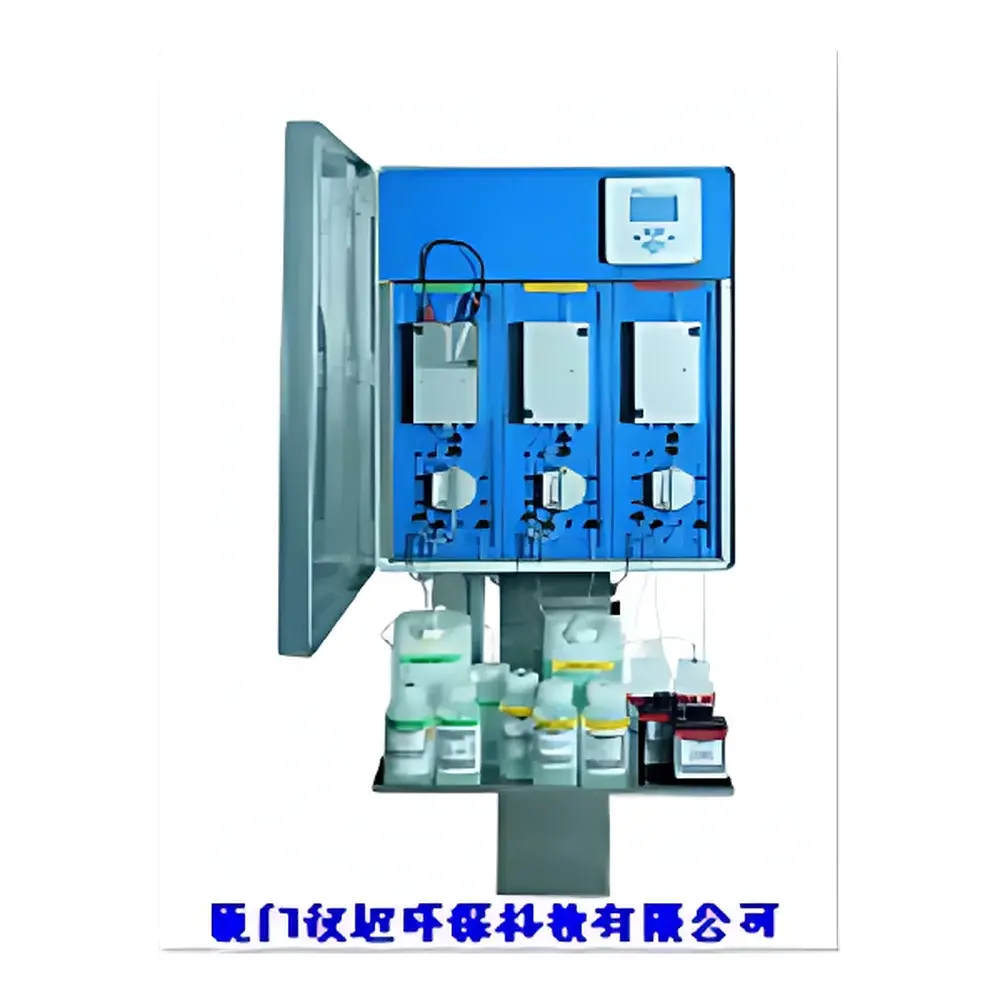
WTW TresCon Online Nitrogen and Phosphorus Analyzer
| Brand | WTW |
|---|---|
| Origin | Germany |
| Model | TresCon |
| Measurement Principles | Photometric (UV-Vis) with segmented flow analysis (SFA) |
| Operating Temperature | 0–40 °C |
| Storage Temperature | −25–60 °C |
| Power Supply | 230 VAC ±10%, 50 Hz or 115 VAC ±10%, 50–60 Hz |
| Max. Power Consumption | 480 W |
| Enclosure Rating | IP65 equivalent (PVC housing, stainless steel mounting frame) |
| Display | 240 × 128 pixel backlit graphic LCD |
| Analog Outputs | 3 isolated 4–20 mA |
| Digital Interfaces | RS232, RS485 |
| Certifications | CE, GS, DIN-GOST, IEC 61010-1, EN 50081-1, EN 50082-2 |
| Compliance | Designed for continuous operation in industrial wastewater, aquaculture, and municipal water monitoring per ISO 15681-1 (phosphate), ISO 11905-1 (nitrate/nitrite), and EPA Method 353.2 (total phosphorus) |
Overview
The WTW TresCon Online Nitrogen and Phosphorus Analyzer is a photometric, segmented flow analysis (SFA)-based continuous monitoring system engineered for reliable, long-term quantification of nitrogen- and phosphorus-containing species in aqueous environmental and process streams. It operates on the principle of colorimetric reaction detection—where target analytes (e.g., NH₄⁺-N, NO₃⁻-N, PO₄³⁻) react with specific reagents under controlled thermal and hydraulic conditions to form stable chromophores, whose absorbance is measured at defined wavelengths (typically 400–800 nm). The system integrates optical detection, precise fluidic control, and embedded thermal regulation into a single platform, enabling trace-level quantification without manual intervention. Designed for deployment in municipal wastewater treatment plants, agricultural runoff monitoring stations, aquaculture facilities, and industrial effluent discharge points, the TresCon meets the operational demands of unattended, 24/7 environmental compliance monitoring while maintaining analytical integrity across variable matrix conditions.
Key Features
- Modular architecture supporting up to three independently configurable analytical modules—enabling simultaneous, parallel measurement of multiple parameters (e.g., NH₄-N + NO₃-N + PO₄-P) within one instrument frame.
- Self-identifying hardware: Controller automatically detects installed modules and loads corresponding calibration curves, method protocols, and maintenance schedules—eliminating manual configuration errors.
- Integrated automation suite: AutoClean (periodic tubing/valve flushing), AutoCal (multi-point standard-based recalibration), AutoRead (peak-absorbance integration with baseline correction), AutoThermControl (Peltier-assisted temperature stabilization of reaction zones), AutoKorr (background absorbance compensation for turbid or colored samples), and AutoFlowControl (real-time pressure monitoring to detect blockages, leaks, or low reagent levels).
- Adaptive measurement logic: AutoAdapt dynamically adjusts sampling frequency based on concentration drift—increasing resolution during transient events and conserving reagent during stable conditions.
- Intuitive human-machine interface: 240 × 128 graphic LCD with backlight supports multi-parameter numeric display, time-series trend graphs (daily/weekly), status icons, and step-by-step maintenance guidance—all accessible via eight tactile membrane keys.
- Robust mechanical design: PVC enclosure (IP65-equivalent ingress protection), stainless steel wall-mount or floor-standing frame, color-coded fluidic connections (per DIN 47100), and vibration-resistant power input.
- Comprehensive diagnostics: Remote troubleshooting via modem-supported RS232/RS485; predictive maintenance alerts triggered by component aging models or performance deviation thresholds.
Sample Compatibility & Compliance
The TresCon is validated for use with raw and treated wastewater, surface water, groundwater, aquaculture recirculation streams, and agricultural drainage. Its segmented flow manifold minimizes cross-contamination and accommodates suspended solids up to 100 mg/L when paired with optional pre-filtration. Analytical modules comply with internationally recognized methods: PO₄-P per ISO 15681-1 (molybdenum blue), NO₃-N/NO₂-N per ISO 11905-1 (cadmium reduction + diazotization), NH₄-N per ISO 11732 (salicylate-hypochlorite), and TN/TP via persulfate UV digestion followed by photometric detection—aligned with EPA Methods 353.2 and 365.3. The system’s architecture supports GLP/GMP-aligned data integrity: all calibrations, measurements, alarms, and maintenance logs are timestamped and stored locally for ≥28 days, with full audit trail capability for regulatory review.
Software & Data Management
The embedded firmware provides native support for analog output mapping (three isolated 4–20 mA channels), Modbus RTU over RS485, and ASCII protocol over RS232—enabling seamless integration into SCADA, DCS, or LIMS environments. Data logging includes raw absorbance values, calculated concentrations, QC flag indicators (e.g., “low signal,” “calibration expired”), and diagnostic codes. All stored records are exportable via serial dump or USB memory stick (optional). While no proprietary PC software is required for basic operation, WTW’s *LabX* connectivity module (sold separately) enables remote configuration, firmware updates, and centralized fleet management—fully compliant with FDA 21 CFR Part 11 requirements for electronic records and signatures when deployed with appropriate validation documentation.
Applications
- Municipal wastewater treatment: Real-time monitoring of nitrification/denitrification efficiency at bioreactor inlets/outlets and final effluent discharge points.
- Aquaculture process control: Continuous tracking of NH₄-N and NO₂-N to prevent acute toxicity in recirculating aquaculture systems (RAS).
- Agricultural runoff assessment: Quantification of nutrient leaching from fertilized fields into adjacent waterways—supporting Total Maximum Daily Load (TMDL) reporting.
- Industrial pretreatment verification: Compliance assurance for food processing, textile, and chemical manufacturing facilities discharging nitrogen- or phosphorus-rich effluents.
- Research-grade environmental monitoring: Long-term trend analysis in mesocosms, constructed wetlands, and limnological field stations where reagent stability and measurement reproducibility are critical.
FAQ
What analytes can the TresCon measure simultaneously?
Up to three parameters from the following list: NH₄-N, NO₃-N, NO₂-N, PO₄-P, Total Phosphorus (TP), and Total Nitrogen (TN). Module combinations are user-selectable at installation.
Does the system require daily operator intervention?
No. With AutoClean, AutoCal, and AutoFlowControl enabled, scheduled maintenance intervals extend to 1–3 months depending on sample matrix and reagent consumption rate.
Is the TresCon suitable for outdoor installation?
Yes—when mounted in its standard wall or floor bracket and operated within the specified 0–40 °C ambient range. Optional sunshade and climate-controlled enclosures are available for extreme environments.
How is calibration traceability ensured?
Each module accepts certified reference materials traceable to NIST or BAM standards. Calibration curves are stored with metadata (date, operator ID, standard lot number) and subject to automatic validity checks.
Can historical data be exported for regulatory submission?
Yes. All logged parameters—including timestamps, QC flags, and diagnostic events—are exportable as CSV or ASCII files compatible with regulatory reporting formats (e.g., EPA Net, EU Water Framework Directive portals).





