
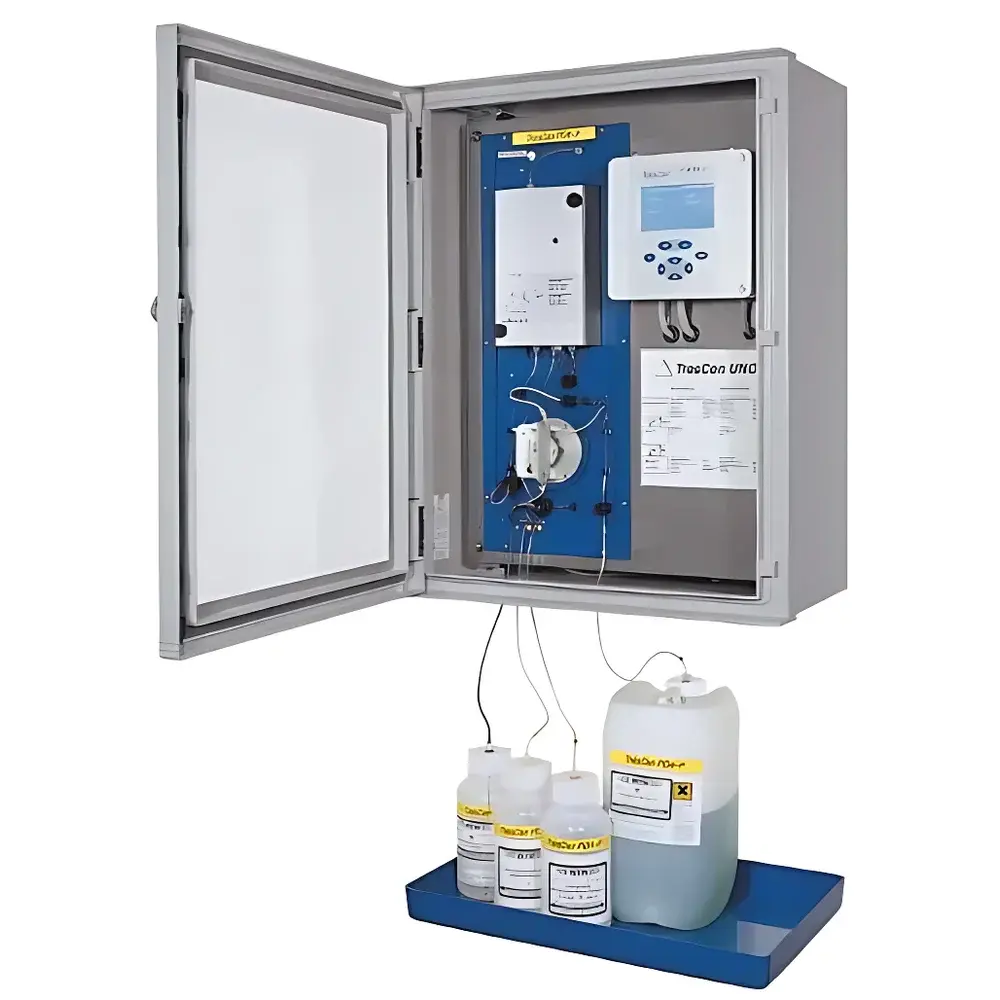
WTW TresCon Uno A111 Online Ammonia Nitrogen Analyzer
| Brand | WTW |
|---|---|
| Origin | Imported |
| Manufacturer Type | Authorized Distributor |
| Instrument Type | Online Analyzer |
| Measurement Principle | Ammonia Gas-Sensing Electrode (NH₃-Selective Electrode) |
| Measurement Range | 0.05–1000 mg/L NH₄–N (dual-range: low range 0.05–10 mg/L, high range 0.1–1000 mg/L) |
| Accuracy | ±5% of reading |
| Detection Limit | 0.05 mg/L NH₄–N |
| Analysis Time | ≤3 minutes per sample |
| Sample Throughput | 3 samples per cycle |
| Compliance | Designed for continuous operation in EPA-compliant and ISO 5667-3 / ISO 15839 environmental monitoring applications |
Overview
The WTW TresCon Uno A111 Online Ammonia Nitrogen Analyzer is a dedicated, single-channel automated system engineered for reliable, real-time quantification of ammonium nitrogen (NH₄–N) in aqueous environmental matrices. It operates on the well-established ammonia gas-sensing electrode principle—a selective potentiometric method compliant with ISO 14253-1 and widely referenced in ASTM D1426 and EN 25663 for wastewater and surface water analysis. The instrument integrates a compact TresCon Uno central controller with the OA110 ammonia-specific analysis module, enabling autonomous operation without manual intervention. Upon sample introduction, the system automatically adjusts pH to >12 using sodium hydroxide reagent, converting all ammonium ions (NH₄⁺) quantitatively to dissolved ammonia gas (NH₃). A chelating agent (e.g., EDTA) is simultaneously dosed to sequester interfering metal cations and prevent precipitation—critical for long-term stability in municipal and industrial effluent streams. The liberated NH₃ diffuses across a hydrophobic PTFE membrane into the internal electrolyte of the gas-sensitive electrode, inducing a measurable pH shift proportional to NH₃ partial pressure. This analog signal is digitized, temperature-compensated (via integrated Pt100 sensor), and converted to NH₄–N concentration using Nernstian calibration curves traceable to certified reference materials.
Key Features
- Modular architecture: TresCon Uno host + OA110 ammonia module—field-expandable to multi-parameter configurations (e.g., NO₃⁻, PO₄³⁻) via future module integration
- True online operation: Continuous sampling, automatic zero/span calibration, and self-diagnostic routines reduce operator dependency
- Dual-range measurement capability: Low-range mode (0.05–10 mg/L) optimized for drinking water and sensitive ecological monitoring; high-range mode (0.1–1000 mg/L) suited for activated sludge return lines and industrial discharge points
- Robust fluidic design: Corrosion-resistant wetted parts (PP, PTFE, glass) ensure longevity in aggressive wastewater environments
- Integrated temperature compensation: Real-time correction based on Pt100 sensor embedded in flow cell, minimizing thermal drift
- Compliance-ready data handling: Audit-trail logging, user-access levels, and timestamped event records support GLP/GMP and EPA Method 350.1 documentation requirements
Sample Compatibility & Compliance
The TresCon Uno A111 is validated for use with raw sewage, secondary effluent, surface water (rivers, lakes), groundwater, and treated drinking water sources. It tolerates suspended solids up to 100 mg/L (with optional inline filtration) and chloride concentrations ≤5,000 mg/L without significant interference. The system meets ISO 15839:2007 (Water quality — Specifications for on-line analyzers for water quality monitoring) for performance verification and is compatible with regulatory frameworks requiring continuous emission monitoring (CEMS) under EU Directive 2000/60/EC (Water Framework Directive) and U.S. Clean Water Act §402 NPDES permit conditions. All reagents—including NaOH, EDTA, and buffer solutions—are supplied as pre-formulated, shelf-stable kits conforming to CLP/GHS labeling standards.
Software & Data Management
The embedded TresCon Control Software (v4.x) provides intuitive web-based configuration via Ethernet or RS485 Modbus RTU interface. It supports scheduled calibration (daily/weekly), dynamic range switching, and alarm thresholds configurable per parameter. Raw sensor output, calculated NH₄–N values, reagent consumption logs, and maintenance alerts are stored locally for ≥90 days and exportable as CSV or XML. For enterprise-level integration, the analyzer complies with OPC UA and MQTT protocols, enabling seamless ingestion into SCADA systems (e.g., Siemens Desigo, Schneider EcoStruxure) and cloud platforms (AWS IoT Core, Microsoft Azure IoT Hub). All electronic records adhere to FDA 21 CFR Part 11 requirements through digital signature enforcement, role-based access control, and immutable audit trails.
Applications
- Real-time monitoring at wastewater treatment plant influent, bioreactor zones, and final effluent discharge points
- Automated compliance reporting for municipal utilities subject to ammonia limits under national discharge permits
- Early-warning detection of nitrification failure in activated sludge systems
- Long-term trend analysis in river basin monitoring networks (e.g., Danube, Rhine, Yangtze)
- Integration into smart irrigation systems for reclaimed water reuse schemes
- Research-grade kinetic studies of ammonium oxidation in pilot-scale MBRs and constructed wetlands
FAQ
What sample pretreatment is required prior to analysis?
No filtration or centrifugation is needed for typical wastewater samples; however, an optional 100-µm inline filter is recommended for highly turbid or fiber-laden influents.
How frequently must the ammonia electrode be replaced?
Under standard operating conditions (24/7 operation, pH >12 exposure), the gas-sensing electrode maintains stable response for ≥6 months; replacement intervals are tracked automatically in the maintenance log.
Can the TresCon Uno A111 be interfaced with existing PLC-based control systems?
Yes—native Modbus RTU support allows direct integration with Allen-Bradley, Siemens S7, and Mitsubishi FX series PLCs without gateway hardware.
Is the system suitable for seawater or brackish water applications?
While not designed for full-strength seawater (>35 g/L salinity), it performs reliably in estuarine environments with salinity up to 15 g/L when calibrated with matrix-matched standards.
Does the analyzer meet requirements for certified environmental monitoring under ISO/IEC 17025?
When operated within its specified environmental conditions (10–40°C ambient, <80% RH), and paired with accredited calibration services, the system fulfills technical competence criteria for routine testing laboratories per ISO/IEC 17025:2017 Clause 7.2.2.
Related Products







