
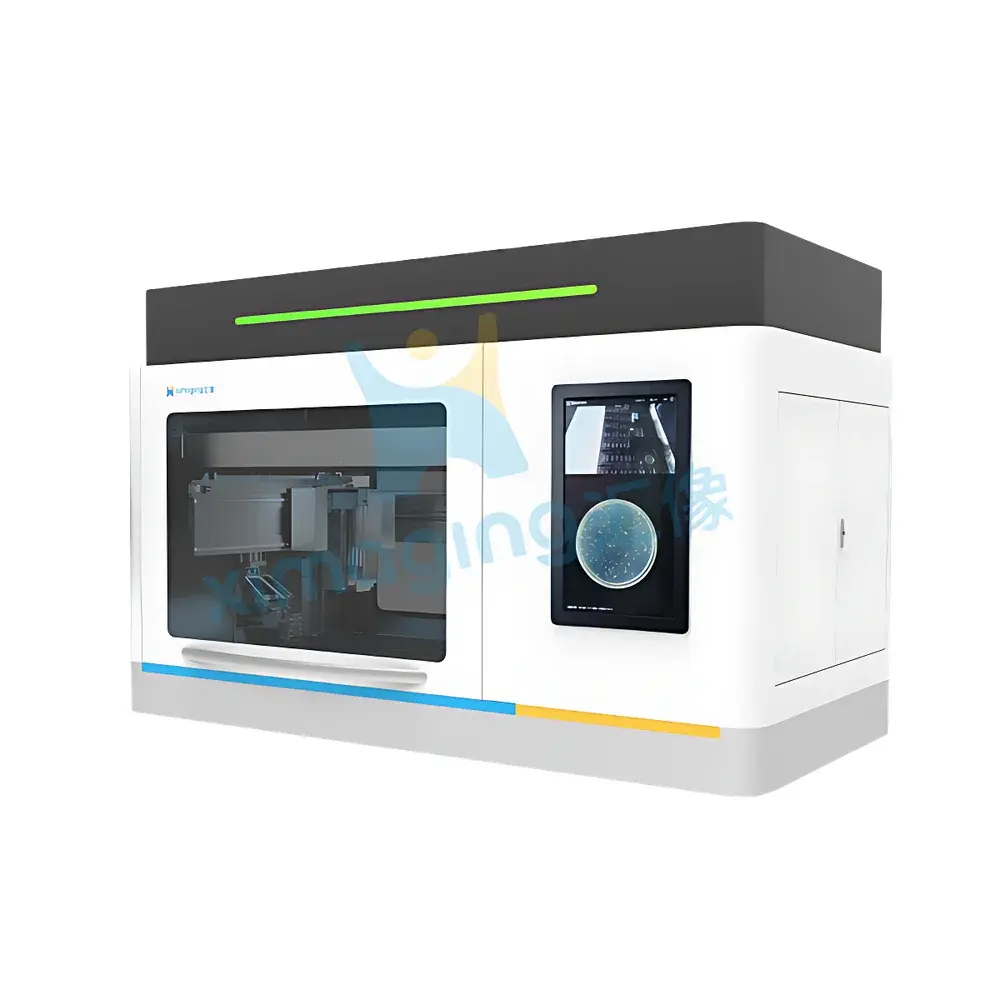
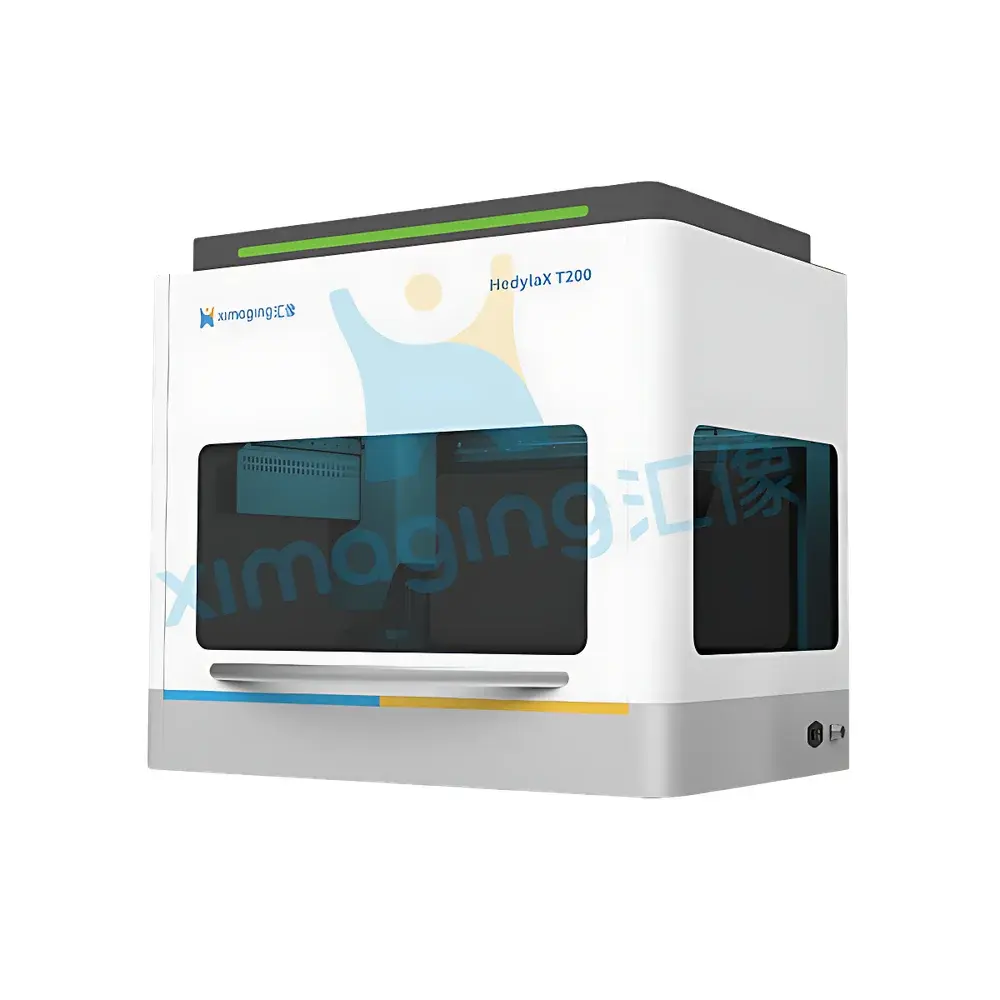
X-Imaging HedylaX Intelligent Microbial Colony Picking Workstation
| Brand | X-Imaging |
|---|---|
| Origin | Shanghai, China |
| Manufacturer Type | Original Equipment Manufacturer (OEM) |
| Country of Origin | China |
| Model | X-Imaging HedylaX |
| Inoculation Modes | Solid-to-Liquid, Solid-to-Solid, Liquid-to-Solid, Liquid-to-Liquid |
| Colony Picking Accuracy | ≥98% (for colonies ≥1 mm in diameter) |
| Positioning Precision | ±0.15 mm (XY stage), ±0.05 mm (Z-axis) |
Overview
The X-Imaging HedylaX Intelligent Microbial Colony Picking Workstation is an integrated automation platform engineered for high-fidelity, traceable colony isolation and inoculation in microbiological and synthetic biology workflows. Leveraging a triad of core technologies—AI-powered computer vision, precision liquid handling, and closed-loop motion control—the system performs fully automated colony detection, selection, picking, and transfer across diverse inoculation configurations. Its operational principle relies on high-resolution monochrome imaging (≥5 MP, LED-lit top-down illumination), real-time morphological segmentation using convolutional neural networks trained on >10⁴ annotated colony images, and deterministic robotic arm navigation with sub-millimeter repeatability. Designed to replace manual colony picking under laminar flow hoods, the HedylaX eliminates inter-operator variability, reduces biosafety risks associated with repetitive pipetting, and embeds full digital provenance at every step—from plate image capture to destination well assignment.
Key Features
- AI-driven colony recognition engine supporting multi-class morphology classification (e.g., circular, irregular, mucoid, filamentous) with ≥98% recall for colonies ≥1 mm diameter under standard agar thickness (3–4 mm) and lighting conditions.
- Non-contact, single-use sterile disposable tips (96-well format compatible) mounted on a temperature-controlled gripper module; tip ejection and loading executed automatically without operator intervention.
- Multi-mode inoculation capability: solid-to-liquid (colony → broth), solid-to-solid (colony → agar plate), liquid-to-solid (glycerol stock → plate), and liquid-to-liquid (culture → microtiter well), each configurable via protocol editor.
- Dynamic plating patterns including spiral, grid, Z-pattern, and concentric “回”-shaped streaking—programmable per destination plate with adjustable stroke density and overlap ratio.
- Integrated barcode scanner and thermal label printer enabling bidirectional traceability: source plate ID, picked colony coordinates, timestamp, operator ID (if logged), and destination location are embedded in machine-readable metadata.
- Dual-platform scalability: HedylaX T200 (single-arm, 120 colonies/hour throughput) and HedylaX T800 (octo-arm, 800 colonies/hour, synchronized parallel processing).
Sample Compatibility & Compliance
The HedylaX accommodates standard SBS-compliant consumables—including 60 mm, 90 mm, and 150 mm Petri dishes; 96-, 384-, and 1536-well plates; deep-well reservoirs; and custom tip boxes—without mechanical adaptation. All fluidic pathways are chemically inert (fluoropolymer-coated stainless steel and PEEK), validated for compatibility with common microbiological reagents (LB, SOC, TB, glycerol stocks, antibiotics, dyes). The system meets ISO 13485 design control requirements for IVD-adjacent instrumentation and supports GLP/GMP-aligned audit trails: full event logging (image timestamps, motor encoder values, tip usage counters, error codes), user authentication (LDAP integration optional), and electronic signature-ready export (CSV/JSON/XML) compliant with FDA 21 CFR Part 11 Annex 11 expectations.
Software & Data Management
HedylaX Control Suite v3.2 is a Windows-based application featuring a modular architecture: Vision Module (real-time colony detection and confidence scoring), Protocol Studio (drag-and-drop workflow builder with conditional logic and parameter validation), and TraceLog Manager (relational database backend with SQLite or SQL Server options). All acquired images are stored with EXIF metadata (exposure time, gain, lens focus position); raw pixel data and processed masks are retained by default. Data exports support FAIR principles—each colony pick generates a unique UUID linked to source image hash, coordinate transform matrix, and instrument calibration certificate ID. Optional cloud sync enables cross-site collaboration while maintaining on-premise data sovereignty.
Applications
- Synthetic biology strain construction: high-throughput isolation of CRISPR-edited clones from transformation plates with phenotypic filtering (e.g., colorimetric reporters, halo assays).
- Industrial bioprospecting: screening of environmental isolates for enzyme activity, solvent tolerance, or thermostability across multi-plate arrays.
- Antimicrobial resistance (AMR) profiling: automated sub-culturing from inhibition zone edges into gradient plates for MIC determination.
- Microbial library curation: deconvolution of pooled mutant libraries (e.g., transposon insertion, barcoded knockouts) with spatial mapping to original array positions.
- QC/QA in biopharma: verification of monoclonality in master cell bank derivation per ICH Q5D and USP <1043>, with image-based evidence archived for regulatory submission.
FAQ
Does the HedylaX require pre-calibration for different agar types or plate brands?
No. The AI vision module auto-adjusts contrast and segmentation thresholds based on real-time histogram analysis of each captured image; no manual thresholding or plate-specific calibration is needed.
Can the system integrate with LIMS or ELN platforms?
Yes. RESTful API endpoints support bidirectional communication with major LIMS (e.g., LabVantage, Thermo Fisher SampleManager) and ELNs (e.g., Benchling, LabArchives) via JSON payloads containing pick events, plate IDs, and image URIs.
What maintenance is required for long-term reliability?
Daily: tip waste bin emptying and optical window wipe. Quarterly: stage belt tension check and camera focus verification using NIST-traceable calibration target. No consumable fluids or lubricants are used in the motion system.
Is remote monitoring supported?
Yes. Web-based dashboard (HTTPS/TLS 1.2+) provides live camera feed, queue status, error logs, and throughput KPIs; accessible via corporate VPN or zero-trust network architecture.
How is colony size accuracy validated during installation qualification (IQ)?
A certified 10-point polystyrene bead grid (diameters 0.5–3.0 mm, NIST SRM 1963) is imaged and analyzed; system reports measured vs. nominal diameters with ≤±0.08 mm deviation at 95% confidence level.
Related Products




