
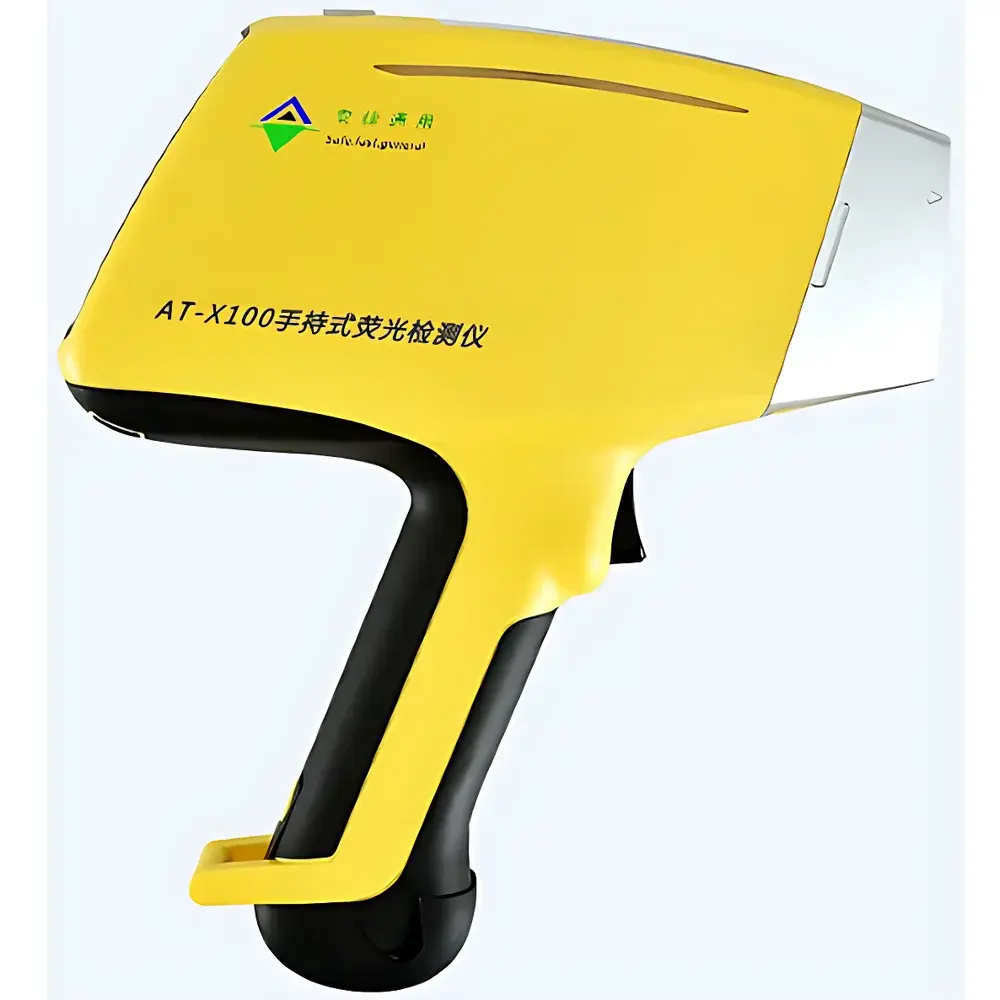
AT-X100 Handheld Energy Dispersive X-Ray Fluorescence Spectrometer by Safe
| [Brand | Safe |
|---|---|
| Origin | Beijing, China |
| Manufacturer Type | Direct Manufacturer |
| Model | AT-X100 |
| Portability | Handheld / Field-Deployable |
| Elemental Range | Mg to U |
| Quantification Range | 1 ppm – 99.99% (w/w) |
| Repeatability | ≤ 0.1% RSD |
| Detector Options | Si-Pin or SDD (Selectable) |
| Compliance | Designed for field-deployable environmental screening per EPA Method 6200, ASTM D7298, and China’s HJ 1003–2018] |
Overview
The AT-X100 Handheld Energy Dispersive X-Ray Fluorescence (ED-XRF) Spectrometer is an engineered solution for rapid, on-site elemental analysis of heterogeneous environmental matrices—particularly soils, sediments, sludges, dusts, filters, and solid waste. Operating on the principle of energy-dispersive X-ray fluorescence, the instrument excites sample atoms using a miniaturized X-ray tube; characteristic secondary X-rays emitted from elements Mg through U are resolved by a solid-state detector and quantified via fundamental parameter (FP) algorithms calibrated against certified reference materials (CRMs). Unlike laboratory-based wavelength-dispersive systems, the AT-X100 prioritizes field robustness, operational simplicity, and regulatory alignment—enabling real-time decision support during site investigations, remediation verification, and RCRA-related compliance screening without sample digestion or lab turnaround delays.
Key Features
- Compact ergonomic design: Weighing under 1.5 kg with balanced center-of-gravity for extended handheld operation in variable terrain and weather conditions.
- One-button acquisition: Initiated via trigger actuation; spectral collection completes in 1–10 seconds depending on required detection limits and matrix complexity.
- Dual detector configuration: Standard Si-Pin detector optimized for routine screening; optional high-resolution silicon drift detector (SDD) available for improved peak separation and lower detection limits (LODs) in complex multi-element matrices.
- Non-destructive testing (NDT): No sample preparation required—analysis performed directly on solids, powders, pastes, or filter media without grinding, pressing, or acid digestion.
- Real-time quantification engine: Delivers simultaneous reporting of element concentrations in both weight percent (to three decimal places) and parts-per-trillion/million (ppm/ppb) units, traceable to NIST-traceable CRMs.
- Embedded calibration management: Supports user-defined calibrations for site-specific matrices (e.g., clay-rich soil, slag-contaminated ash), automatic drift correction, and hardware diagnostics accessible via touchscreen interface.
Sample Compatibility & Compliance
The AT-X100 accommodates diverse physical forms encountered in environmental fieldwork—including granular soils, wet slurry filtrates, airborne particulate filters, thin-film coatings, and heterogeneous waste fragments. Its analytical performance meets method requirements for EPA Method 6200 (Field Portable XRF Screening for Metals), ASTM D7298 (Standard Practice for Field Screening of Soils Using Portable XRF), and China’s HJ 1003–2018 (Technical Specification for Field Screening of Heavy Metals in Soil Using Portable XRF). While not intended for final regulatory reporting without confirmatory lab analysis, it satisfies Tier 1 screening criteria for rapid delineation of contamination boundaries, hotspot identification, and triage prioritization prior to composite sampling. Instrument firmware includes audit-ready logging of operator ID, GPS coordinates, timestamp, measurement duration, and detector voltage/current settings—supporting GLP-aligned data integrity workflows.
Software & Data Management
The embedded Android-based operating system runs Safe’s proprietary XRF Manager software, enabling full remote control via Wi-Fi or Bluetooth from tablets or laptops. All spectra, quantitative results, metadata (including photo capture, location tagging, and operator notes), and calibration logs are exportable in standardized formats: CSV for statistical processing, PDF for field reports, and native .XRF binary files for reprocessing with advanced FP or empirical calibration models. The software enforces 21 CFR Part 11–compatible electronic signatures for critical actions (e.g., calibration validation, report generation), maintains immutable audit trails of all parameter changes, and supports secure cloud synchronization with enterprise LIMS integration via RESTful API.
Applications
- Rapid assessment of RCRA-listed metals (As, Ba, Cd, Cr, Pb, Hg, Se, Ag) and priority pollutants (Ni, Co, Mn, Zn, Cu) in soil and sediment at brownfield sites, landfills, and industrial facilities.
- Real-time mapping of contamination plumes in surface water sediments and wastewater treatment residuals.
- Verification of remediation endpoints during excavation and backfill operations—reducing over-digging and disposal costs.
- Screening of airborne particulates collected on Teflon filters for occupational exposure assessments (e.g., mining, smelting, battery recycling).
- Supporting epidemiological studies linking environmental metal exposure (e.g., As in groundwater-irrigated fields, Mn in industrial zones) to public health surveillance programs.
FAQ
Is the AT-X100 compliant with ISO/IEC 17025 or CLIA standards for accredited testing?
No—the AT-X100 is designed for field screening and qualitative/semi-quantitative triage, not for definitive compliance testing requiring accredited laboratory validation.
Can it analyze liquids or slurries directly?
Yes—when stabilized in a low-background sample cup or filtered onto a polypropylene membrane, aqueous suspensions and digested extracts may be measured with appropriate calibration and matrix-matched standards.
What safety certifications does the instrument hold?
It complies with IEC 61010-1 (electrical safety), IEC 62471 (LED/X-ray radiation safety), and carries CE marking for electromagnetic compatibility (EMC) and RoHS conformity.
Does the instrument require annual recalibration by the manufacturer?
No—users may perform daily verification checks using supplied check standards; full recalibration is recommended biannually or after significant mechanical impact, and can be executed in-house using CRM sets.
How is data integrity ensured during offline field use?
All measurements are time-stamped, geotagged, and cryptographically hashed upon acquisition; local storage retains full spectral archives for ≥10,000 analyses, synchronized automatically upon network reconnection.
Related Products





