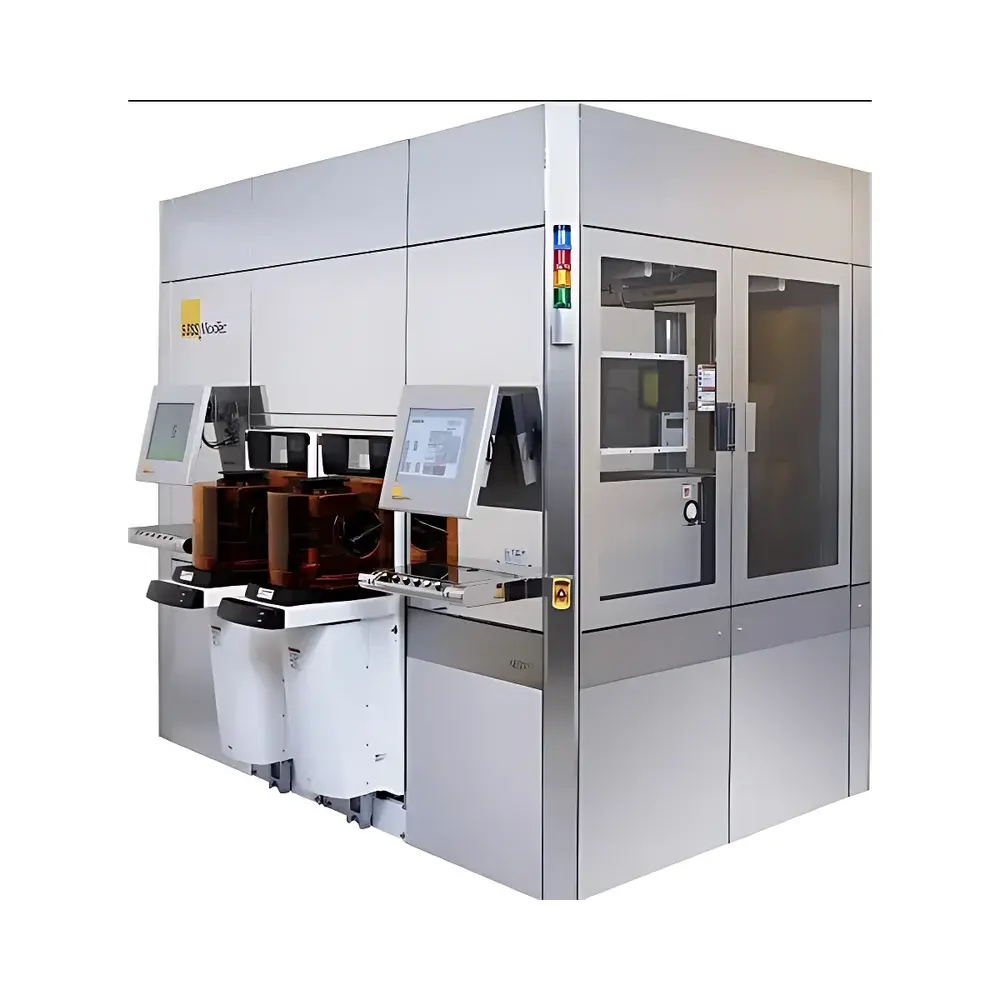
XBS300 Temporary Bonding System by SUSS MicroTec
| Brand | SUSS MicroTec |
|---|---|
| Origin | Germany |
| Model | XBS300 |
| Application | Temporary bonding for 200 mm and 300 mm wafers |
| Substrate Compatibility | Silicon, glass carrier substrates (same or different diameters) |
| Alignment Method | Edge recognition + center alignment with GYRSET® technology |
| Coating Uniformity | Optimized via integrated non-contact multi-point thickness measurement |
| Process Steps Supported | Release layer deposition, adhesive spin-coating, low-force wafer bonding, UV or thermal curing, post-bond cooling |
| Platform Architecture | Modular, scalable throughput, minimized footprint |
| Adhesive Compatibility | Open platform supporting all commercially available temporary bonding adhesives |
| Compliance Context | Designed for semiconductor mask & reticle manufacturing environments compliant with ISO 14644-1 Class 5 cleanroom requirements and compatible with GLP/GMP-aligned process documentation workflows |
Overview
The XBS300 Temporary Bonding System is a high-precision, production-grade platform engineered by SUSS MicroTec for temporary wafer bonding in advanced mask and reticle manufacturing. It operates on the principle of controlled mechanical lamination under precisely regulated force, temperature, and alignment conditions—enabling reversible bonding between device wafers and carrier substrates (e.g., silicon or glass) during thin-wafer handling, grinding, polishing, and etching processes. Unlike permanent bonding systems, the XBS300 is specifically optimized for low-stress, high-yield temporary adhesion—ensuring minimal residual stress, no interfacial voids, and full reversibility without damage to patterned surfaces. Its architecture supports both 200 mm and 300 mm substrate formats, making it suitable for high-volume photomask fabrication lines where throughput, reproducibility, and process traceability are critical.
Key Features
- Modular process configuration: Supports independent integration of release layer coater, adhesive dispense/spin module, precision bond chamber, UV curing station, and thermal cure/cooling stage.
- GYRSET® alignment technology: Combines edge detection and center alignment to achieve sub-5 µm overlay accuracy between device and carrier wafers—even when substrate diameters differ (e.g., 300 mm device wafer on 200 mm carrier).
- Non-contact, multi-point thickness metrology: Integrated optical sensors measure adhesive film uniformity across the full wafer surface prior to bonding—enabling real-time feedback and closed-loop process control.
- Low-force bonding actuation: Hydraulic-pneumatic hybrid pressure control ensures bonding forces below 10 kN, minimizing risk of pattern deformation or cracking in fragile photomask blanks.
- Cleanroom-optimized mechanical design: Fully enclosed chamber with ISO 14644-1 Class 5 compatibility; stainless steel construction; ESD-safe components; and vacuum-integrated chucking for particle-free substrate handling.
- Open materials platform: Certified compatibility with industry-standard temporary adhesives including acrylics (e.g., NOA81), polyimides, and thermally cleavable polymers—validated per manufacturer datasheets and internal SUSS process libraries.
Sample Compatibility & Compliance
The XBS300 accommodates standard photomask substrates—including quartz, low-thermal-expansion glass (LTEM), and silicon—up to 300 mm diameter. Carrier substrates may be of equal or smaller dimension, enabling cost-efficient use of 200 mm carriers for 300 mm mask processing. All wet-process modules (e.g., release layer spin-coating) are chemically resistant to common solvents used in mask cleaning (e.g., NMP, PGMEA, IPA). The system meets CE machinery directive (2006/42/EC) and electromagnetic compatibility (2014/30/EU) requirements. While not a regulated medical device, its data logging architecture supports audit-ready operation in environments governed by ISO 9001, ISO 13485 (where applicable), and internal quality management systems aligned with SEMI E10 and E142 standards.
Software & Data Management
Controlled via SUSS’s proprietary BOND-OS™ software suite, the XBS300 provides full recipe-based operation with version-controlled parameter sets, operator-level access rights, and timestamped event logging. All process data—including alignment offsets, coating thickness maps, bond force profiles, and cure energy integrals—are stored in SQLite databases with optional export to CSV or direct integration with factory MES via SECS/GEM interface. Audit trail functionality complies with ALCOA+ principles (Attributable, Legible, Contemporaneous, Original, Accurate, Complete, Consistent, Enduring, Available), supporting internal quality audits and regulatory readiness for ISO/IEC 17025-accredited laboratories.
Applications
- Temporary bonding of photomasks during backside metallization and ion-beam etching
- Carrier-assisted thinning of EUV mask blanks (≤50 µm final thickness)
- Stress-compensated bonding for high-aspect-ratio absorber patterning
- Multi-layer reticle fabrication requiring sequential lithography and etch cycles
- Development of next-generation high-transmission pellicles requiring ultra-flat bonded interfaces
FAQ
Does the XBS300 support automated cassette-to-cassette operation?
Yes—when integrated with SUSS AutoLoad™ robotic handler modules, the XBS300 achieves fully unattended batch processing with SMIF or FOUP-compatible load ports.
Can the system be qualified for use in an ISO Class 4 cleanroom?
The base platform meets ISO Class 5; achieving Class 4 requires additional filtration upgrades and facility-level validation—details available in SUSS Cleanroom Integration Guide v3.2.
Is GYRSET® alignment compatible with patterned carrier wafers?
Yes—GYRSET® uses infrared edge detection and contrast-independent centering algorithms, enabling reliable alignment even on opaque or metallized carriers.
What level of process documentation does the system provide for quality audits?
Each bond run generates a PDF-certified report containing raw sensor logs, alignment verification images, thickness maps, and electronic signature fields compliant with FDA 21 CFR Part 11 Annex 11 expectations.
How is adhesive residue removal addressed after debonding?
The XBS300 is designed as a front-end bonding tool only; downstream residue removal is performed using dedicated plasma ashers or solvent-based cleaning tools—SUSS offers integrated solutions upon request.
Related Products