
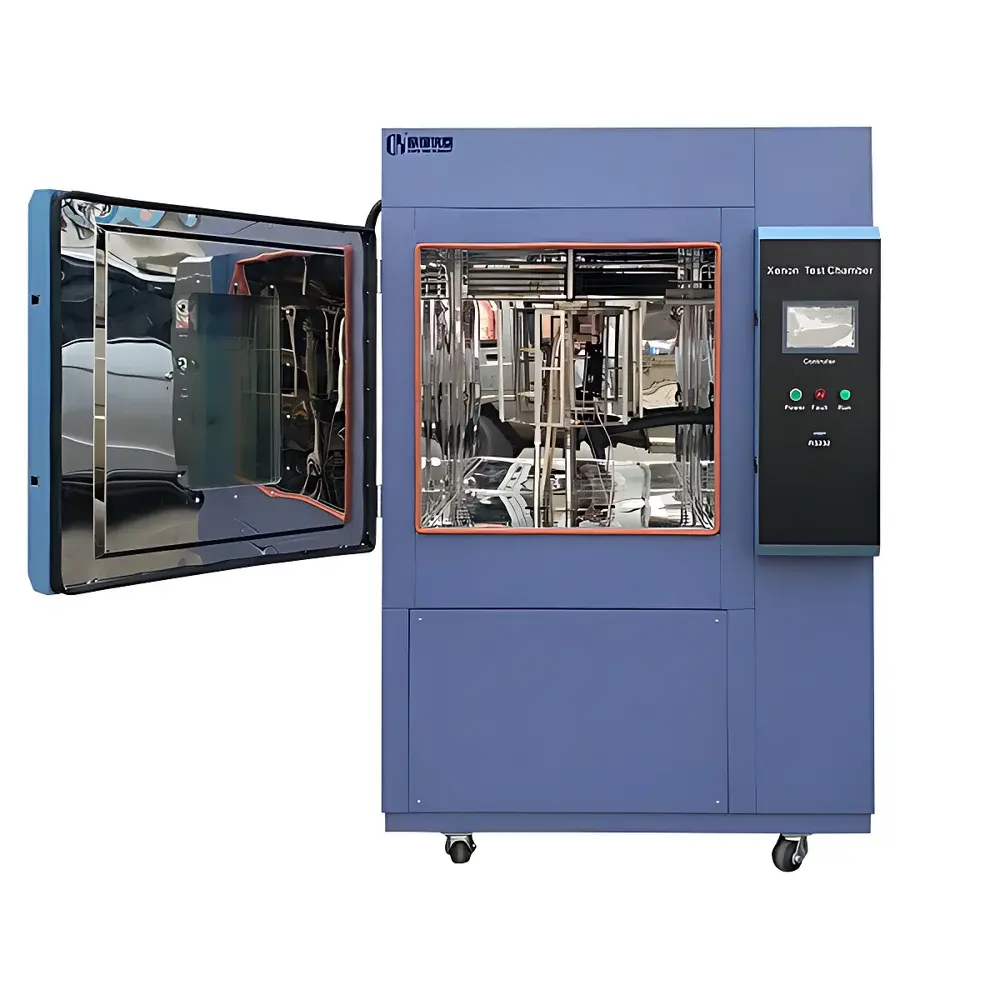
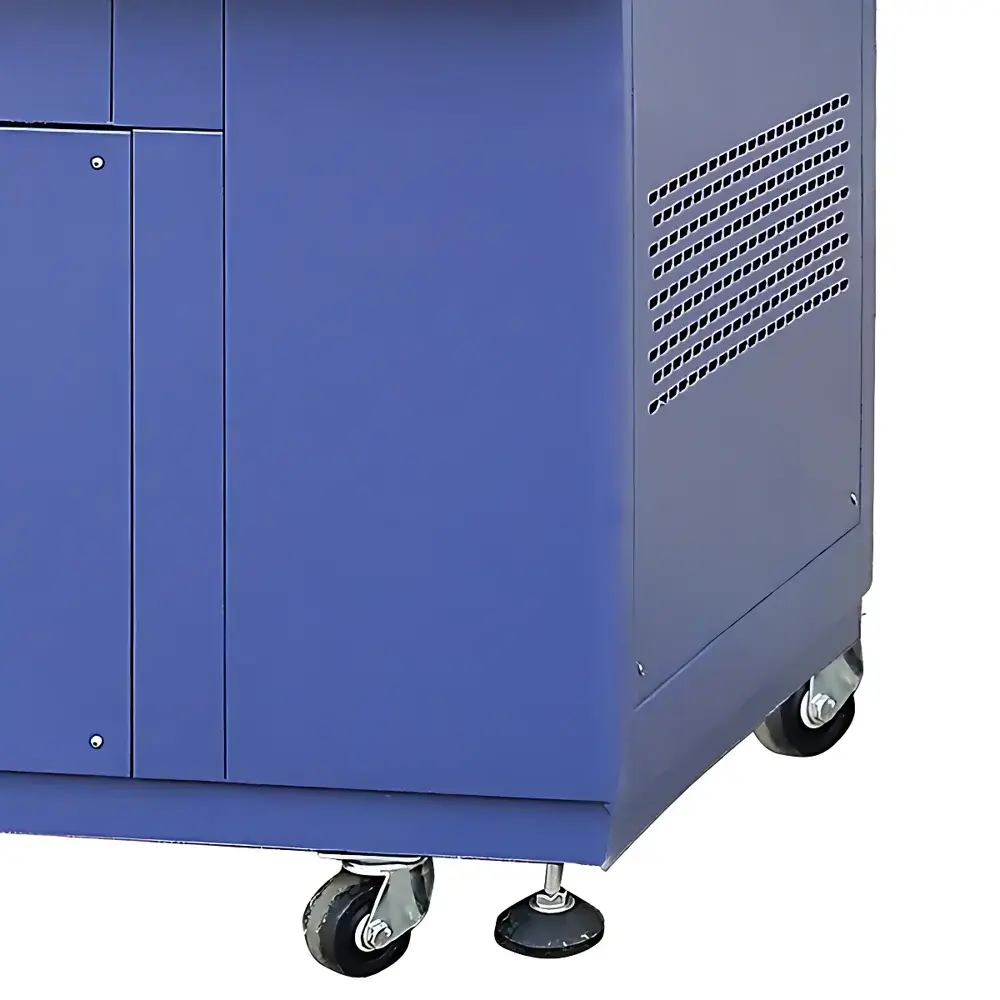
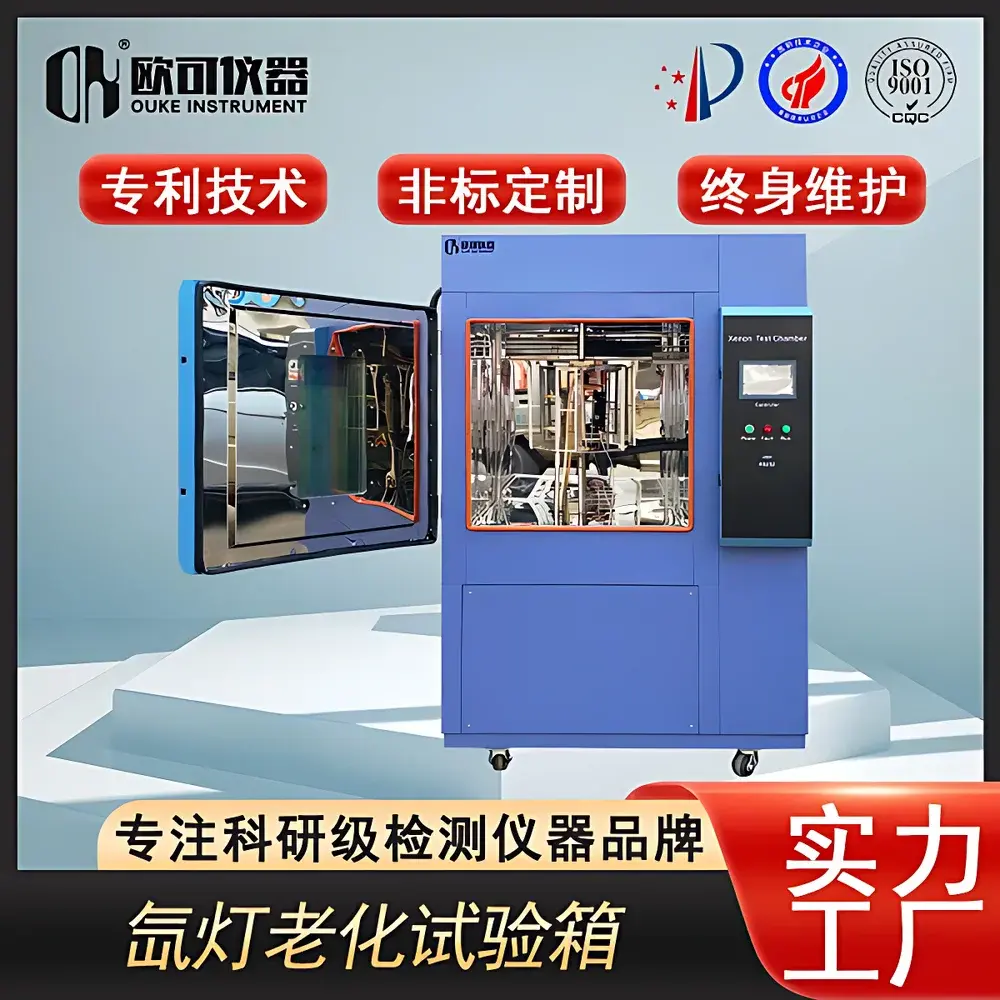
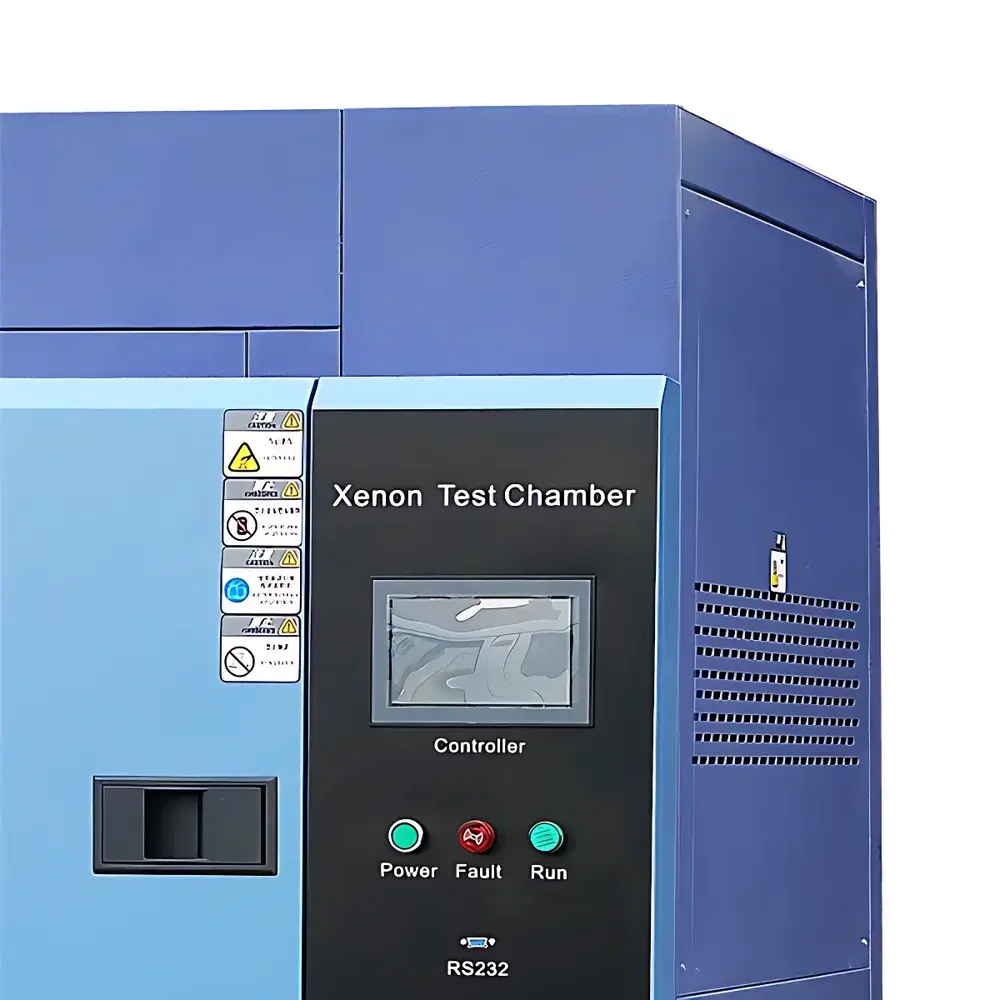
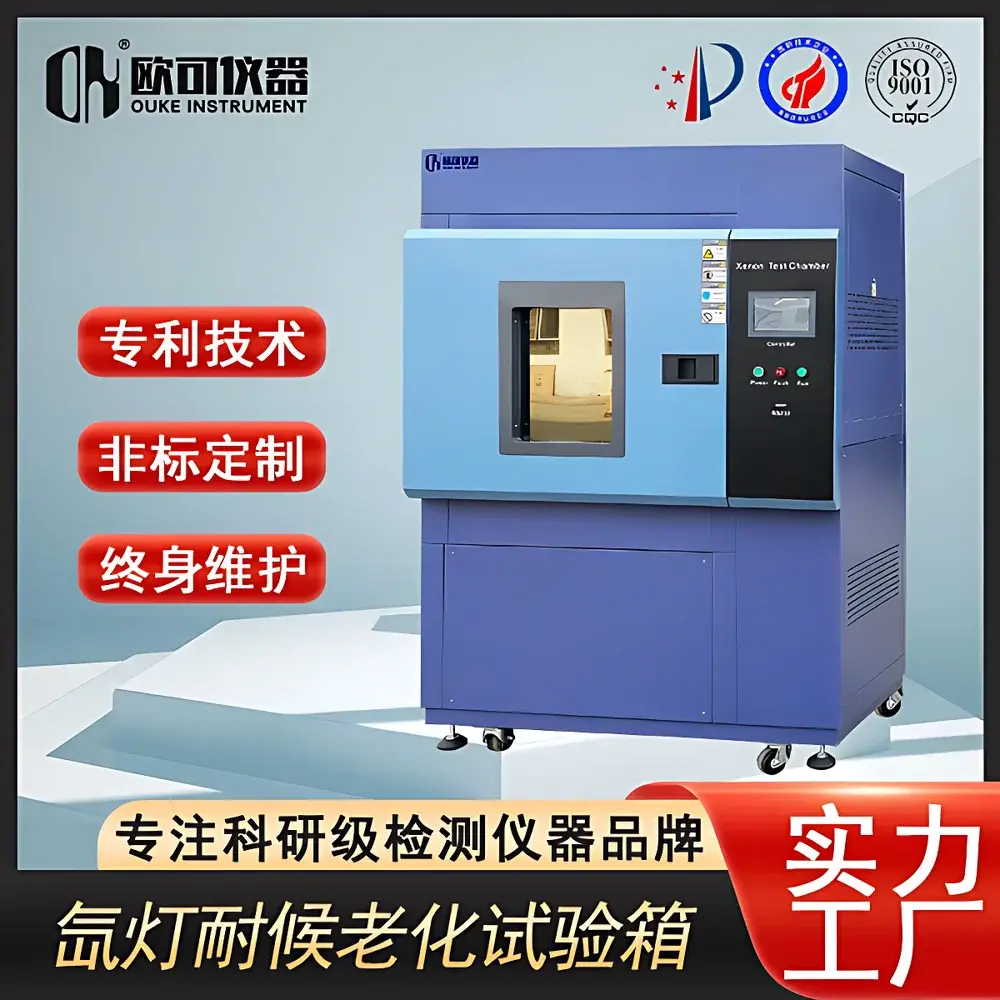
OK-XD-100.001 Xenon Arc Weathering Test Chamber
| Brand | OK Instruments |
|---|---|
| Origin | Guangdong, China |
| Manufacturer Type | Direct Manufacturer |
| Product Origin | Domestic (China) |
| Model | OK-XD-100.001 |
| Xenon Lamp Power | 6 kW |
| Irradiance Range | ≤1200 W/m² |
| Light Exposure Cycle | 1–999 h/min/sec (programmable) |
| Humidity Range | 20–75 %RH |
Overview
The OK-XD-100.001 Xenon Arc Weathering Test Chamber is an engineered environmental simulation system designed to accelerate the evaluation of material degradation under realistic outdoor climatic conditions. It employs a 6 kW air-cooled xenon arc lamp as its primary light source—spectrally filtered to replicate the full solar spectrum (290–2500 nm), including biologically and chemically active UV-B, UV-A, visible, and near-infrared radiation. Unlike narrowband UV sources, xenon arc technology delivers high-fidelity spectral match to terrestrial sunlight (CIE No. 85, ISO 4892-2 Annex A), enabling accurate assessment of photodegradation mechanisms such as chromophore cleavage, polymer chain scission, and photooxidation. Integrated with precision-controlled temperature, relative humidity (20–75 %RH), and programmable water spray/cold condensation cycles, the chamber supports multi-stress exposure protocols that mirror diurnal and seasonal environmental dynamics—including thermal cycling, moisture absorption/desorption, and wet-dry transitions. This enables reproducible acceleration of real-world aging phenomena: color fading, gloss loss, chalking, cracking, embrittlement, and mechanical property decay.
Key Features
- 6 kW high-stability xenon arc lamp with quartz envelope and integrated forced-air cooling for consistent spectral output and extended service life
- Optical filtering system compliant with ISO 4892-2: includes Daylight-Q filter (for outdoor exposure simulation) and Window Glass-Q filter (for indoor/behind-glass applications)
- Microprocessor-based touchscreen controller supporting up to 99 programmable test cycles, each with independent settings for irradiance, black panel temperature (BPT), chamber air temperature, RH, and spray duration/frequency
- Dual-mode humidity control: ultrasonic humidification + refrigerative dehumidification for stable RH regulation across operational temperature ranges
- Automated spray system using deionized water (resistivity ≥1 MΩ·cm) with adjustable pressure (0.1–0.3 MPa), nozzle distribution uniformity < ±5 %, and programmable activation during light or dark phases
- Rotating sample tray (360° continuous rotation) with standardized specimen holders per ISO 4892-2 and ASTM G155; optional horizontal static rack available for flat-panel testing
- Real-time monitoring and data logging of irradiance (calibrated broadband sensor, traceable to NIST), BPT, chamber temperature, RH, and spray status
Sample Compatibility & Compliance
The OK-XD-100.001 accommodates rigid and flexible specimens up to 75 mm in thickness and 500 × 500 mm in planar dimension. Compatible substrates include thermoplastics (PP, ABS, PC), elastomers (EPDM, SBR), coated metals, textile laminates, architectural sealants, and photovoltaic encapsulants. The system meets essential requirements for conformance with international test standards: ISO 4892-2 (Plastics — Methods of exposure to laboratory light sources — Part 2: Xenon-arc lamps), ASTM G155 (Standard Practice for Operating Xenon Arc Equipment for Exposure of Non-Metallic Materials), GB/T 16422.2 (identical to ISO 4892-2), AATCC TM16-2021, and SAE J2412/J2527. All critical sensors are factory-calibrated and support user-performed verification per ISO/IEC 17025 guidelines. Data audit trails comply with GLP principles, and optional 21 CFR Part 11-compliant software modules are available for regulated QA/QC environments.
Software & Data Management
The embedded control interface provides intuitive cycle programming, real-time graphical display of all monitored parameters, and automatic generation of CSV-formatted test logs (timestamped at 1-second intervals). Optional OK-WeatherLink™ PC software enables remote supervision, advanced statistical analysis (e.g., ΔE*ab vs. exposure dose, gloss retention curves), and report generation aligned with ISO 105-A02 and ASTM D2244. All irradiance measurements are referenced to a calibrated reference cell traceable to national metrology institutes. System firmware supports over-the-air updates and includes built-in diagnostic routines for lamp voltage/current stability, filter degradation alerts, and humidity sensor drift compensation.
Applications
This chamber serves as a core tool in R&D and quality assurance laboratories across multiple industries. In automotive engineering, it validates exterior trim durability under SAE J2412 cyclic protocols. For coatings manufacturers, it quantifies colorfastness and film integrity per ISO 11341 and ASTM D4303. In the textile sector, it supports AATCC TM16 and ISO 105-B02 assessments of fabric fading resistance. Photovoltaic material developers use it to evaluate backsheet yellowing and EVA discoloration per IEC 61215-2 MQT10. Construction product labs apply it to assess roofing membrane cracking (ASTM D6785) and silicone sealant adhesion loss. Its ability to co-apply UV, heat, moisture, and mechanical stress makes it indispensable for failure root-cause analysis and formulation optimization.
FAQ
What spectral filters are included with the standard configuration?
The base unit ships with one Daylight-Q filter (Q/B) for outdoor exposure simulation and one Window Glass-Q filter (Q/W) for indoor or behind-glass applications.
How often must the xenon lamp be replaced?
Lamp service life is rated at ≥1500 hours under nominal irradiance (0.35 W/m² @ 340 nm); replacement interval depends on usage intensity and spectral fidelity requirements.
Is calibration documentation provided with the system?
Yes — each unit includes a factory calibration certificate for irradiance, black panel temperature, and relative humidity sensors, with traceability to national standards.
Can the chamber operate without water spray functionality?
Yes — spray operation is fully programmable and may be disabled independently while maintaining full control over irradiance, temperature, and humidity.
Does the system support automated pass/fail evaluation against acceptance criteria?
While the hardware does not perform automatic pass/fail judgment, OK-WeatherLink™ software allows users to define custom thresholds (e.g., ΔE*ab > 3.0 after 1000 kJ/m²) and generate compliance flags within exported reports.



