
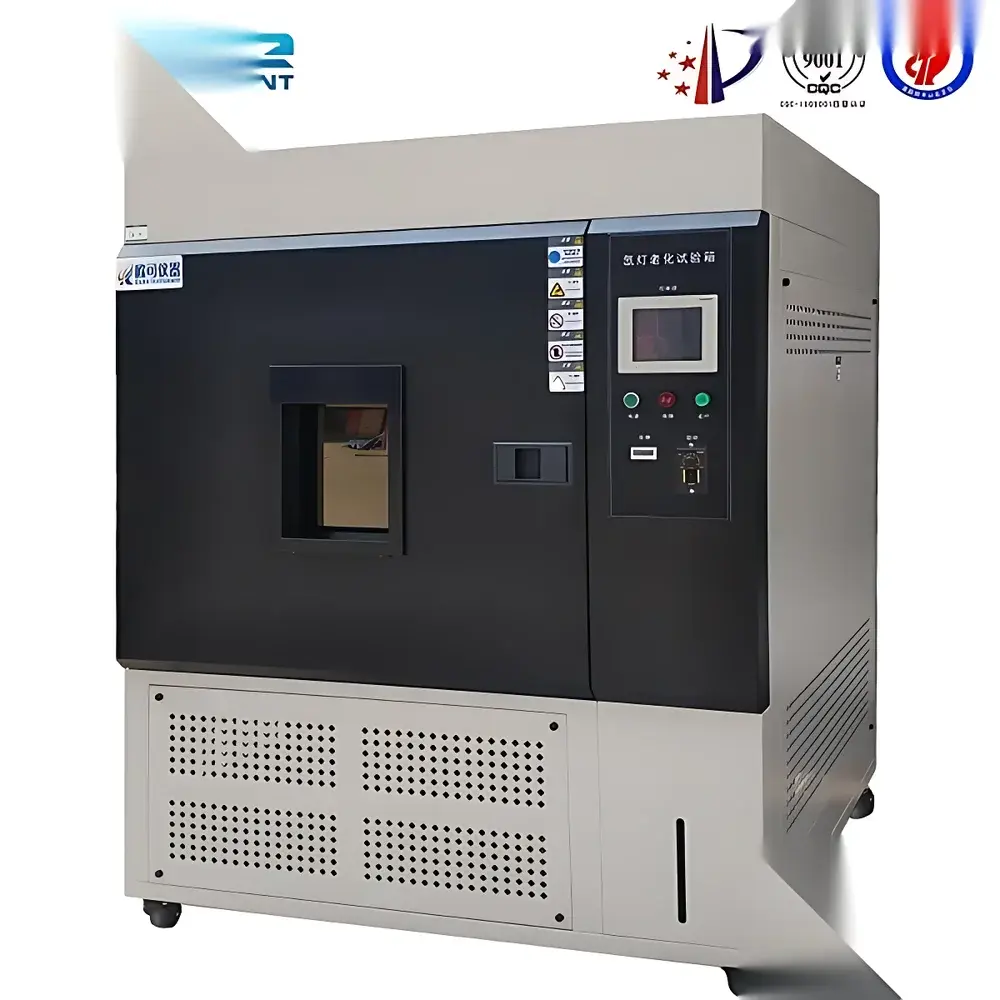
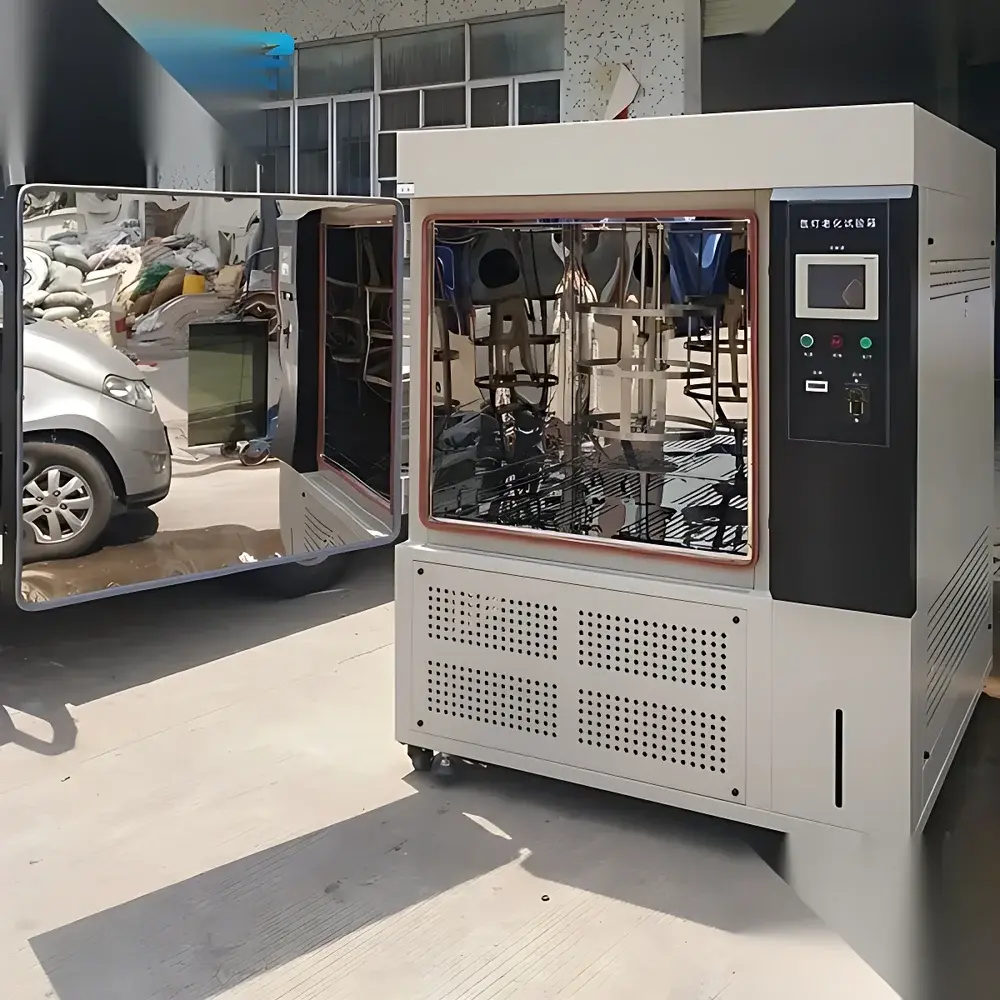
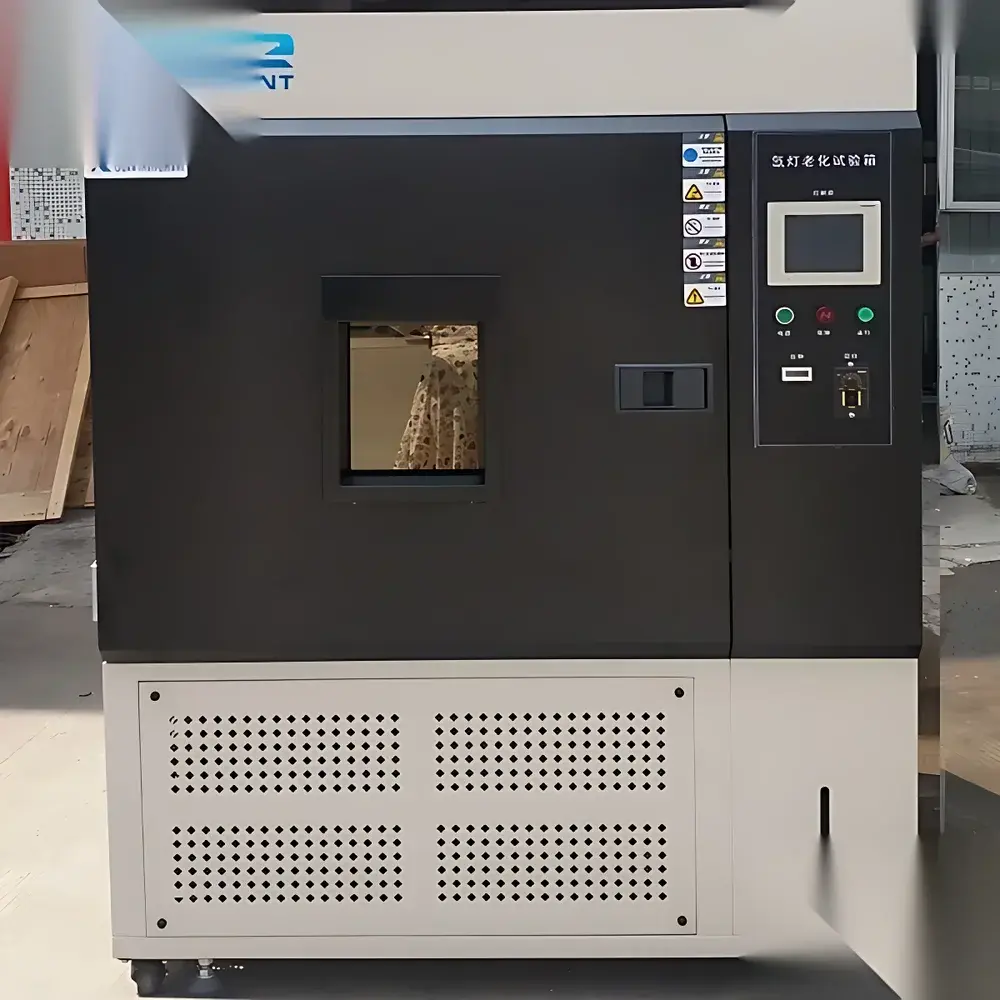
OK-XD-100 Compact Xenon Arc Weathering Test Chamber
| Brand | OEM |
|---|---|
| Origin | Imported |
| Manufacturer Type | Distributor |
| Country of Origin | Import |
| Model | OK-XD-100 |
| Price | USD 5,200 (FOB) |
| Internal Chamber Dimensions | 50 × 50 × 40 cm |
| Temperature Range | 0–150°C (chamber), 40–85°C (black panel) |
| Humidity Range | 20–75% RH (light cycle), 20–98% RH (dark cycle) |
| Control Accuracy | ±0.5°C / ±2.0% RH |
| Uniformity | ±2.0°C / ±3.0% RH |
| Irradiance | 550 W/m² ±10% (300–800 nm) or 1000 W/m² ±10% (300–1200 nm) |
| Xenon Lamp Power | 1.8 kW |
| Lamp Life | ~1500 h |
| Spray Duration | 1–999 min (intermittent/continuous) |
| Spray Pressure | 70–127 kPa |
| Sample Mounting | Dual-layer mesh tray or 500-mm-diameter rotating turntable (0–3 rpm) |
| Construction | Interior – SUS304 stainless steel |
| Power Supply | AC 380 V ±5%, 50 Hz ±0.5 Hz |
Overview
The OK-XD-100 Compact Xenon Arc Weathering Test Chamber is an engineered environmental simulation system designed to accelerate the evaluation of material degradation under controlled solar radiation, thermal stress, and moisture exposure. It employs a long-arc, air-cooled xenon lamp that replicates the full solar spectrum (300–1200 nm), enabling photometric fidelity critical for assessing photochemical stability in polymeric, textile, coating, and automotive components. Unlike UV-only or fluorescent-based testers, this chamber delivers broadband irradiance with spectral power distribution closely aligned with terrestrial sunlight—essential for validating compliance with international weathering standards such as ISO 4892-2, ASTM G155, and GB/T 16422.2. Its compact footprint (100 × 170 × 90 cm overall) makes it suitable for QC labs with limited floor space while maintaining full functional equivalence to larger-scale xenon test platforms.
Key Features
- Full-spectrum xenon arc source with calibrated irradiance output (550 W/m² ±10% at 300–800 nm; 1000 W/m² ±10% at 300–1200 nm), supported by durable optical filters to stabilize spectral distribution over lamp lifetime.
- Integrated water spray system with adjustable pressure (70–127 kPa) and programmable duration (1–999 minutes), enabling both intermittent and continuous wetting cycles to simulate rain, dew, or condensation phases per ISO 4892-2 Annex B.
- Precise dual-zone climate control: chamber air temperature (0–150°C), black panel temperature (40–85°C), and relative humidity (20–98% RH), all maintained within ±0.5°C and ±2.0% RH accuracy via PID-regulated heating, refrigeration, and steam humidification.
- Flexible sample mounting architecture: standard dual-layer stainless steel mesh trays or optional 500-mm-diameter rotating turntable (0–3 rpm) with variable speed control to ensure uniform irradiance exposure across irregularly shaped specimens.
- Robust construction using interior SUS304 stainless steel and exterior powder-coated steel or full stainless enclosure, ensuring corrosion resistance and long-term operational integrity in high-humidity, saline, or chemical-laden test environments.
- Modular lamp assembly with quick-release mechanism—lamp replacement requires no realignment or recalibration, minimizing downtime and supporting GLP-aligned maintenance logs.
Sample Compatibility & Compliance
The OK-XD-100 accommodates flat, curved, or three-dimensional specimens up to 50 × 50 × 40 cm internal volume, including textiles, painted panels, rubber gaskets, plastic housings, and composite laminates. Its design supports standardized specimen mounting per ISO 105-B02 (colorfastness to light), ISO 105-B04 (light + perspiration), and ASTM D529 (automotive interior materials). All operational parameters—including irradiance setpoints, temperature ramp profiles, humidity transitions, and spray timing—are fully programmable to replicate specific climatic sequences defined in GB/T 8427, GB/T 14576, and ISO 4892-2 Cycle 1–5. The system meets essential requirements for ISO/IEC 17025-accredited laboratories and supports audit-ready documentation when paired with compliant data logging software.
Software & Data Management
Equipped with a 7-inch industrial touchscreen HMI, the chamber provides intuitive local control of test programs, real-time parameter visualization (irradiance, black panel temperature, chamber RH), and event-triggered alarms (e.g., lamp failure, low water, door open). Optional PC-based software enables remote monitoring, automated report generation (PDF/CSV), and secure data export compliant with FDA 21 CFR Part 11 requirements—including electronic signatures, audit trails, and user access levels. All test data are timestamped, version-controlled, and stored with metadata (calibration date, lamp hours, filter status) to support traceability in regulated industries such as medical device packaging validation or automotive Tier-1 supplier qualification.
Applications
This chamber is routinely deployed in R&D and quality assurance workflows for evaluating: color shift and gloss loss in automotive exterior trim; chalking and cracking resistance in architectural coatings; UV-induced embrittlement in PVC window profiles; fading kinetics of digital textile prints; and synergistic degradation mechanisms in light–heat–moisture exposure scenarios. It serves as a primary tool for pre-compliance screening prior to outdoor exposure (e.g., Arizona desert or Florida subtropical sites), reducing time-to-market for new formulations. Universities and national metrology institutes also utilize the OK-XD-100 for interlaboratory comparison studies and reference material certification under ISO Guide 34.
FAQ
What standards does the OK-XD-100 comply with?
It supports testing per ISO 4892-2, ASTM G155, GB/T 16422.2, GB/T 8427, GB/T 14576, and other photostability and weathering protocols requiring xenon arc irradiation.
Can the chamber operate without water spray?
Yes—spray function is fully programmable and can be disabled for dry-cycle tests such as thermal aging or UV-only exposure simulations.
How is irradiance calibrated and maintained?
Calibration uses NIST-traceable broadband radiometers; optical filters are replaced per manufacturer schedule (typically every 1,200–1,500 lamp hours) to preserve spectral fidelity.
Is black panel temperature measurement included?
Yes—integrated black panel sensor (BPT) conforms to ISO 4892-2 requirements and is independently calibrated against reference thermocouples.
Does the system support multi-step test profiles?
Yes—up to 99 segments per program, each with independent settings for irradiance, temperature, humidity, and spray timing.



