
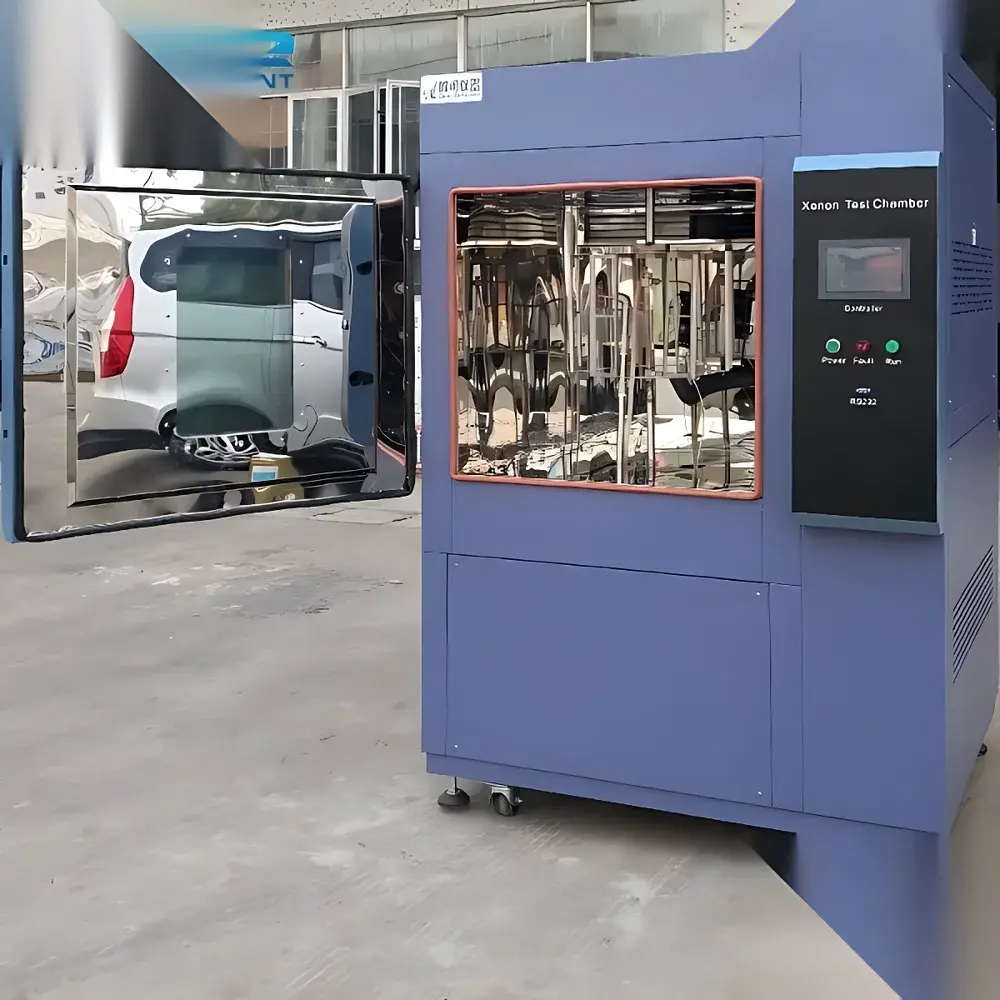
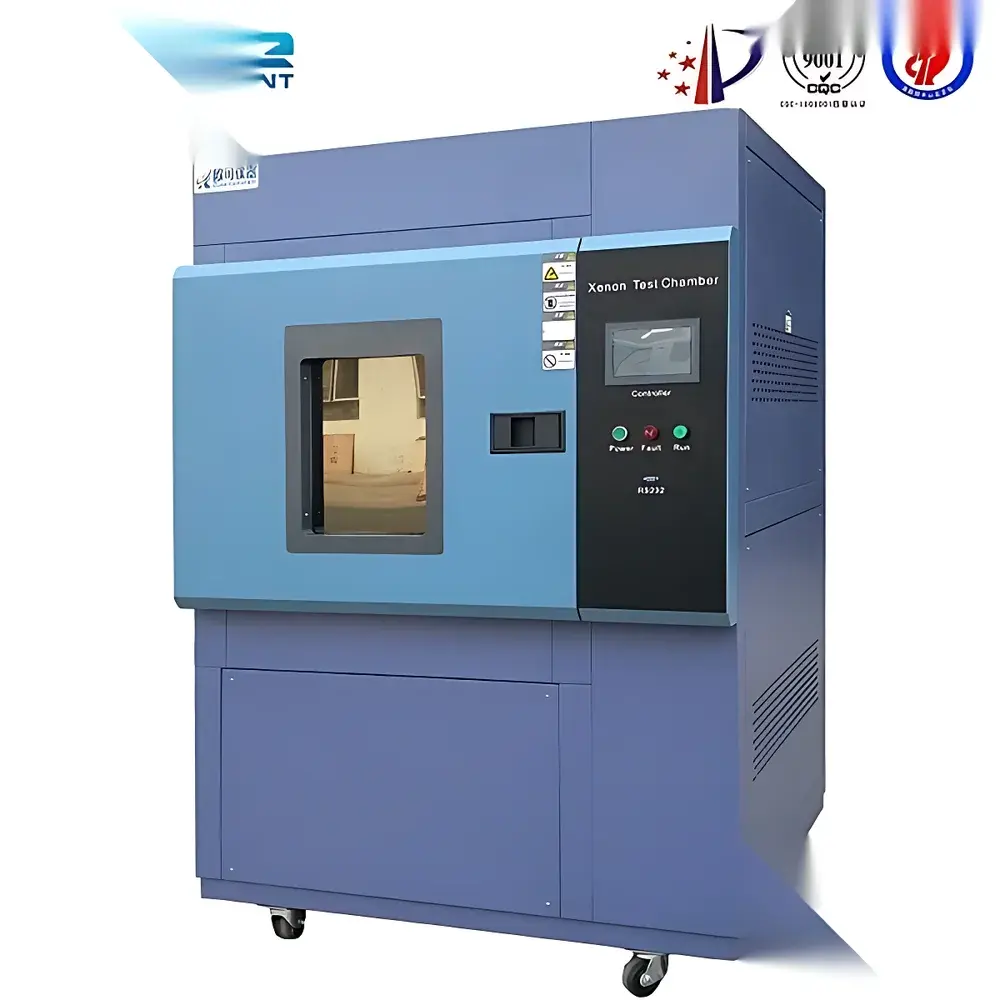
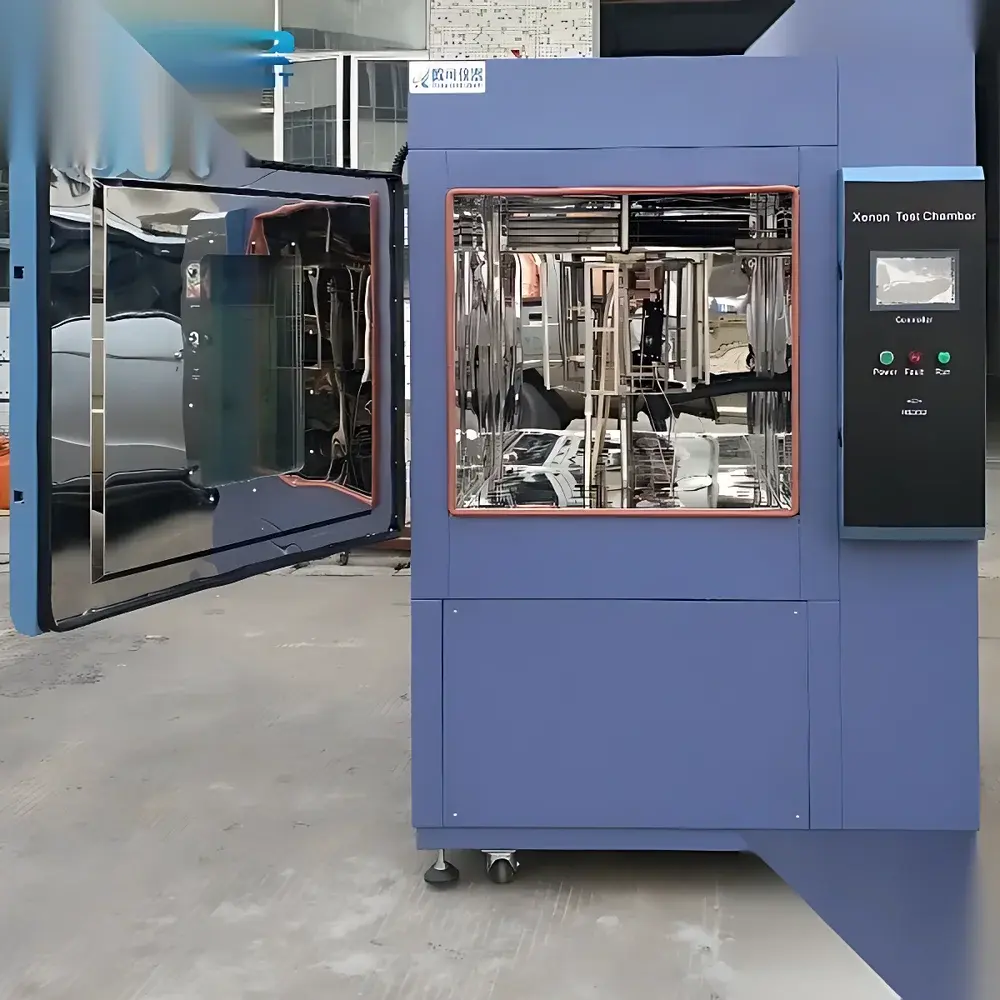
OK-XD-100 Xenon Arc Weathering Test Chamber
| Brand | OEM |
|---|---|
| Origin | Imported |
| Manufacturer Type | Authorized Distributor |
| Model | OK-XD-100 |
| Internal Chamber Dimensions (W×D×H) | 50×50×40 cm |
| Temperature Range | 0–150°C (Chamber), 40–85°C (Black Panel) |
| Humidity Range | 20–75% RH (Light Cycle), 20–98% RH (Dark Cycle) |
| Temperature Control Accuracy | ±0.5°C |
| Humidity Control Accuracy | ±2.0% RH |
| Temperature Uniformity | ±2.0°C |
| Humidity Uniformity | ±3.0% RH |
| Irradiance | 550 W/m² ±10% (300–800 nm) or 1000 W/m² ±10% (300–1200 nm) |
| Xenon Lamp Power | 1.8 kW |
| Lamp Life | ~1500 h |
| Spray Duration | 1–999 min (intermittent/continuous) |
| Spray Pressure | 70–127 kPa |
| Sample Holder | Dual-layer flat mesh rack or 500 mm diameter rotating turntable (0–3 rpm) |
| Construction | Interior – SUS304 stainless steel |
| Power Supply | AC 380 V ±5%, 50 Hz ±0.5 Hz |
Overview
The OK-XD-100 Xenon Arc Weathering Test Chamber is an engineered environmental simulation system designed to replicate the photodegradative effects of natural sunlight, heat, and moisture on polymeric, textile, coating, automotive, and architectural materials. It employs a long-arc, air-cooled xenon lamp that emits a continuous spectrum closely matching terrestrial solar irradiance (290–2500 nm), enabling accelerated aging under controlled spectral power distribution. Unlike UV fluorescent or metal halide sources, xenon arc technology delivers full-spectrum irradiation—including critical UVA, UVB, visible, and near-infrared bands—making it the reference method for ISO 4892-2, ASTM G155, and GB/T 16422-2 compliance. The chamber integrates precise black panel temperature control, programmable relative humidity modulation across light/dark cycles, and calibrated broadband irradiance monitoring to ensure repeatability in weathering performance assessment.
Key Features
- Full-spectrum xenon arc source with spectral filtering options to emulate daylight (Daylight Filter Q/B), window glass transmission (Window Glass Filter), or extended UV exposure (Extended UV Filter)
- Independent control of chamber air temperature (0–150°C), black panel temperature (40–85°C), and relative humidity (20–98% RH) with real-time feedback loops
- Programmable water spray system with adjustable duration (1–999 min), frequency, and pressure (70–127 kPa) to simulate rain, dew, or condensation cycles
- Flexible sample mounting configurations: dual-layer flat stainless-steel mesh racks or motorized 500 mm diameter rotating turntable (0–3 rpm) accommodating irregularly shaped specimens
- Robust construction using interior SUS304 stainless steel for corrosion resistance and exterior options in either stainless steel or powder-coated carbon steel
- Calibrated irradiance monitoring at 340 nm, 420 nm, or broadband (300–800 nm / 300–1200 nm) with automatic lamp output compensation to maintain setpoint stability over lamp lifetime (~1500 h)
- Intuitive touchscreen controller with preloaded test profiles aligned with GB/T 8427, ISO 105-B02, ASTM D529, and other internationally recognized weathering standards
Sample Compatibility & Compliance
The OK-XD-100 accommodates diverse specimen geometries—including flat panels, molded parts, textiles, laminates, and coated substrates—via its modular fixture design. Its internal chamber volume (50 × 50 × 40 cm) supports standard test coupons per ISO 4892-2 and ASTM D529, while optional custom fixtures enable evaluation of larger or non-planar components. All operational parameters—including irradiance intensity, temperature ramp rates, humidity dwell times, and spray sequences—are traceable and reproducible under GLP-aligned laboratory conditions. The system meets mechanical and electrical safety requirements per IEC 61000-6-3 (EMC) and IEC 61000-6-2 (immunity), and supports documentation protocols required for ISO/IEC 17025-accredited testing laboratories.
Software & Data Management
The embedded controller logs time-stamped records of irradiance, chamber temperature, black panel temperature, relative humidity, spray status, and lamp operating hours. Data export is supported via USB interface in CSV format for integration into LIMS or statistical process control platforms. Optional PC-based software enables remote monitoring, multi-sequence scheduling, alarm notification (email/SMS), and automated report generation compliant with FDA 21 CFR Part 11 requirements—including electronic signatures, audit trails, and user access level management. Calibration certificates for irradiance sensors and temperature/humidity transducers are provided with NIST-traceable documentation.
Applications
This chamber is routinely deployed in R&D and QC laboratories for evaluating color fading, gloss loss, chalking, cracking, embrittlement, and adhesion failure in automotive interior trim, exterior paints, plastic housings, PVC flooring, roofing membranes, outdoor signage, and textile upholstery. It serves as a primary tool for validating material durability against regulatory benchmarks such as GB/T 15102-2006 (laminate flooring), GB/T 15104-2006 (decorative veneer), and ISO 11341 (paints and varnishes). In academic research, it supports studies on photo-oxidation kinetics, stabilizer efficacy, and spectral sensitivity of organic pigments under simulated climatic stressors.
FAQ
What spectral filters are available for the OK-XD-100, and how do they affect test relevance?
The system supports Daylight (Q/B), Window Glass (WG), and Extended UV filters—each altering the UV cutoff and IR content to match specific exposure scenarios (e.g., indoor vs. outdoor, behind glass vs. direct sun).
Can irradiance be maintained constant throughout a test cycle despite lamp aging?
Yes—the integrated optical feedback loop continuously adjusts lamp power to sustain user-defined irradiance setpoints, ensuring consistent photon flux across the full lamp service life.
Is the OK-XD-100 suitable for testing specimens requiring strict temperature uniformity per ISO 17025?
With ±2.0°C temperature uniformity and ±0.5°C control accuracy across the working volume, it satisfies ISO 17025 clause 5.4.2 for environmental condition stability during accredited testing.
How is calibration traceability established for this instrument?
All critical sensors (irradiance, temperature, humidity) ship with individual calibration certificates traceable to national metrology institutes (e.g., NIM, NIST, PTB), including uncertainty budgets and recalibration intervals.
Does the system support automated pass/fail evaluation based on colorimetric thresholds?
While the chamber itself does not perform color measurement, its data export protocol enables seamless integration with spectrophotometers (e.g., Konica Minolta CM-700d, X-Rite Ci7600) for post-test ΔE*ab analysis and rule-based pass/fail logic in external QA software.



