
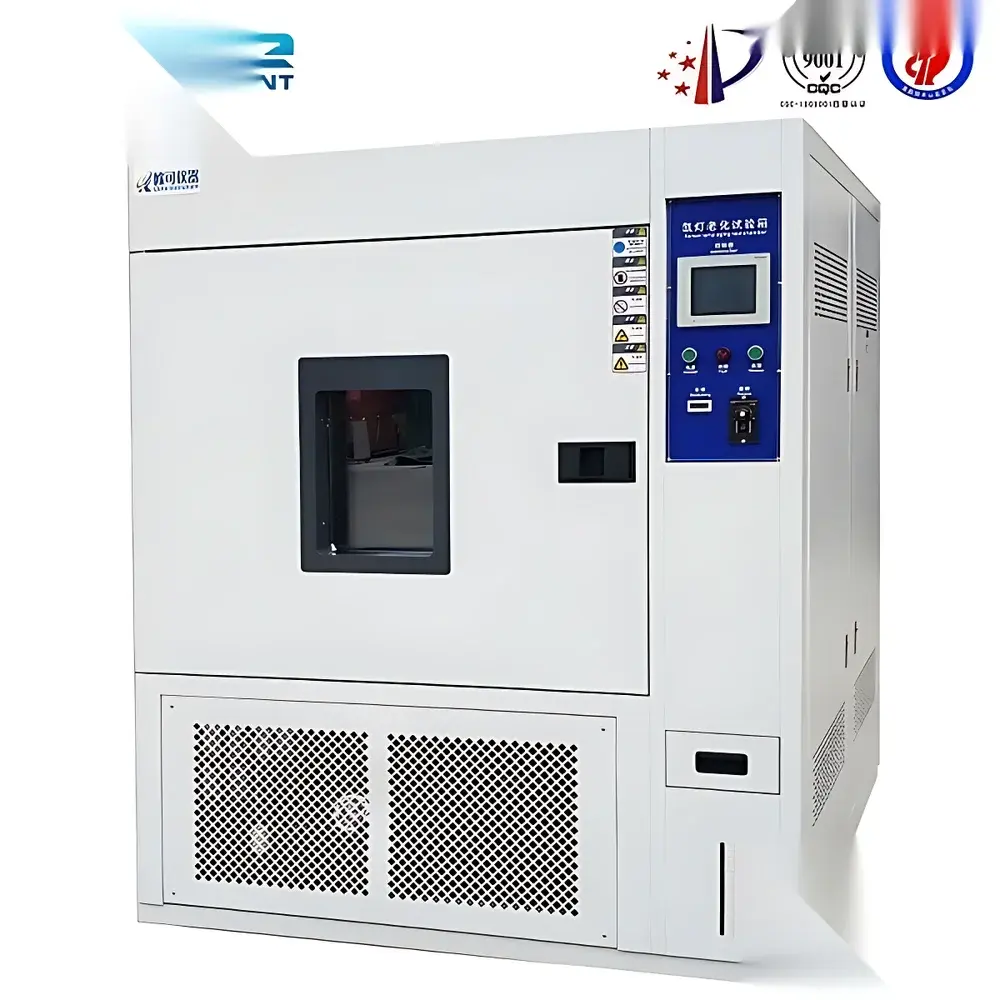
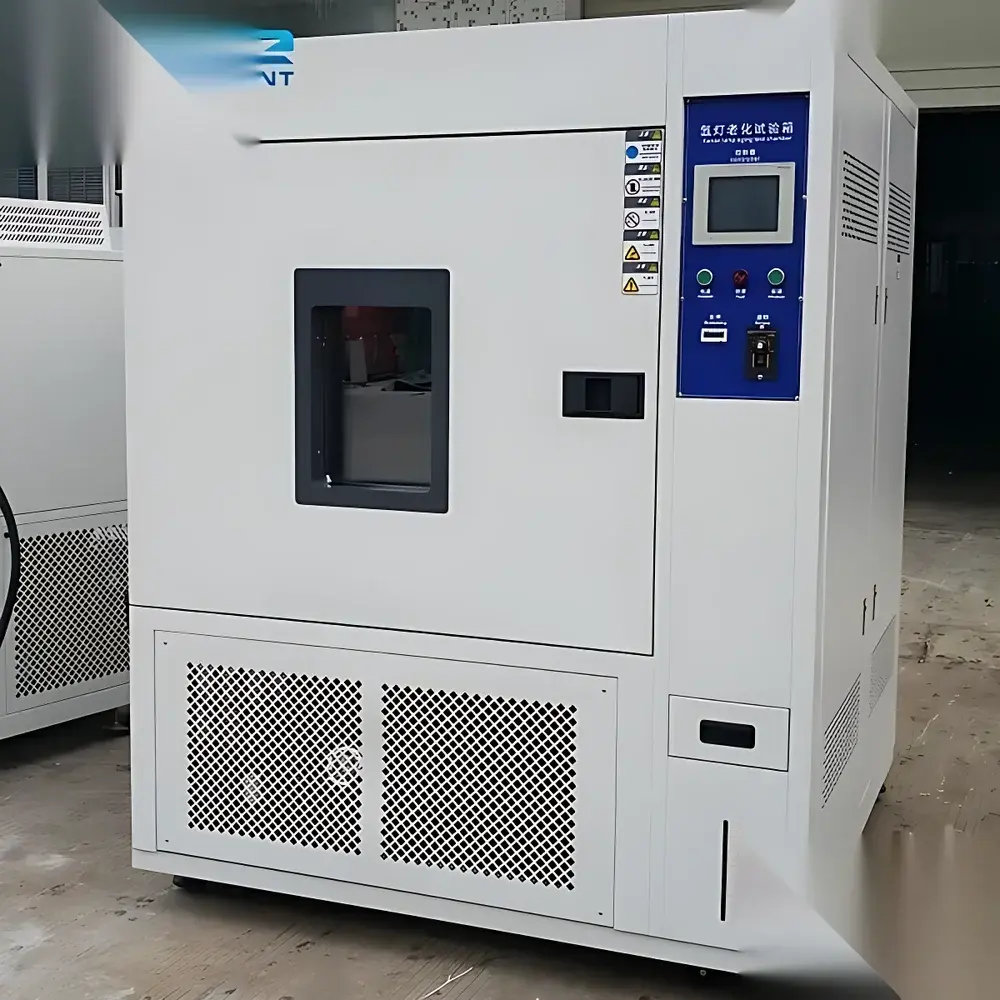
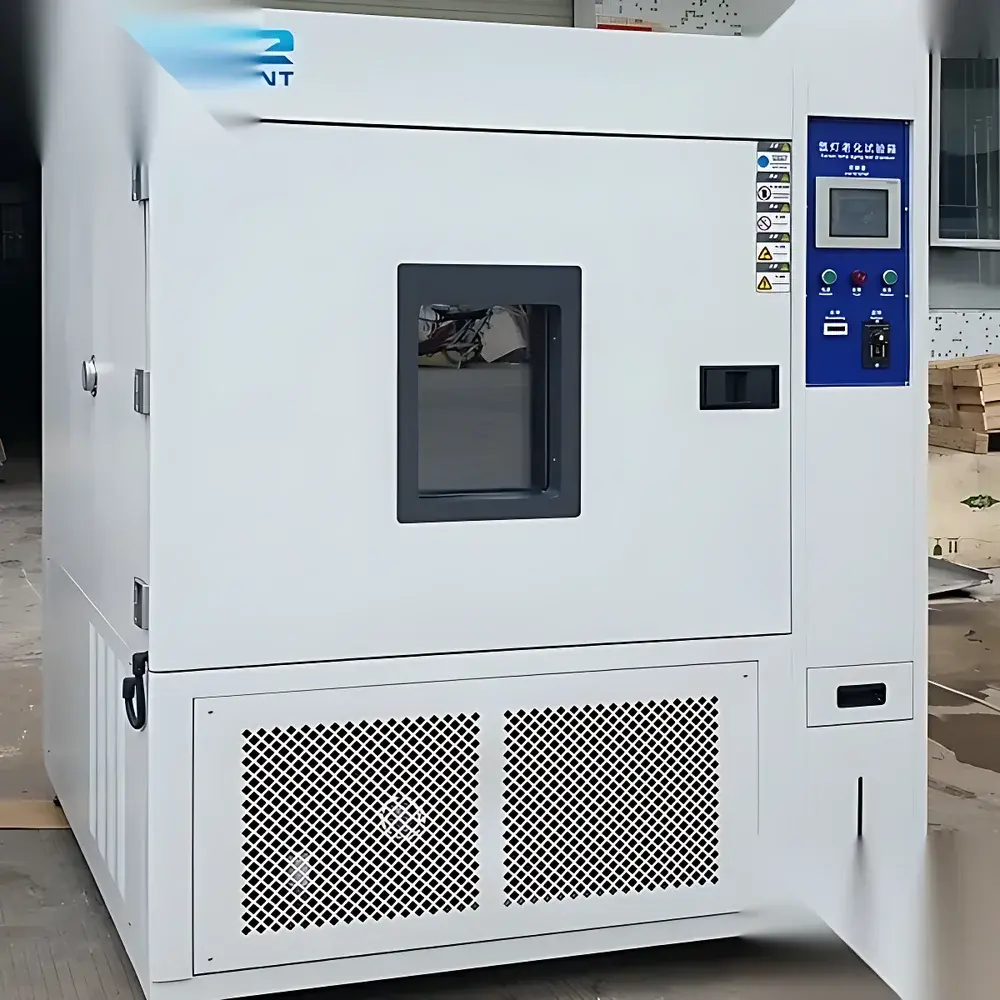
OK-XD-1000 Xenon Arc Weathering Test Chamber for Floor Coating Durability Assessment
| Brand | Other Brands |
|---|---|
| Origin | Imported |
| Manufacturer Type | Authorized Distributor |
| Price | USD 5,300 (Reference Only) |
| Chamber Interior Dimensions | 1000 × 1000 × 1000 mm |
| Temperature Range | RT to 80°C (Models B & C) / RT to –80°C (Model A) |
| Humidity Range | 30–90% RH |
| Xenon Lamp Power | 3 kW (Horizontal) / 6 kW (Vertical) |
| Irradiance Control | (550 ± 5) W/m² (290–800 nm) |
| Filter Type | External Quartz Filter |
| Spray System | Stainless Steel Nozzles (Ø0.4 mm), Pressure 78–127 kPa, Programmable On/Off Cycle (1 min–99 h) |
| Dark Cycle | Adjustable (10 min–99 h) |
| Sample Rotation | 360°, 1 rpm (for 75 × 150 mm standard panels) |
| Controller | Touchscreen Programmable LCD Interface |
| Temperature Resolution | ±0.1°C |
| Humidity Resolution | ±1% RH |
| Timer Range | 0–99 h 99 min 99 s |
| Lamp Service Life | >1000 h |
| Compliance | GB/T 8427–1989, GB/T 8430–1998, GB/T 1865–1997, GB/T 16422.2–1999 |
Overview
The OK-XD-1000 Xenon Arc Weathering Test Chamber is an engineered environmental simulation system designed specifically for accelerated aging evaluation of floor coatings—including epoxy, polyurethane, MMA, and acrylic-based systems—under controlled, reproducible solar-spectrum irradiation. Utilizing a stabilized 3 kW or 6 kW xenon arc lamp as its primary radiation source, the chamber replicates full-spectrum sunlight (290–800 nm) with spectral power distribution closely aligned to terrestrial solar irradiance (CIE 85:1989, ISO 4892-2). The system integrates precise temperature, humidity, spray, and dark-cycle control to simulate real-world outdoor exposure conditions—including thermal cycling, moisture condensation, rain simulation, and UV-induced photochemical degradation—enabling predictive assessment of gloss retention, color shift (ΔE), chalking, cracking, and adhesion loss over accelerated timeframes. Its modular architecture supports both horizontal and vertical lamp configurations, accommodating diverse specimen geometries and industry-standard test protocols.
Key Features
- Robust chamber construction: Cold-rolled steel exterior with electrostatic gray powder coating; interior lined with mirror-finish SUS304 stainless steel for corrosion resistance and uniform reflectivity.
- High-fidelity irradiance control: Calibrated xenon lamp output maintained at (550 ± 5) W/m² across the 290–800 nm band using external quartz filter assemblies to ensure spectral consistency and repeatability between test runs.
- Programmable multi-parameter exposure cycles: Independent control of light/dark intervals (10 min–99 h), spray duration/frequency (1 min–99 h), temperature (RT to 80°C or –80°C), and relative humidity (30–90% RH).
- Rotating sample carousel: 360° continuous rotation at 1 rpm optimized for 75 × 150 mm ASTM D6675-compliant test panels, ensuring uniform irradiance distribution and minimizing edge-shadowing effects.
- Stainless-steel spray subsystem: Precision-engineered nozzles (0.4 mm orifice), high-pressure booster pump, and auto-leveling SUS304 water reservoir compliant with ISO 4892-2 spray requirements for realistic wet/dry cycling.
- Intuitive touchscreen controller: Graphical LCD interface supporting up to 100 programmable test profiles, real-time data logging, alarm history, and password-protected parameter lockdown for GLP-compliant operation.
Sample Compatibility & Compliance
The OK-XD-1000 accommodates flat, rigid specimens up to 1000 mm × 1000 mm × 50 mm in depth, including coated concrete slabs, polymer-modified cementitious flooring samples, and commercial roll goods mounted on rigid backings. It supports standardized mounting fixtures per ASTM D6675, ISO 4892-2, and GB/T 16422.2–1999. All operational parameters—including irradiance intensity, spectral cutoff, temperature ramp rates, and humidity transition dynamics—are traceable to national metrological standards. The system meets mandatory requirements for regulatory testing under Chinese national standards GB/T 8427–1989 (textile colorfastness), GB/T 8430–1998, GB/T 1865–1997 (paints and varnishes), and GB/T 16422.2–1999 (plastics). Optional calibration certificates (NIST-traceable irradiance sensor) and IQ/OQ documentation packages are available for GMP-aligned quality assurance environments.
Software & Data Management
The embedded controller provides local data acquisition at 1-second resolution for temperature, humidity, irradiance, and spray status, with internal storage for ≥30 days of continuous operation logs. Export is supported via USB 2.0 to CSV format for post-processing in MATLAB, Excel, or LIMS platforms. Audit trail functionality records all user actions—including profile edits, manual overrides, and calibration events—with timestamp and operator ID, satisfying FDA 21 CFR Part 11 electronic record requirements when paired with networked authentication. Remote monitoring via Ethernet (Modbus TCP) enables integration into centralized facility management systems without proprietary software dependencies.
Applications
- Accelerated weathering validation of industrial floor coatings for warehouse, pharmaceutical cleanroom, and food processing facility applications.
- Comparative durability benchmarking of UV-stabilized vs. non-stabilized resin formulations under cyclic UV/moisture stress.
- Development-stage screening of pigment dispersion stability and binder hydrolysis resistance in alkaline concrete environments.
- Compliance testing for ISO 10964 (flooring systems), EN 13813 (screeds), and ASTM F2170 (concrete moisture emission) ancillary performance claims.
- Root-cause analysis of field failures—including premature yellowing, intercoat delamination, and efflorescence-triggered blistering—via controlled replication of suspected exposure histories.
FAQ
What standards does the OK-XD-1000 directly support?
It is configured and validated to meet GB/T 16422.2–1999, GB/T 1865–1997, ISO 4892-2, and ASTM G155 requirements for xenon-arc exposure testing.
Can the chamber operate without spray or rotation for simplified tests?
Yes—each subsystem (spray, rotation, humidity) can be individually disabled while maintaining irradiance and thermal control.
Is spectral recalibration required after lamp replacement?
Yes; xenon lamp spectral output degrades with use. A full spectral verification using a calibrated spectroradiometer is recommended after every 1000 hours or lamp change.
Does the system include irradiance monitoring hardware?
Standard configuration includes a broadband irradiance sensor (290–800 nm); optional narrowband sensors (e.g., 340 nm or 420 nm) are available for UV-specific dose tracking.
What maintenance intervals are recommended for long-term reliability?
Filter replacement every 1200 hours, lamp replacement every 1500 hours, and quarterly verification of door seal integrity and water reservoir cleanliness per ISO 4892-2 Annex B.



