
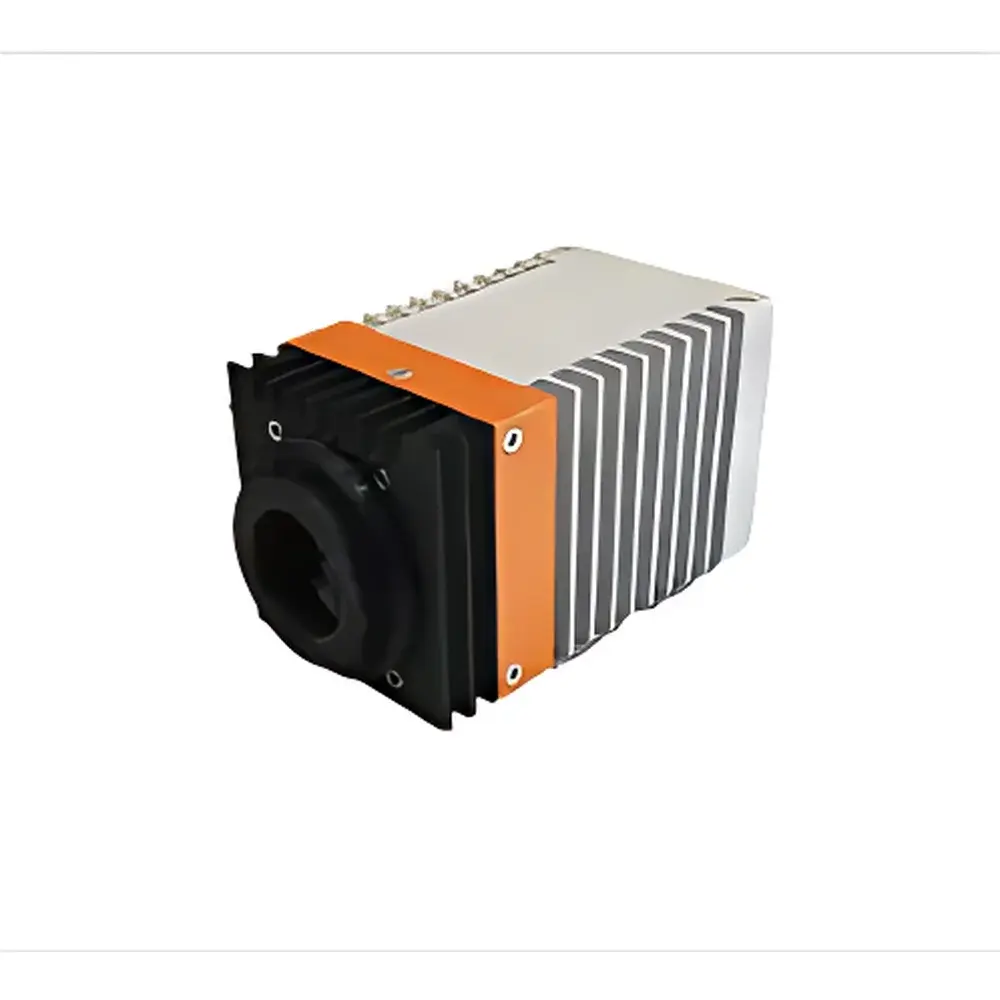
Xenics Wildcat-640-CL 100 InGaAs Area-Scan Short-Wave Infrared (SWIR) Camera
| Brand | XenICs |
|---|---|
| Origin | Belgium |
| Model | Wildcat-640-CL 100 |
| Effective Pixels | 640 × 512 |
| Pixel Size | 20 µm |
| Frame Rate | 100 Hz (configurable to 200 Hz) |
| Cooling | Thermoelectric (TE), stabilized to 0 °C at ambient |
| Interface | Camera Link or USB 3.0 (U3) |
| Readout Noise | Reduced by 30% (High Gain mode) and 200% (HDR mode) vs. predecessor |
| Full Well Capacity | >2× increase in High Gain mode |
| ROIC | Custom ROCI readout integrated circuit |
Overview
The Xenics Wildcat-640-CL 100 is a high-performance, thermoelectrically cooled area-scan short-wave infrared (SWIR) camera based on an indium gallium arsenide (InGaAs) focal plane array (FPA). Operating in the 0.9–1.7 µm spectral band, it delivers quantitative, low-noise imaging for demanding scientific, industrial, and defense applications where visible-light cameras are insufficient—such as silicon wafer inspection, laser beam profiling, active night vision, and hyperspectral imaging. Unlike uncooled SWIR sensors, the Wildcat-640-CL 100 integrates a precision TE cooler capable of stabilizing the InGaAs detector die at 0 °C under ambient conditions—a significant improvement over prior-generation Bobcat platforms (which achieve ~15–20 °C). This enhanced thermal stability directly improves dark current uniformity, temporal noise consistency, and long-exposure repeatability—critical parameters for quantitative radiometric measurement and time-series analysis.
Key Features
- 640 × 512 pixel InGaAs sensor with 20 µm pitch, optimized for high spatial resolution and optical throughput in SWIR optics.
- Configurable frame rates: up to 100 Hz at full resolution (standard), with optional firmware-enabled 200 Hz mode for high-speed transient capture.
- Custom ROCI (Readout Circuit Optimization) architecture enabling sub-electron-level readout noise performance—particularly in High Gain and HDR operational modes.
- Dual interface support: robust Camera Link Base configuration for integration into machine vision systems, plus USB 3.0 (U3) for rapid deployment, lab prototyping, and reduced cabling complexity.
- Integrated TE cooling system with closed-loop temperature regulation, maintaining detector temperature within ±0.1 °C over extended acquisitions—ensuring stable gain calibration and minimal drift.
- Extended dynamic range achieved via dual-gain architecture: High Gain mode doubles full-well capacity (>100 ke⁻) while suppressing read noise; HDR mode enables simultaneous capture of high- and low-intensity regions without saturation or loss of shadow detail.
Sample Compatibility & Compliance
The Wildcat-640-CL 100 is compatible with standard C-mount and F-mount SWIR lenses, supporting objective working distances from macro to telecentric configurations. Its quantum efficiency exceeds 70% across 1.0–1.6 µm, making it suitable for both reflective and luminescent sample interrogation—including photoluminescence mapping of III-V semiconductors, hot-carrier imaging in photovoltaic cells, and fluorescence lifetime studies using SWIR-emitting probes. The camera complies with CE, RoHS, and FCC Part 15 Class B electromagnetic compatibility standards. While not intrinsically rated for hazardous environments, its sealed aluminum housing meets IP40 specifications for dust resistance. For regulated environments, raw image data output supports traceable metadata embedding (exposure time, temperature, gain setting, timestamp), facilitating alignment with GLP/GMP documentation requirements and audit-ready workflows.
Software & Data Management
Xenics provides the fully featured Xeneth SDK (v3.5+), a cross-platform software development kit supporting Windows, Linux, and macOS. It includes native APIs for C/C++, Python (via ctypes), MATLAB, and LabVIEW, enabling seamless integration into custom acquisition pipelines and automated test benches. All acquired frames include embedded non-uniformity correction (NUC) coefficients, pixel-level bad-pixel maps, and calibrated radiometric metadata. The SDK supports hardware-triggered acquisition with microsecond-level jitter, region-of-interest (ROI) readout for increased frame rate, and real-time histogram analysis. Export formats include 16-bit TIFF, HDF5, and raw binary—preserving bit-depth fidelity for post-processing in ENVI, MATLAB Image Processing Toolbox, or custom Python-based analysis stacks. Audit trail functionality logs all user-modified acquisition parameters with timestamps, satisfying basic FDA 21 CFR Part 11 compliance prerequisites when deployed with appropriate system controls.
Applications
- Semiconductor metrology: Defect detection on silicon wafers, bond wire inspection, and through-silicon via (TSV) characterization using SWIR transmission imaging.
- Laser diagnostics: Real-time M² measurement, beam centroid tracking, and modal analysis of fiber-coupled or free-space 1064 nm/1550 nm lasers.
- Defense & surveillance: Covert illumination-based imaging under low-light conditions, camouflage discrimination, and eye-safe LIDAR receiver integration.
- Life sciences: Label-free tissue imaging exploiting endogenous SWIR chromophores (e.g., lipids, water), and NIR-II fluorescence imaging with Ag₂S or PbS quantum dot contrast agents.
- Industrial process control: Monitoring of glass tempering uniformity, polymer extrusion melt flow, and battery electrode drying kinetics via thermal emission signatures.
FAQ
What is the spectral response range of the Wildcat-640-CL 100?
The camera features a standard InGaAs photodiode array sensitive from 0.9 µm to 1.7 µm, with peak quantum efficiency near 1.55 µm.
Does the camera support radiometric calibration?
Yes—Xenics provides factory-calibrated NUC tables and optional absolute radiometric calibration kits traceable to NIST standards, enabling quantitative intensity measurement in W/cm²/sr.
Can I operate the camera in vacuum or high-humidity environments?
The standard enclosure is rated IP40; for vacuum or high-humidity operation, custom hermetic packaging or external environmental housings are required and available upon request.
Is synchronization with external equipment supported?
Yes—the camera offers TTL-compatible trigger input/output ports with programmable delay and exposure gating, enabling precise coordination with lasers, shutters, or motion stages.
What is the typical mean time between failures (MTBF) for continuous operation?
Based on accelerated life testing and field data, MTBF exceeds 25,000 hours under nominal operating conditions (25 °C ambient, 8 h/day duty cycle).





