
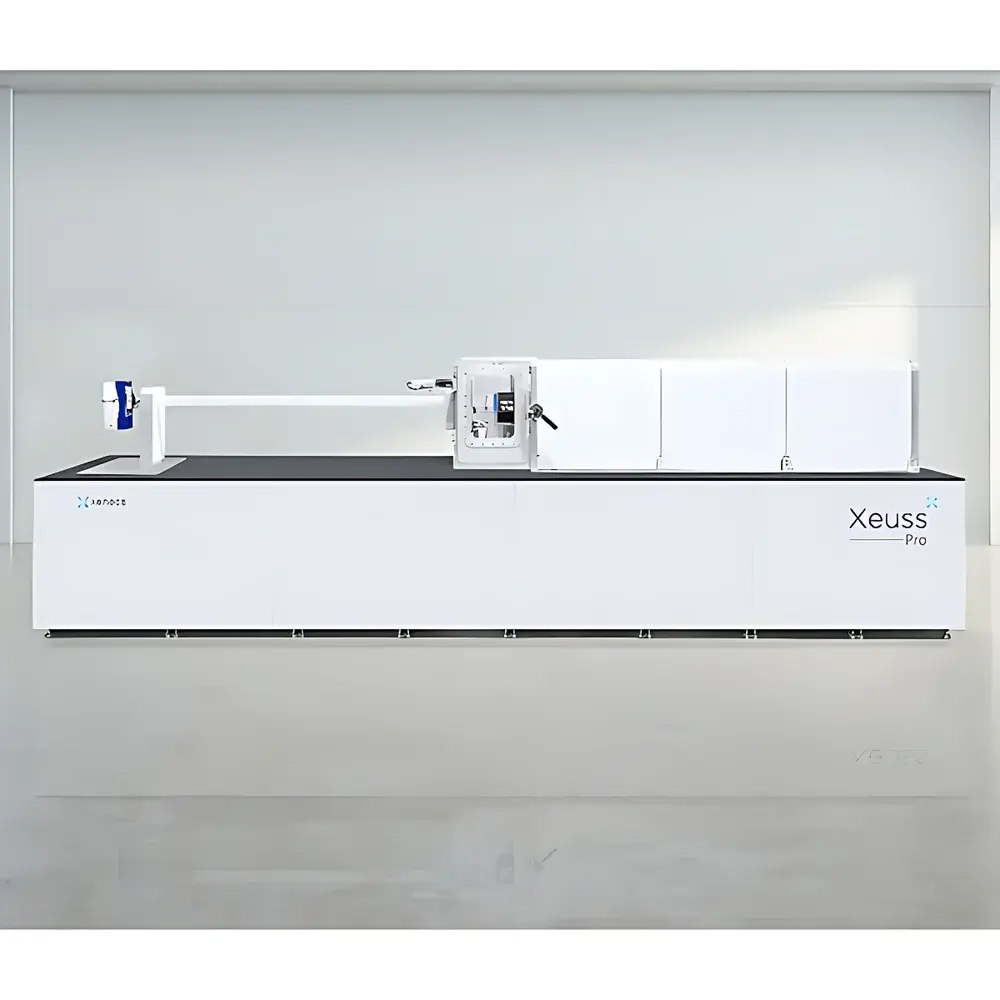
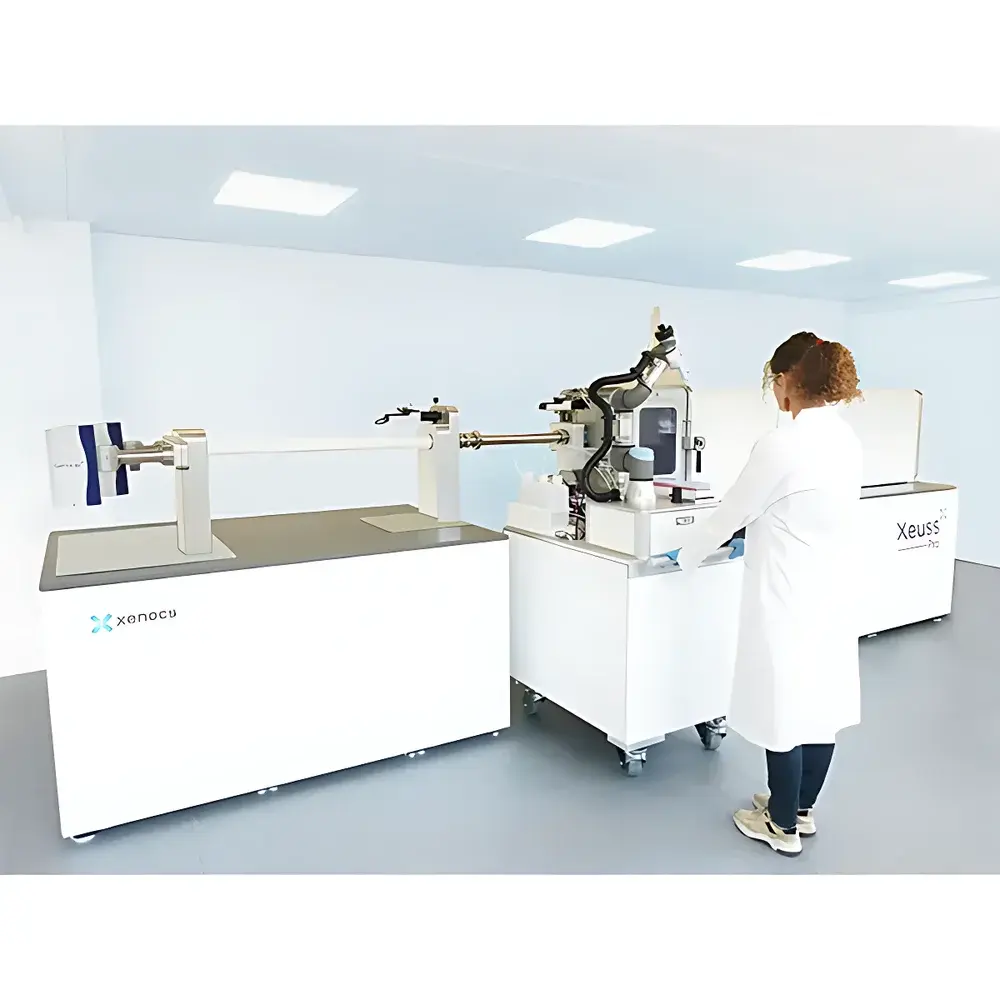
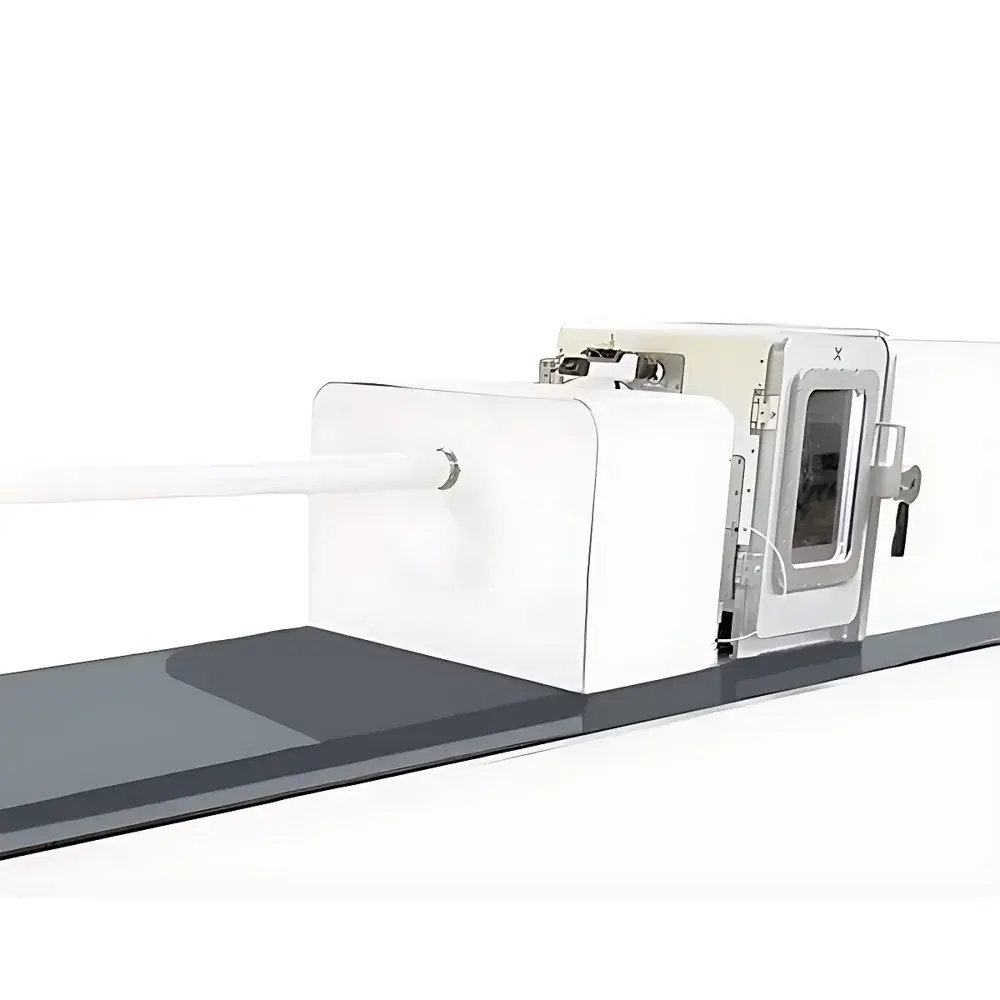
Xenocs Xeuss PRO UHR Ultra-High-Resolution Integrated SAXS/WAXS/USAXS Instrument
| Brand | Xenocs |
|---|---|
| Origin | France |
| Model | Xeuss PRO UHR |
| Instrument Type | Integrated Small-Angle and Wide-Angle X-ray Scattering (SAXS/WAXS/USAXS) System |
| Measurement Range | Up to 900 nm (calibrated with SiO₂ nanoparticle standard, not derived from 2π/qₘᵢₙ) |
| Beam Size | 30 µm (FWHM) |
| Sample Consumption | Extremely Low (µL–nL range) |
| Typical Acquisition Time | 1–30 min per measurement |
| Source Options | Automated switching between Cu, Mo, Cr microfocus sealed-tube or rotating anode sources |
| Detector | Motorized 3-axis goniometer-mounted hybrid pixel detector (e.g., EIGER2 XE) |
| GISAXS/GIWAXS Capability | Yes, with incident-angle control and dedicated data reduction pipelines |
| Beamstop-Free Acquisition | Supported via direct-beam masking and dynamic background subtraction |
| Virtual Detector Mode | Enabled for extended q-range WAXS coverage |
| Software Platform | SAXSflow™ v5.x with GLP-compliant audit trail, FDA 21 CFR Part 11-ready user management, and ISO/IEC 17025-aligned reporting templates |
Overview
The Xenocs Xeuss PRO UHR is a next-generation, fully integrated ultra-high-resolution X-ray scattering platform engineered for laboratory-based structural characterization across atomic, nanoscale, and mesoscale regimes. Released in 2024, it unifies small-angle X-ray scattering (SAXS), wide-angle X-ray scattering (WAXS), ultra-small-angle X-ray scattering (USAXS), and grazing-incidence configurations (GISAXS/GIWAXS) within a single, thermally stabilized optical bench. Its core architecture leverages advanced beam conditioning—featuring a 30 µm micro-focused beam generated by high-brilliance microfocus or rotating anode X-ray sources (Cu Kα, Mo Kα, Cr Kα) or the optional MetalJet liquid-metal jet source—to deliver exceptional q-resolution (down to ~0.0005 Å⁻¹) and signal-to-noise ratio. The system operates on the principle of elastic X-ray scattering from electron density fluctuations, enabling quantitative analysis of nanostructure morphology, long-range order, interfacial curvature, and hierarchical organization without crystallinity requirements. Designed for rigorous scientific environments, the Xeuss PRO UHR supports both static and time-resolved measurements under controlled temperature, humidity, gas atmosphere, shear, or electrochemical stimuli.
Key Features
- Automated multi-source switching: Seamless transition between Cu, Mo, and Cr radiation sources—including compatibility with MetalJet and high-power rotating anodes—for optimal contrast and resolution across diverse sample classes.
- Motorized 3-axis detector goniometer: Enables precise angular positioning for absolute calibration, off-specular GISAXS mapping, and real-time q-space rebinning.
- Beamstop-free acquisition mode: Eliminates shadow artifacts and enables continuous q-range coverage from USAXS through WAXS using dynamic direct-beam masking and pixel-level background modeling.
- Real-time 2D/1D data visualization: Live rendering of scattering patterns and azimuthally integrated intensity curves during acquisition, with on-the-fly Guinier, Porod, and Kratky analysis.
- Virtual Detector technology: Synthesizes extended WAXS coverage beyond physical detector limits via geometric projection and oversampling algorithms—critical for polymer crystallinity and phase identification.
- Modular sample environment integration: Supports BioCUBE for automated biological SAXS, XL Station for large-volume or in-situ reactor cells, robotic sample changers, and custom stages for tensile, thermal, or electrochemical testing.
Sample Compatibility & Compliance
The Xeuss PRO UHR accommodates a broad spectrum of sample forms—including solutions, gels, thin films, fibers, powders, foams, and solid composites—with minimal material requirements (nanoliter-to-microliter volumes for liquids; sub-milligram quantities for solids). Its low-dose capability preserves radiation-sensitive biomolecules and soft matter structures. All hardware and software components comply with IEC 61000-6-3 (EMC) and IEC 61000-6-4 (emission) standards. Data acquisition and processing workflows adhere to GLP and GMP principles, with full audit-trail logging, electronic signatures, and 21 CFR Part 11–compliant user access controls embedded in SAXSflow™. Method validation reports align with ISO/IEC 17025 requirements for accredited testing laboratories.
Software & Data Management
SAXSflow™ v5.x serves as the unified control, acquisition, and analysis suite. It provides automated alignment routines, batch processing pipelines for multi-sample series, and standardized reduction protocols compliant with NIST SRM reference materials. The software includes dedicated modules for anisotropic scattering analysis, form factor fitting (spheres, cylinders, lamellae), structure factor deconvolution, and Porod-invariant-based specific surface area calculation. Raw and processed datasets are stored in HDF5 format with embedded metadata (sample ID, instrument parameters, environmental conditions), ensuring FAIR (Findable, Accessible, Interoperable, Reusable) data principles. Export options include ASCII, NeXus, and CIF-compatible formats for third-party tools such as ATSAS, Scatter, or Fit2D.
Applications
- Nanoparticle & colloidal systems: Size distribution, shape anisotropy, aggregation state, and interparticle interactions in drug delivery carriers or catalysts.
- Polymers & soft matter: Crystallinity index, lamellar spacing, phase separation kinetics, and network topology in thermoplastics or hydrogels.
- Pharmaceutical formulations: Amorphous content quantification, excipient compatibility, and lyophilized matrix pore structure.
- Energy materials: Pore size distribution in battery separators, domain spacing in organic photovoltaics, and ion-conducting channel alignment in fuel cell membranes.
- Biological macromolecules: Low-resolution envelope reconstruction, oligomeric state determination, and conformational changes under ligand binding (BioSAXS mode).
- Advanced composites & thin films: Interface roughness, layer thickness, and in-plane/orientational ordering in multilayer coatings or flexible electronics.
FAQ
What is the minimum q-value achievable with the Xeuss PRO UHR, and how is it calibrated?
The system achieves qmin ≈ 0.0005 Å⁻¹ (corresponding to ~125 nm real-space periodicity), validated using NIST SRM 1963 silica nanoparticles and verified against absolute intensity standards traceable to PTB.
Does the instrument support time-resolved SAXS/WAXS experiments?
Yes—integrated shutter control, fast detector readout (up to 1 kHz frame rate with EIGER2 XE), and synchronized environmental stage triggers enable kinetic studies from milliseconds to hours.
Can GISAXS data be quantitatively modeled directly within SAXSflow™?
Yes—the software includes Parratt-based reflectivity modeling, distorted wave Born approximation (DWBA) fitting, and library-assisted pattern matching for nanostructure parameter extraction.
Is remote operation and monitoring supported?
Fully supported via secure TLS-encrypted web interface; users can monitor beam stability, detector status, and live scattering images from any location with authenticated access.
What training and application support does Xenocs provide post-installation?
Xenocs delivers on-site commissioning, operator certification workshops, and annual method optimization sessions led by application scientists with domain expertise in materials science, pharma, and structural biology.





