
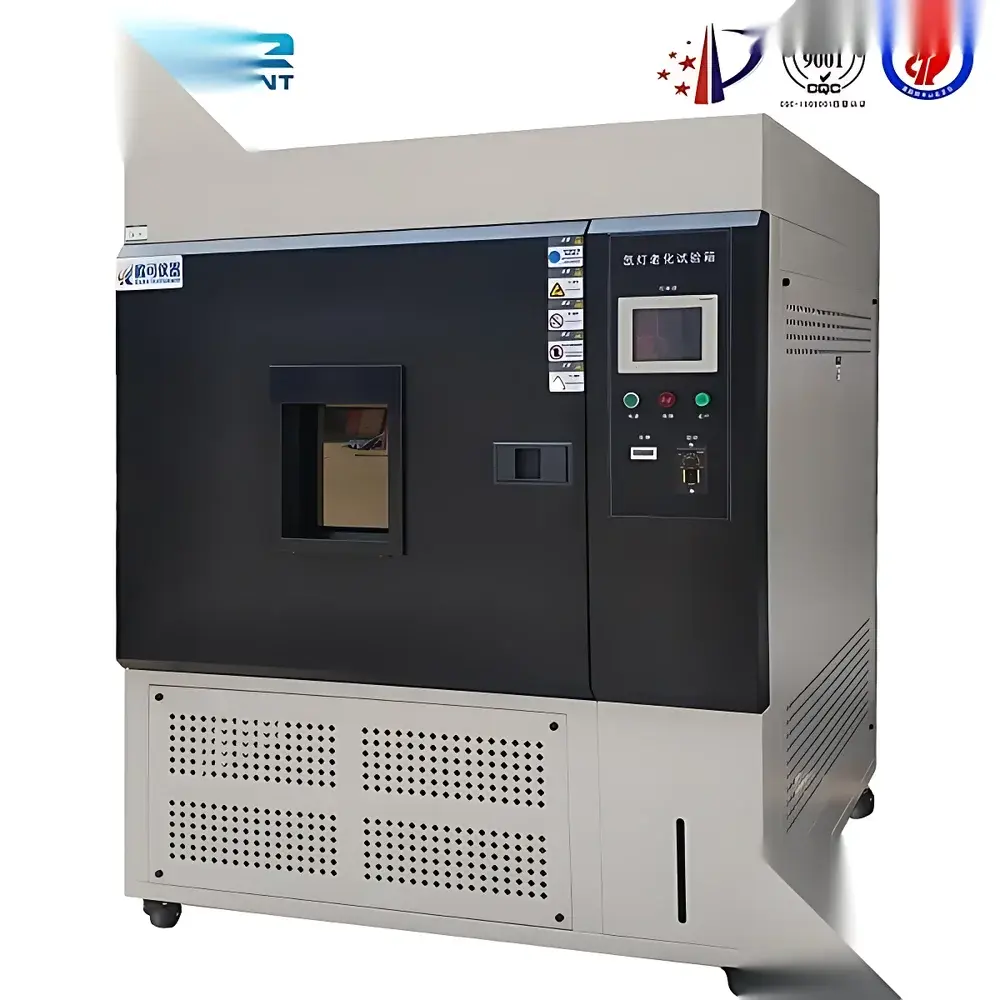
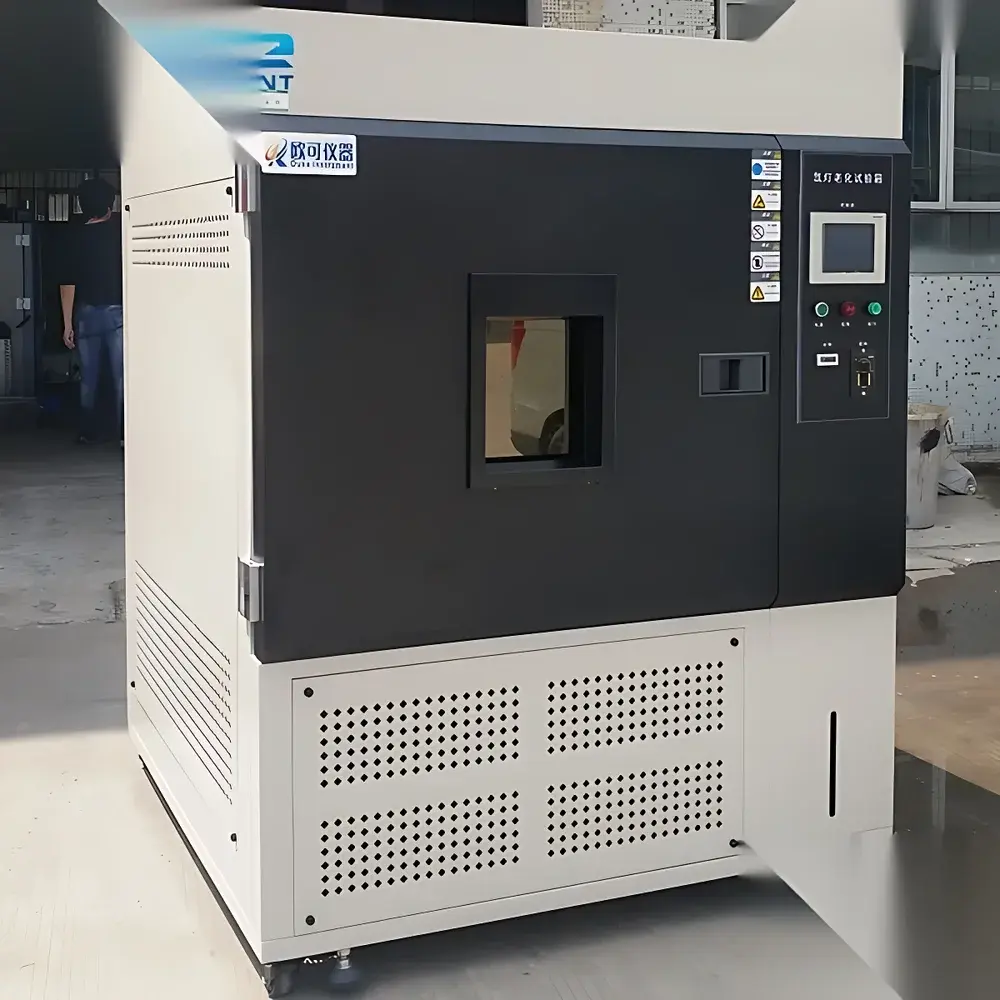
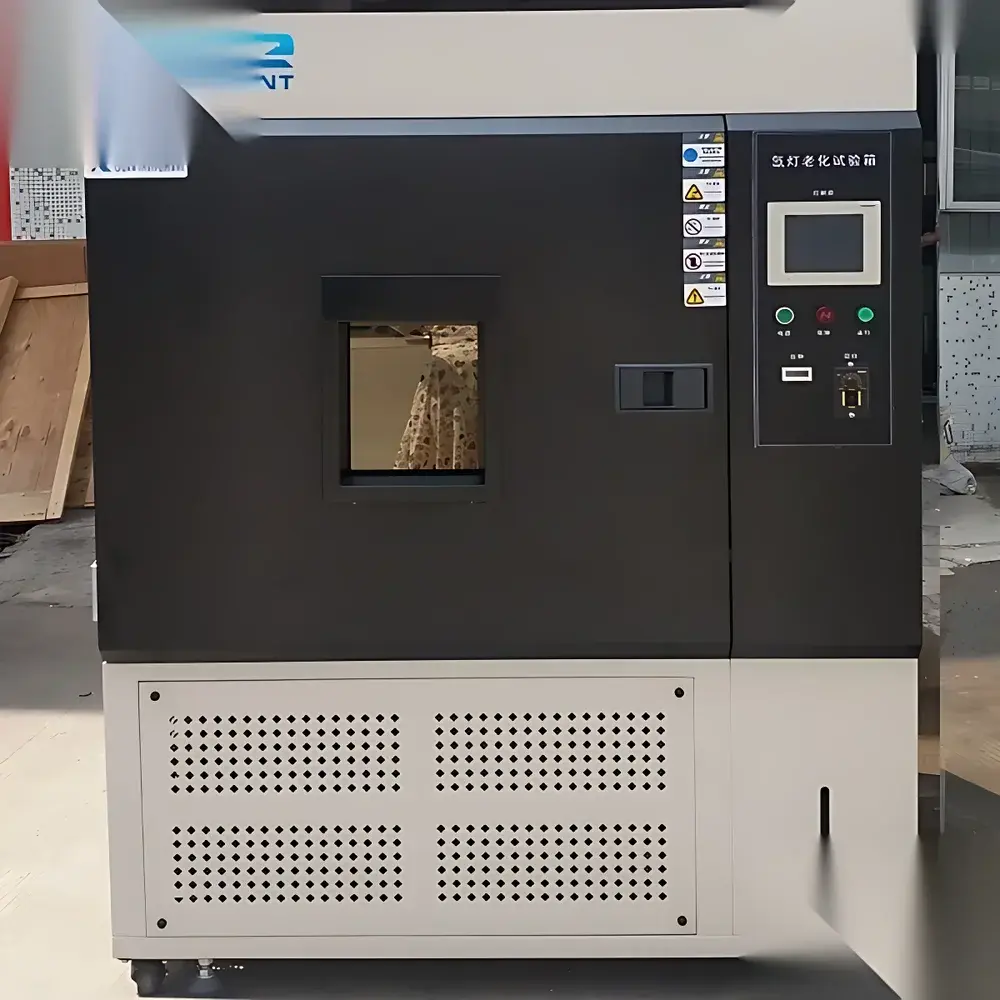
Xenon Arc Weathering Chamber with Combined Environmental Stress Testing Capability
| Brand | OEM / Custom-Built |
|---|---|
| Origin | Imported |
| Manufacturer Type | Authorized Distributor |
| Price | USD 48,500 (FOB Shanghai, ex-works price for reference only |
Overview
The Xenon Arc Weathering Chamber with Combined Environmental Stress Testing Capability is an engineered solution for accelerated material degradation testing under simulated full-spectrum sunlight, controlled thermal cycling, dynamic humidity exposure, and cyclic rain events. Based on ASTM G155, ISO 4892-2, and SAE J2527 standards, the chamber utilizes a high-intensity 9.9 kW water-cooled xenon arc lamp system emitting continuous spectral irradiance across 290–800 nm — closely replicating terrestrial solar radiation including UV-A, UV-B, visible, and near-infrared bands. Unlike UV-only fluorescent systems, this platform enables photodegradation, thermal oxidation, hydrolysis, and mechanical stress evaluation in a single integrated test environment. Its dual-axis environmental control architecture permits independent modulation of black-panel temperature (monitored via calibrated bimetallic black panel thermometer), chamber air temperature (0–80 °C), relative humidity (65–98% RH), and programmable spray cycles — enabling replication of diurnal weather patterns, desert sun exposure, tropical monsoon conditions, or automotive under-hood thermal-humidity transients.
Key Features
- Integrated multi-stress simulation: simultaneous and sequential control of xenon irradiance, temperature, humidity, and water spray
- High-fidelity spectral output: 9.9 kW water-jacketed xenon lamp with optical filter assembly compliant with ISO 4892-2 Daylight, Window Glass, and Extended UV filters
- Automated water management: built-in deionized water filtration system with conductivity monitoring (<2 µS/cm), auto-refill function, and low-water level interlock
- Precision climate control: PT100 platinum resistance sensors for temperature (±0.1 °C accuracy) and capacitive RH sensors (±1% RH accuracy), managed by a programmable microprocessor-based controller with 100-segment time/temperature/humidity/irradiance profiling
- Robust mechanical design: inner chamber constructed from mirror-finish SUS304 stainless steel; outer enclosure options include electrostatically coated carbon steel or brushed SUS304; silicone rubber gasket rated for –40 °C to +150 °C operation
- Comprehensive safety architecture: triple-layer protection including overtemperature cutoff, dry-run prevention for humidifier, xenon lamp arc-failure detection, motor thermal overload relay, earth leakage circuit breaker, and non-volatile memory retention for power interruption recovery
Sample Compatibility & Compliance
The chamber accommodates flat-panel and three-dimensional specimens up to 500 × 760 × 500 mm (D×W×H), mounted on adjustable SUS304 sample racks. It supports standard specimen holders per ASTM D7869, ISO 11341, and GB/T 16422.2. All operational parameters are traceable to NIST-calibrated references. The system meets electromagnetic compatibility (EMC) requirements per IEC 61000-6-3 and IEC 61000-6-4, and complies with CE machinery directive 2006/42/EC. For regulated industries, optional audit-ready features include 21 CFR Part 11–compliant electronic signatures, automated calibration log generation, and GLP/GMP-aligned user access control (role-based permissions, event-driven audit trails).
Software & Data Management
The embedded controller supports Ethernet connectivity and integrates with optional PC-based software for remote monitoring, real-time data logging (temperature, RH, irradiance, spray status), and export in CSV or XML format. Data timestamps are synchronized to UTC and include sensor ID, measurement uncertainty estimates, and system diagnostic flags. Historical profiles can be archived with SHA-256 checksum verification. Optional firmware upgrade path supports future integration into enterprise LIMS environments via OPC UA or Modbus TCP protocols.
Applications
This chamber serves R&D and QA laboratories in automotive (interior trim, headlamp lenses, sealants), aerospace (composite coatings, radome materials), paints & coatings (gloss retention, chalking resistance), plastics (polyolefins, engineering resins), textiles (colorfastness, tensile strength loss), and photovoltaic module encapsulant validation. It is routinely deployed for qualification per Ford CETP 00.00-L-467, GMW14124, Volkswagen PV3929, and UL 746C accelerated aging protocols.
FAQ
What xenon lamp lifetime is specified under standard operating conditions?
Rated lamp life is 1600 hours at nominal irradiance (0.35 W/m² @ 340 nm); actual service life depends on filter type, setpoint intensity, and cooling water quality.
Is the chamber compatible with ISO 11341:2019 cyclic test sequences?
Yes — the controller supports preloaded ISO 11341 cycles and allows custom sequence definition with variable irradiance ramps, dark periods, and condensation phases.
Can black-panel temperature be logged independently from chamber air temperature?
Yes — dual-channel analog inputs record both black-panel and air temperature continuously with timestamped resolution of 1 second.
Does the system support third-party calibration certificate issuance?
Yes — factory calibration certificates traceable to national metrology institutes (NMI) are available upon request; on-site calibration services supported globally via certified partners.
What is the minimum required water resistivity for the internal filtration loop?
Deionized water must maintain resistivity ≥1 MΩ·cm (conductivity ≤1 µS/cm) to prevent scaling and ensure stable lamp cooling performance.



