
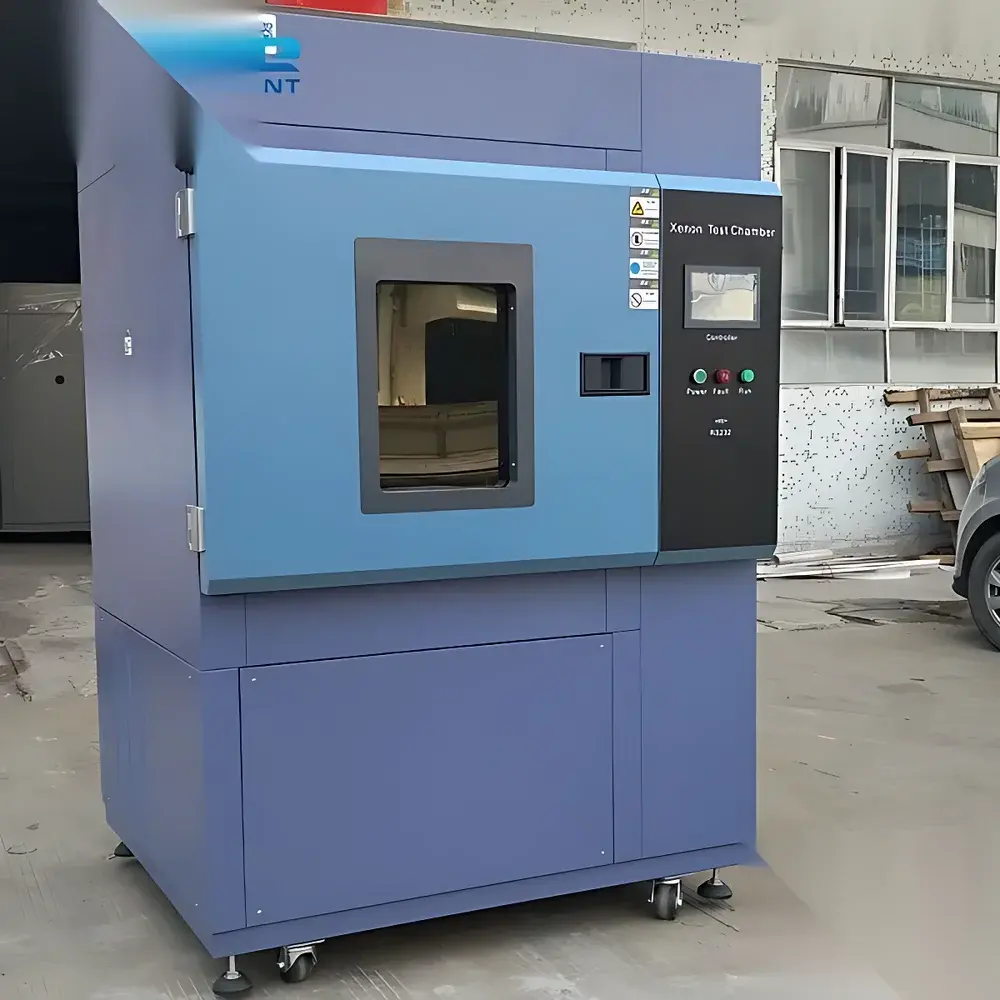
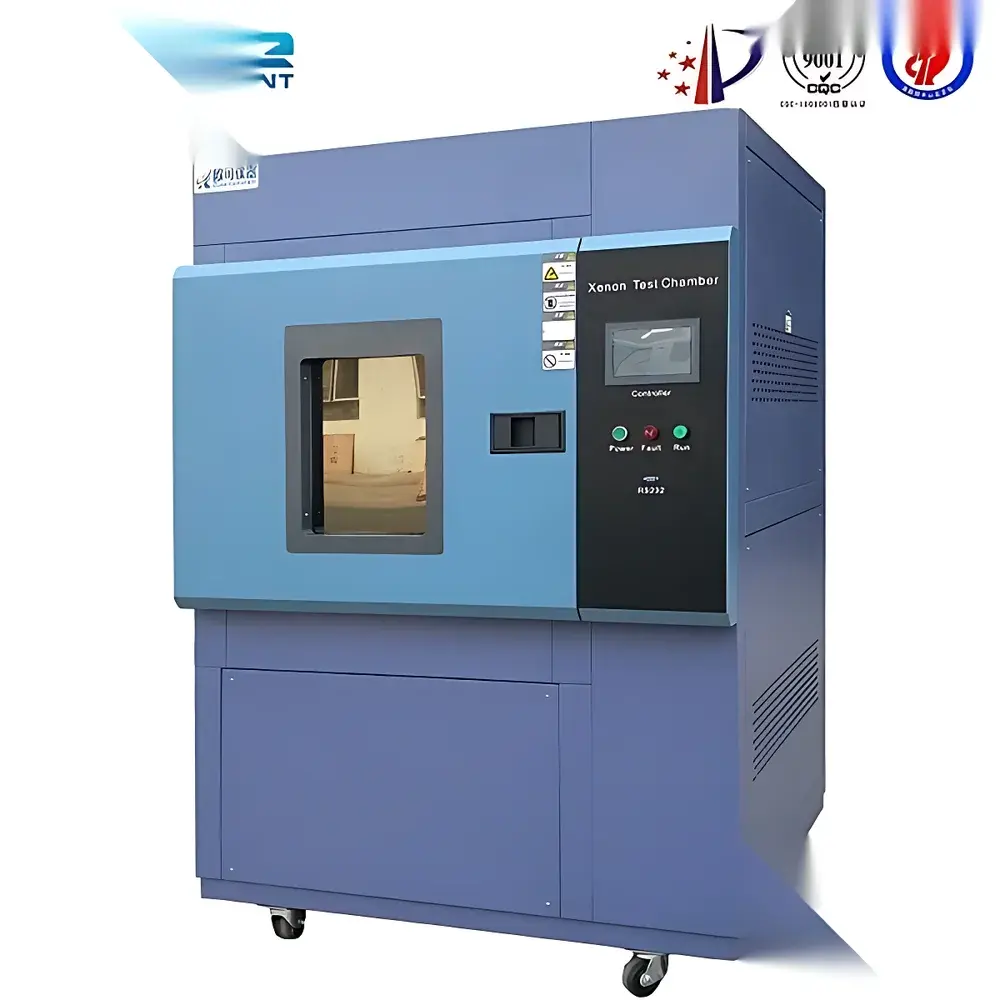
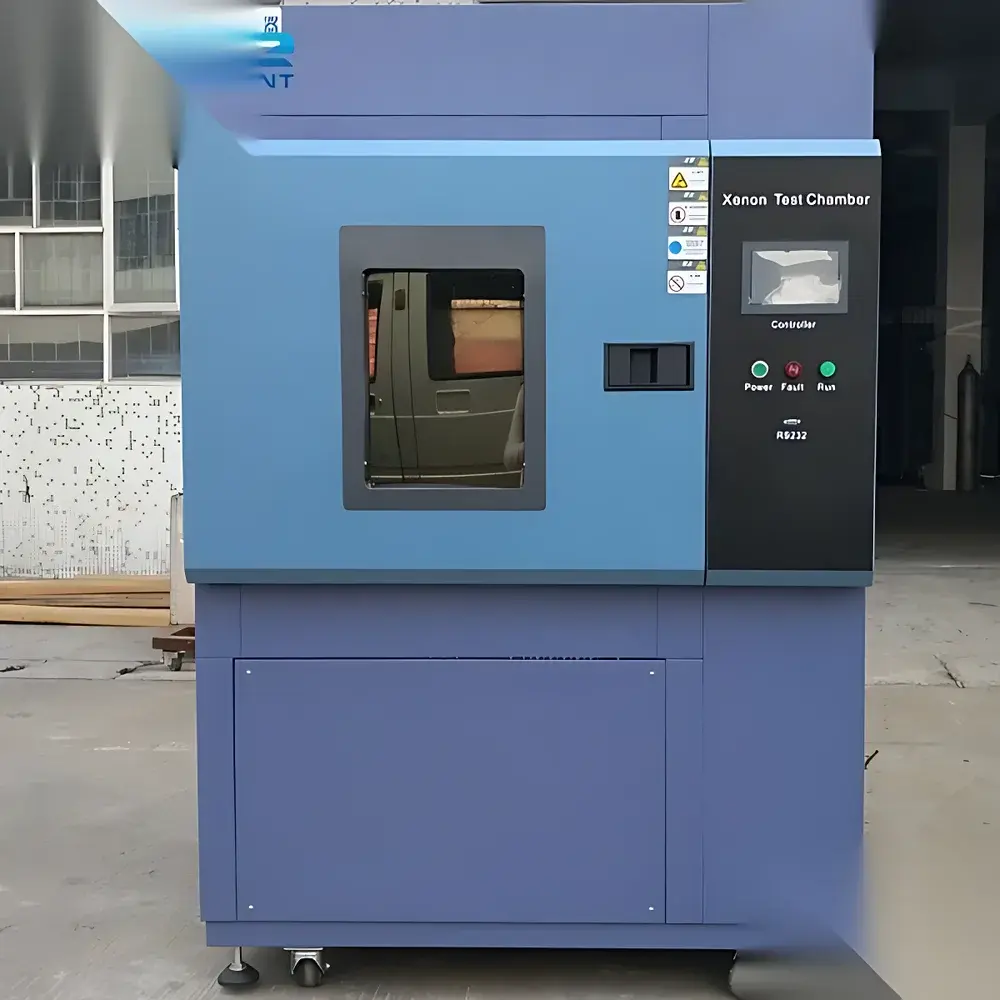
Xenon Arc Weathering Test Chamber Manufacturer
No specifications available.
Overview
The Xenon Arc Weathering Test Chamber is an engineered environmental simulation system designed to replicate the damaging effects of natural sunlight, heat, and moisture on materials—enabling accelerated aging assessment under controlled, repeatable conditions. Based on the principle of xenon arc irradiation, it employs a high-intensity, water-cooled 6 kW full-spectrum xenon lamp that closely matches the solar spectral power distribution (SPD) from 290 nm to 800 nm. This spectral fidelity—particularly in the critical UV-A, visible, and near-infrared regions—ensures realistic photochemical degradation pathways for polymers, coatings, textiles, automotive interiors, and architectural finishes. The chamber integrates precise irradiance control (550 W/m² ±5 W/m² within 350–850 nm), black panel temperature monitoring (53°C ±3°C), and programmable wet/dry cycles, making it suitable for standardized testing per ISO 4892-2, ASTM G155, SAE J2527, and GB/T 16422.2.
Key Features
- 6 kW water-cooled xenon arc lamp with >1,000-hour service life and electronic auto-triggering (trigger time 10 min)
- Full-spectrum output (290–800 nm) with external filter system: 0% transmission below 255 nm; ≥90% transmission between 400–800 nm
- Precise irradiance regulation at user-selectable monitoring wavelengths (e.g., 340 nm or 365 nm), with closed-loop feedback control
- Temperature range: ambient +10°C to 70°C; uniformity ±2°C across test area; stability ±1°C
- Rotating sample carousel (≥1 rpm, infinitely variable speed) ensuring uniform exposure across all specimens
- Programmable rain cycle options: e.g., 60 min irradiation / 12 min spray or 102 min irradiation / 18 min spray
- Water spray system operating at 78–127 kPa pressure, integrated with deionized water filtration
- Touchscreen programmable controller supporting multi-segment profiles, real-time data logging, and alarm history
- Robust stainless-steel interior chamber (standard internal dimensions: 950 × 950 × 900 mm); optional configurations available (e.g., 600 × 800 × 850 mm up to 1000 × 1000 × 1000 mm)
Sample Compatibility & Compliance
This chamber accommodates flat or three-dimensional samples mounted on rotating fixtures or static racks—compatible with standard specimen holders per ISO 4892 and ASTM D2565. It supports both horizontal and vertical lamp orientations (configurable per model variant), enabling optimal geometry alignment for automotive trim, façade panels, or flexible film substrates. All operational parameters—including irradiance setpoints, temperature ramps, humidity levels (in humidity-equipped variants), and spray timing—are traceable and auditable. The system architecture supports GLP-compliant data integrity requirements when paired with validated software: audit trails, electronic signatures, and 21 CFR Part 11–ready export formats are achievable via optional firmware modules. Calibration certificates for irradiance sensors and PT100 black panel thermometers are provided upon installation and recommended annually.
Software & Data Management
The embedded controller runs deterministic real-time firmware with non-volatile memory for profile storage and event logging. Users define multi-step test programs—including ramp/soak sequences, irradiance modulation, and synchronized spray activation—via an intuitive graphical interface. Logged parameters include chamber air temperature, black panel temperature, irradiance (W/m²), elapsed time, and fault codes. Data export is supported via USB or Ethernet (Modbus TCP) to external LIMS or QA systems. Optional PC-based software enables remote monitoring, trend analysis, deviation reporting, and PDF report generation compliant with internal QA protocols and external certification bodies (e.g., TÜV, SGS, UL).
Applications
- Accelerated weathering validation of automotive exterior plastics, paints, and sealants per SAE J2412/J2527
- UV resistance qualification of aerospace polymer composites and cabin interior materials
- Colorfastness and gloss retention testing for architectural coatings and roofing membranes (ASTM D4303, ISO 11341)
- Photostability assessment of medical device packaging and pharmaceutical primary containers
- Quality assurance for textile dyes, geotextiles, and outdoor signage materials
- Comparative durability benchmarking across material formulations during R&D stage
FAQ
What spectral range does the xenon lamp cover, and how is UV cut-off managed?
The lamp emits from 290 nm to 800 nm. External borosilicate and quartz filters suppress wavelengths below 255 nm while maintaining ≥90% transmittance between 400–800 nm—matching terrestrial solar irradiance profiles.
Is irradiance calibration traceable to national standards?
Yes. The irradiance sensor is factory-calibrated against NIST-traceable reference cells; annual recalibration is recommended and supported by certified service partners.
Can the chamber operate continuously for extended test durations (e.g., 1,000+ hours)?
Yes. With scheduled lamp replacement (>1,000 h rated life), filtered water supply, and routine maintenance (filter cleaning, sensor verification), uninterrupted operation meets ISO 4892-2 cycle requirements.
Does the system support humidity control?
Humidity capability (30–90% RH) is available in designated model variants (e.g., Type C); standard models maintain ambient humidity only.
What electrical infrastructure is required for the 6 kW lamp configuration?
A dedicated 380 V / 50 Hz three-phase supply with ≥9 kW total capacity and appropriate circuit protection is mandatory; cooling water supply (≤30°C inlet, ≥2 L/min flow) must also be provisioned.



