
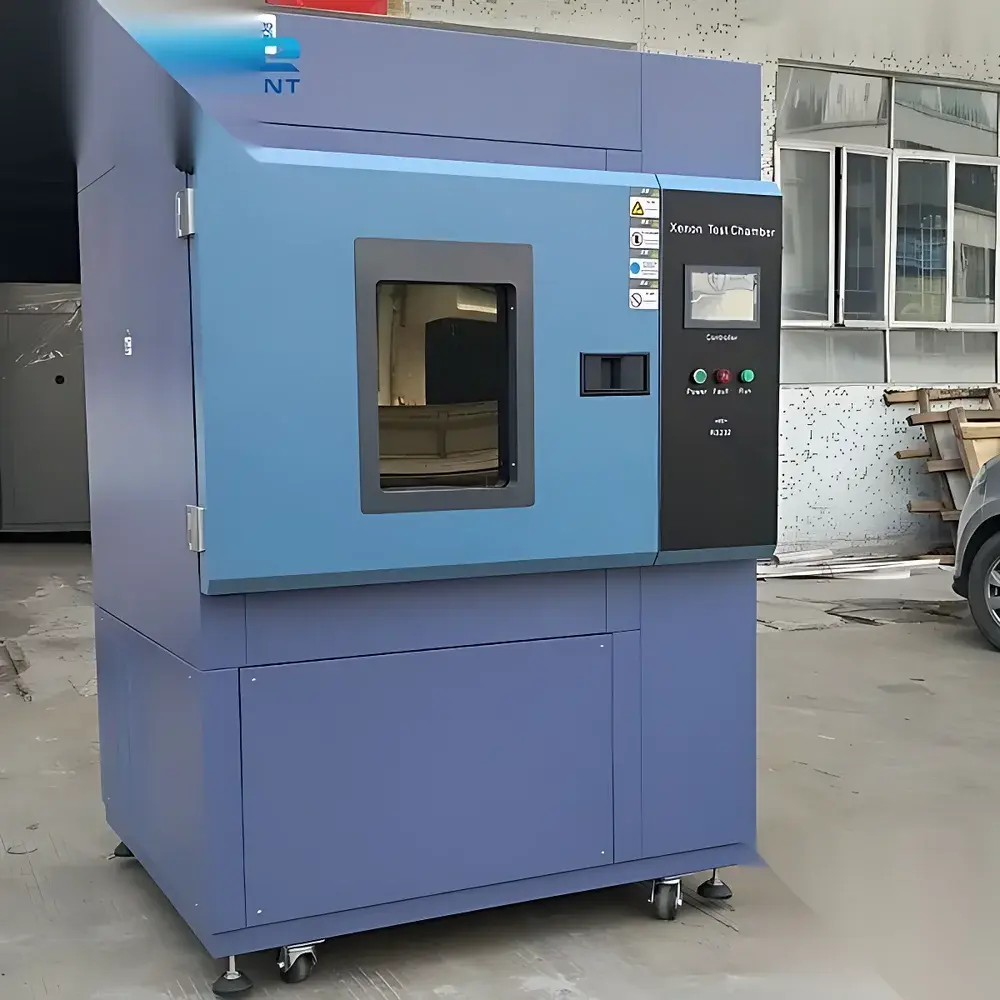
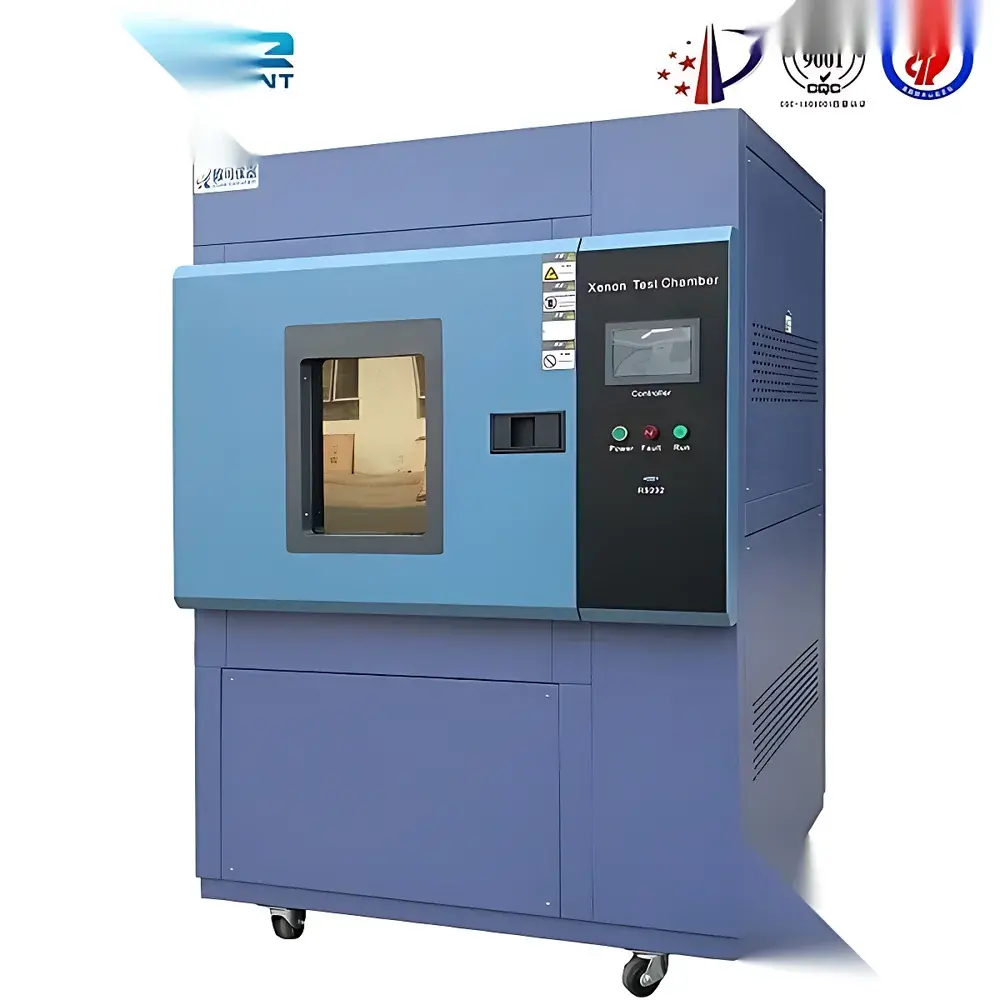
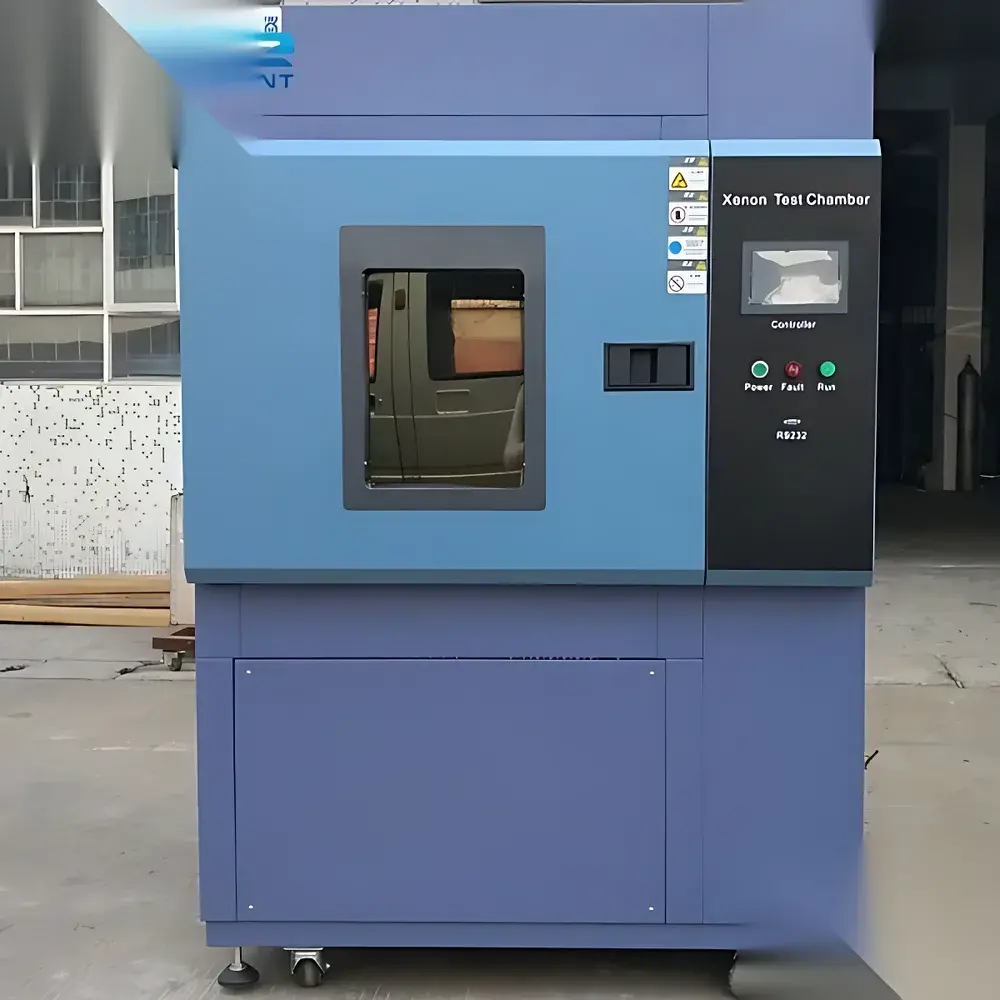
Xenon Arc Weathering Test Chamber – Model XW-800
| Key | Irradiance at 340 nm: 0.5 W/m² |
|---|---|
| Irradiance at 300–400 nm | 60 W/m² |
| Test Chamber Interior Dimensions (H×D×W) | 800 × 900 × 800 mm |
| Lamp Type | 4500 W water-cooled xenon arc lamp |
| Filter Options | Borosilicate (267–800 nm) or Soda-lime (300–800 nm) |
| Sample Turntable Diameter | 690 ± 3 mm |
| Construction | Interior and exterior of SUS#304 stainless steel (1.0 mm thickness, brushed finish interior / powder-coated exterior) |
Overview
The Xenon Arc Weathering Test Chamber – Model XW-800 is an engineered environmental test system designed to simulate and accelerate the effects of solar radiation, temperature, and humidity on materials under controlled laboratory conditions. Based on the principle of xenon arc irradiation—closely replicating the full-spectrum solar output from UV through visible to near-infrared—the chamber enables quantitative assessment of photodegradation, color fading, gloss loss, cracking, chalking, and polymer embrittlement. Its spectral distribution complies with internationally recognized weathering standards including ISO 4892-2, ASTM G155, SAE J2527, and AATCC TM16, supporting reproducible, traceable, and auditable testing in R&D, quality assurance, and regulatory compliance workflows.
Key Features
- High-power 4500 W water-cooled xenon arc lamp with integrated voltage stabilization circuitry ensures long-term irradiance stability and minimal spectral drift over extended test cycles.
- Dual-filter configuration support: borosilicate glass (transmission range 267–800 nm) for UV-aggressive simulations and soda-lime glass (300–800 nm) for broader-spectrum, daylight-relevant exposure profiles.
- Programmable irradiance control with real-time feedback monitoring at 340 nm (0.5 W/m²) and broadband (300–400 nm, 60 W/m²), meeting calibration requirements per ISO 17025-accredited procedures.
- Touchscreen HMI controller with multi-language interface supports flexible test sequencing—including continuous irradiation, light/dark cycling (DEWCYCLE), cumulative radiant exposure tracking, and user-defined time-based ramping of temperature and humidity.
- Robust stainless steel construction: interior chamber fabricated from 1.0 mm SUS#304 brushed-finish stainless steel for corrosion resistance and ease of cleaning; exterior finished with electrostatic powder coating over SUS#304 substrate for durability and thermal insulation integrity.
- Integrated air handling system with precision PID-controlled heating, refrigeration, and steam humidification maintains stable chamber conditions across defined operating ranges (typically 10–80°C, 10–95% RH non-condensing).
Sample Compatibility & Compliance
The XW-800 accommodates flat or three-dimensional specimens up to 690 mm in diameter on its motorized turntable, ensuring uniform angular exposure and minimizing edge-shadowing artifacts. Specimen holders are compatible with standard ISO 105-B02, ASTM D2244, and GB/T 16422.2 mounting fixtures. All operational parameters—including irradiance setpoints, chamber temperature/humidity profiles, cycle durations, and total exposure dose—are logged with timestamped metadata, satisfying documentation requirements for GLP, GMP, and FDA 21 CFR Part 11-compliant environments when paired with validated software audit trails. The system’s optical and thermal performance is verified against NIST-traceable reference sensors and calibrated radiometers prior to shipment.
Software & Data Management
The embedded controller provides local data logging of irradiance, chamber temperature, relative humidity, lamp voltage/current, and system status at configurable intervals (1–60 s). Trend visualization tools enable real-time overlay of up to four parameters, with export capability to CSV for post-test analysis in MATLAB, Excel, or LIMS platforms. Optional Ethernet/IP connectivity supports remote monitoring, centralized fleet management via SCADA-compatible protocols, and integration into enterprise QA databases. Firmware updates are delivered via secure USB import and include version-controlled change logs compliant with IEC 62304 software lifecycle requirements.
Applications
This chamber is routinely deployed across automotive OEMs for evaluating dashboard trim, exterior coatings, and headlamp lenses; in textile laboratories assessing colorfastness per ISO 105-B02 and AATCC TM16-2021; in packaging R&D for UV barrier validation of laminated films and ink systems; and in polymer science for studying photo-oxidative degradation kinetics of polyolefins, PVC, and engineering thermoplastics. It also serves as a primary tool for qualification testing of outdoor signage, architectural sealants, and photovoltaic encapsulant materials under accelerated aging protocols aligned with IEC 61215 and UL 1703.
FAQ
What spectral filters are included standard with the XW-800?
The system ships with both borosilicate and soda-lime filter options, pre-aligned and mechanically secured for rapid interchange without recalibration.
Is irradiance calibration performed before delivery?
Yes—each unit undergoes full spectral irradiance mapping using a NIST-traceable spectroradiometer, and a calibration certificate documenting 340 nm and broadband output is provided with shipment.
Can the chamber operate unattended for multi-week test cycles?
Absolutely—the controller supports scheduled power-on/off, automatic fault recovery, email/SMS alerts (via optional gateway), and continuous data logging to internal flash memory with 30-day buffer capacity.
Does the system meet ISO/IEC 17025 requirements for accredited labs?
When operated with documented SOPs, periodic verification using certified reference materials, and maintained calibration records, the XW-800 meets the technical competence criteria outlined in ISO/IEC 17025:2017 Clause 6.4 for equipment used in accredited testing.
What maintenance intervals are recommended for the xenon lamp and filters?
Lamp replacement is advised every 1500 hours of operation; filter inspection and cleaning should occur biweekly, with replacement every 500 hours or after visible haze or microcracking is observed.
Related Products



