
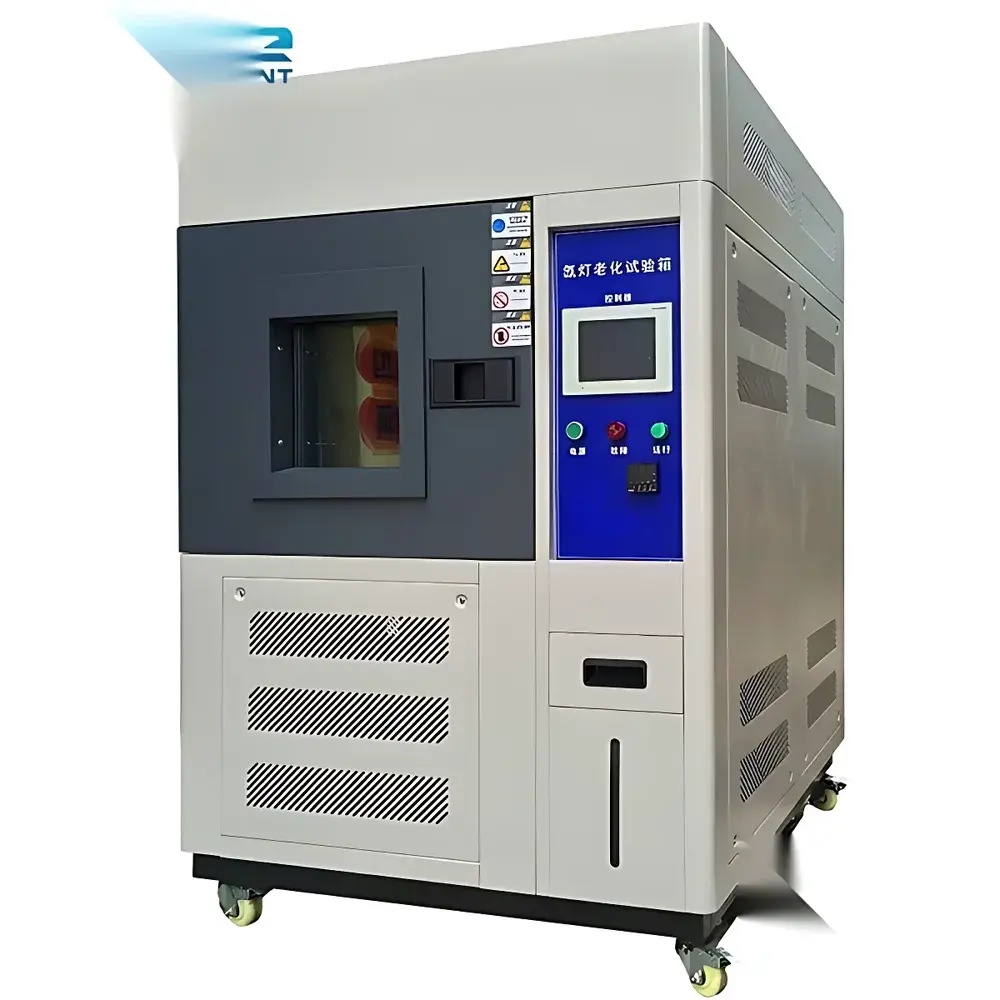
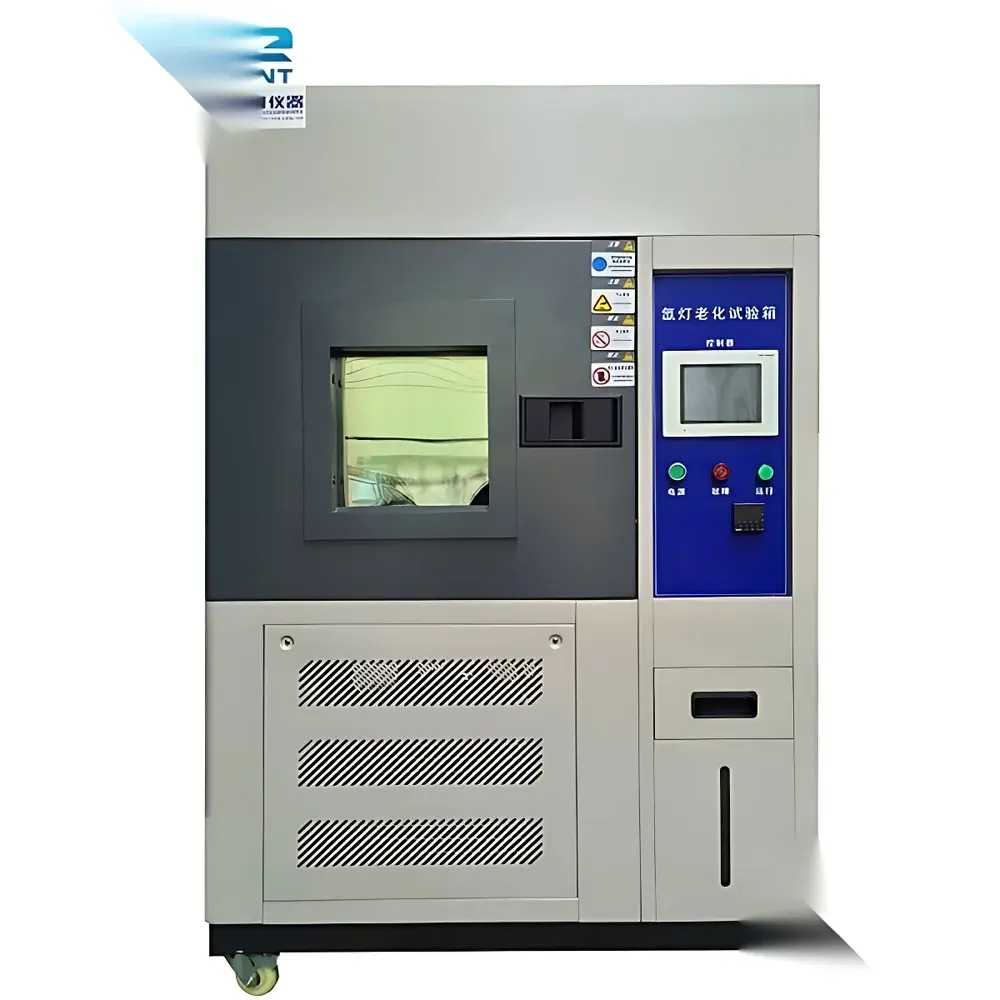
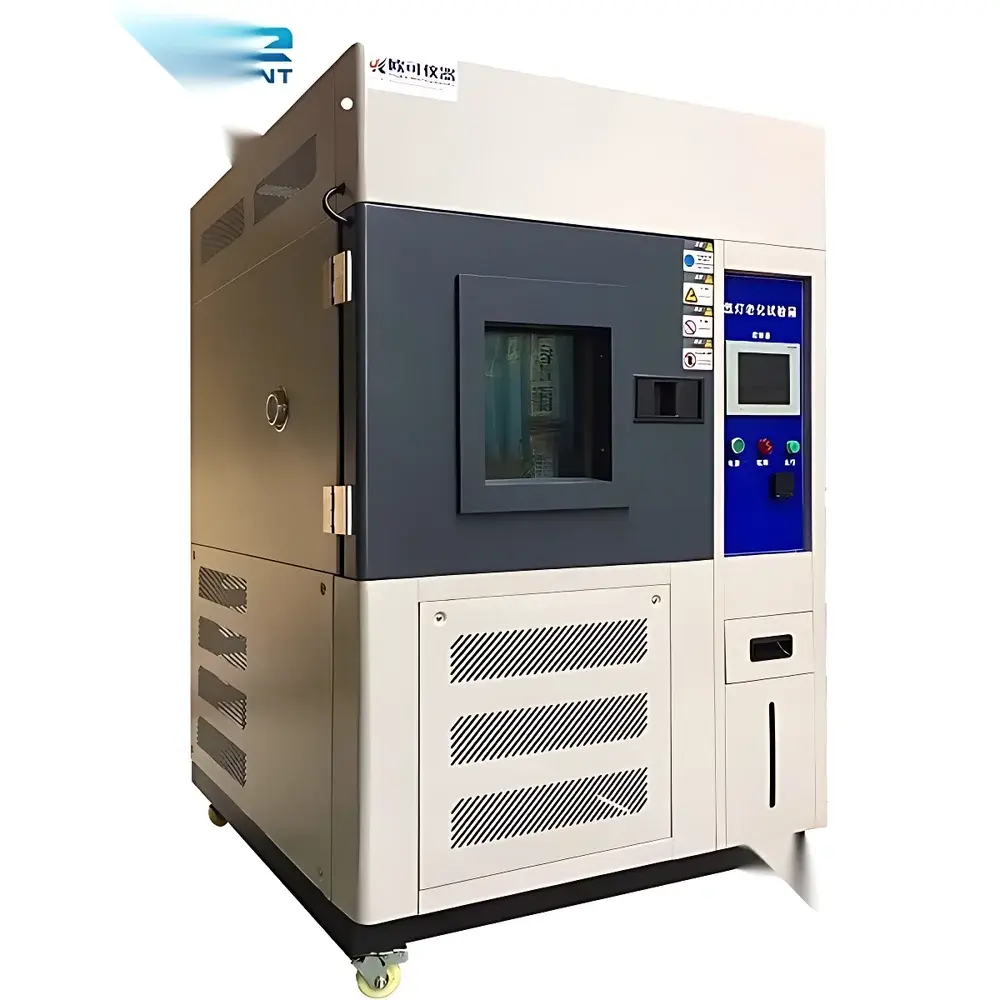
Xenon Arc Weathering Test Chamber OK-XD-1000
| Brand | Other Brands |
|---|---|
| Origin | Imported |
| Manufacturer Type | Authorized Distributor |
| Internal Dimensions (W×D×H) | 1000 × 1000 × 1000 mm |
| External Dimensions (W×D×H) | 1850 × 1350 × 1550 mm |
| UV-A Spectral Range | 320–380 nm |
| Irradiance Control Range | 0.7 W/m² @ 340 nm (adjustable) |
| Humidity Range (Irradiation Mode) | 45–80% RH |
| Condensation Humidity | ≥95% RH |
| Condensation Temperature Range | 40–60°C (±3°C tolerance) |
| Light Exposure Temperature Range | 50–60°C (±3°C tolerance) |
| Black Panel Temperature Range | 30–60°C (±1°C tolerance) |
| Temperature Resolution | 0.1°C |
| Water Tray Depth | ≤30 mm with Auto-Water Supply Control |
| Irradiance Measurement | Fixed-position UV radiometer with high-accuracy digital display |
| Cycle Programming | Independent and combined irradiation/condensation cycles, programmable up to 999 hours per segment |
| Electrical Components | Schneider (France) control modules |
Overview
The OK-XD-1000 Xenon Arc Weathering Test Chamber is an engineered environmental simulation system designed to replicate the damaging effects of sunlight, moisture, and heat on polymeric materials, coatings, textiles, automotive components, and outdoor signage. It employs a wind-cooled xenon arc lamp as its primary radiation source—mimicking the full solar spectrum (290–800 nm) with spectral filtering to emphasize UV-A (320–380 nm), critical for accelerated photochemical degradation studies. Unlike water-cooled systems, this model utilizes forced-air cooling for lamp thermal management, reducing infrastructure requirements while maintaining stable irradiance output and long-term lamp life. The chamber supports ASTM G155, ISO 4892-2, SAE J2527, and GB/T 16422.2 test protocols, enabling correlation with real-world outdoor exposure data under controlled laboratory conditions.
Key Features
- Wind-cooled xenon arc lamp system with Philips electronic ballasts and starters—ensuring reliable ignition and consistent spectral output across extended operation cycles.
- Fixed-position UV radiometer calibrated to 340 nm, eliminating manual probe repositioning and enhancing measurement reproducibility between tests.
- Black panel temperature sensor mounted on anodized aluminum surface—providing direct material-relevant thermal feedback with ±1°C accuracy, essential for correlating thermal stress with photodegradation kinetics.
- PID self-tuning temperature controller for precise regulation of chamber air and black panel temperatures during both irradiation (50–60°C) and condensation (40–60°C) phases.
- Programmable dual-mode cycling: independent or alternating irradiation and condensation sequences, each configurable up to 999 hours with user-defined dwell times and transition logic.
- Integrated auto-refill water tray (≤30 mm depth) with level sensing—maintaining consistent condensation humidity (>95% RH) without manual intervention.
- Compliance-grade electrical architecture featuring Schneider contactors, relays, and circuit protection—designed for continuous-duty industrial environments and GLP-compliant lab operations.
Sample Compatibility & Compliance
The OK-XD-1000 accommodates flat-panel specimens up to 1000 mm × 1000 mm × 50 mm (W×D×H), with adjustable sample racks permitting vertical or angled mounting per ISO 4892-2 orientation requirements. Its UV-A spectral distribution and irradiance stability meet the spectral power distribution (SPD) tolerances specified in ASTM G155 Class A and ISO 4892-2 Method B. Humidity control adheres to the dew-point-based condensation methodology defined in IEC 60068-2-30. The system’s closed-loop control architecture supports audit-ready operation under GLP and GMP frameworks, with optional data logging compatible with FDA 21 CFR Part 11–compliant software platforms (available separately).
Software & Data Management
While the standard OK-XD-1000 operates via an embedded touchscreen HMI with non-volatile cycle memory, optional PC-based control software enables remote monitoring, real-time irradiance trending, alarm event logging, and export of timestamped CSV datasets. All temperature, humidity, irradiance, and cycle-state parameters are recorded at user-selectable intervals (1–60 min). Audit trails include operator ID, parameter changes, and system faults—supporting traceability in regulated quality assurance workflows. Data integrity safeguards include write-protected storage and checksum-verified backups.
Applications
This chamber is routinely deployed in R&D laboratories and QC departments for evaluating color fade resistance (ΔE*), gloss retention, chalking, cracking, and tensile property loss in paints, plastics, elastomers, and architectural sealants. Automotive Tier-1 suppliers use it for validating exterior trim durability per SAE J2527; aerospace OEMs apply it to assess UV resistance of composite laminates per Boeing D6-17487. Academic researchers leverage its programmable condensation cycles to study hydrolytic degradation mechanisms in biodegradable polymers under simulated subtropical climates.
FAQ
Does the OK-XD-1000 comply with ASTM G155 and ISO 4892-2?
Yes—the spectral filter configuration, irradiance uniformity, and black panel temperature control meet the Class A requirements of ASTM G155 and Method B of ISO 4892-2.
Is lamp calibration required before each test?
No—the fixed-position radiometer eliminates daily recalibration; however, annual NIST-traceable verification of the UV sensor is recommended for metrological continuity.
Can the chamber operate unattended for multi-day cycles?
Yes—its auto-refill water system, thermal cutouts, and redundant safety interlocks enable safe 24/7 operation up to 999-hour continuous or segmented cycles.
What maintenance is required for the xenon lamp assembly?
Lamp replacement is typically needed every 1,500–2,000 hours of operation; Philips ballasts extend lamp life by minimizing current surge during ignition.
Is third-party validation support available?
Yes—qualified service engineers provide IQ/OQ documentation packages aligned with ISO/IEC 17025 and pharmaceutical equipment qualification standards.



