
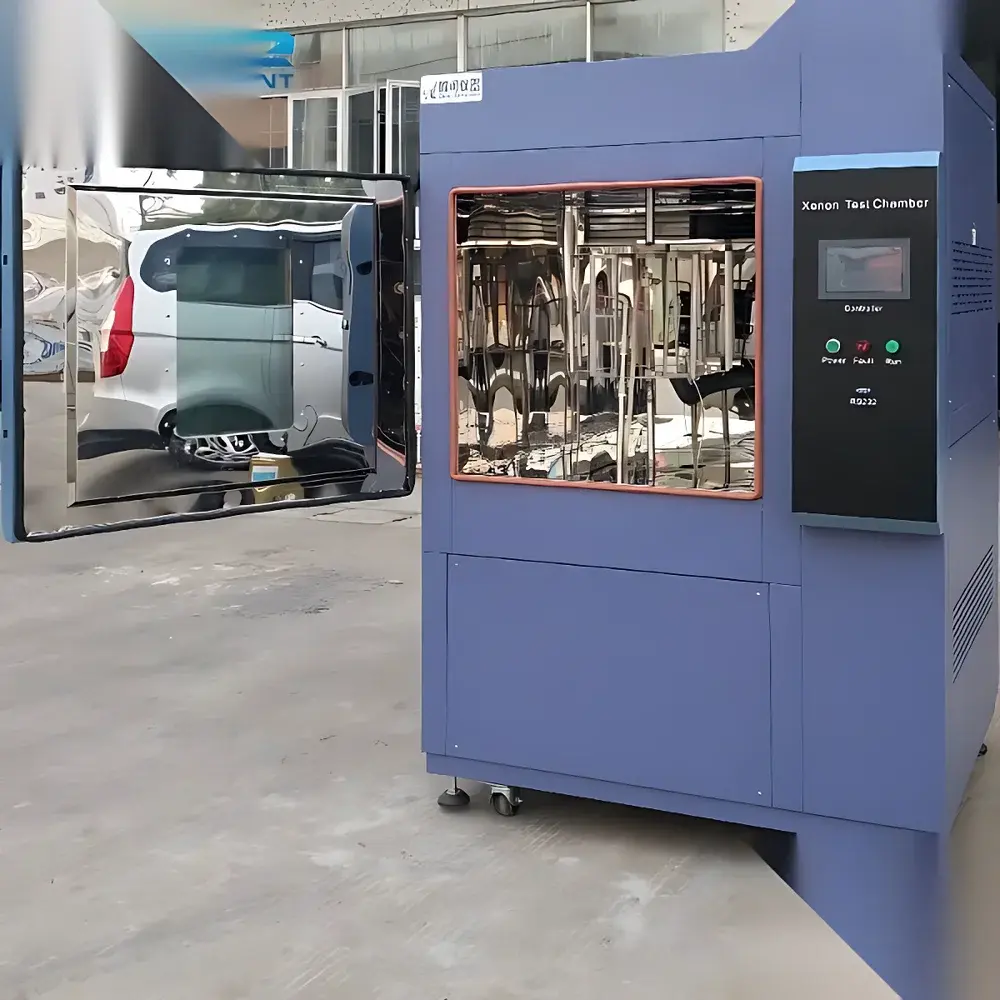
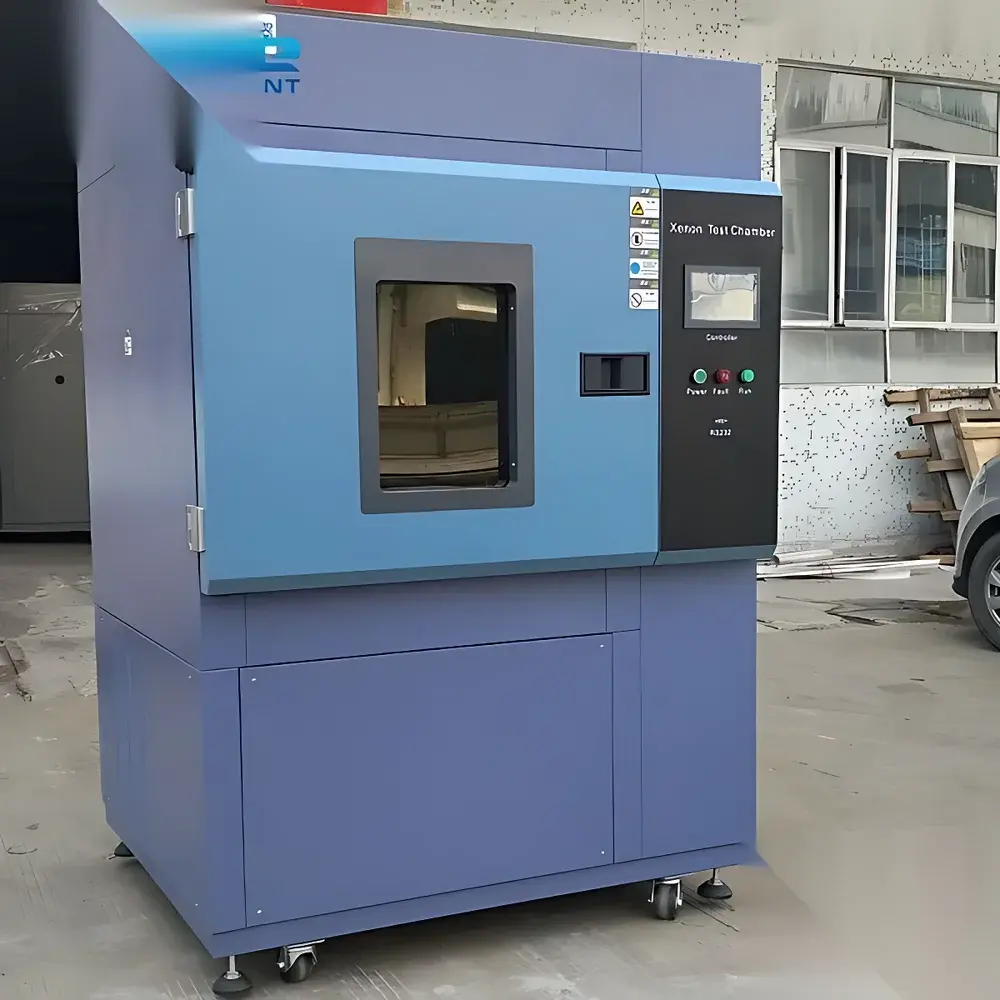
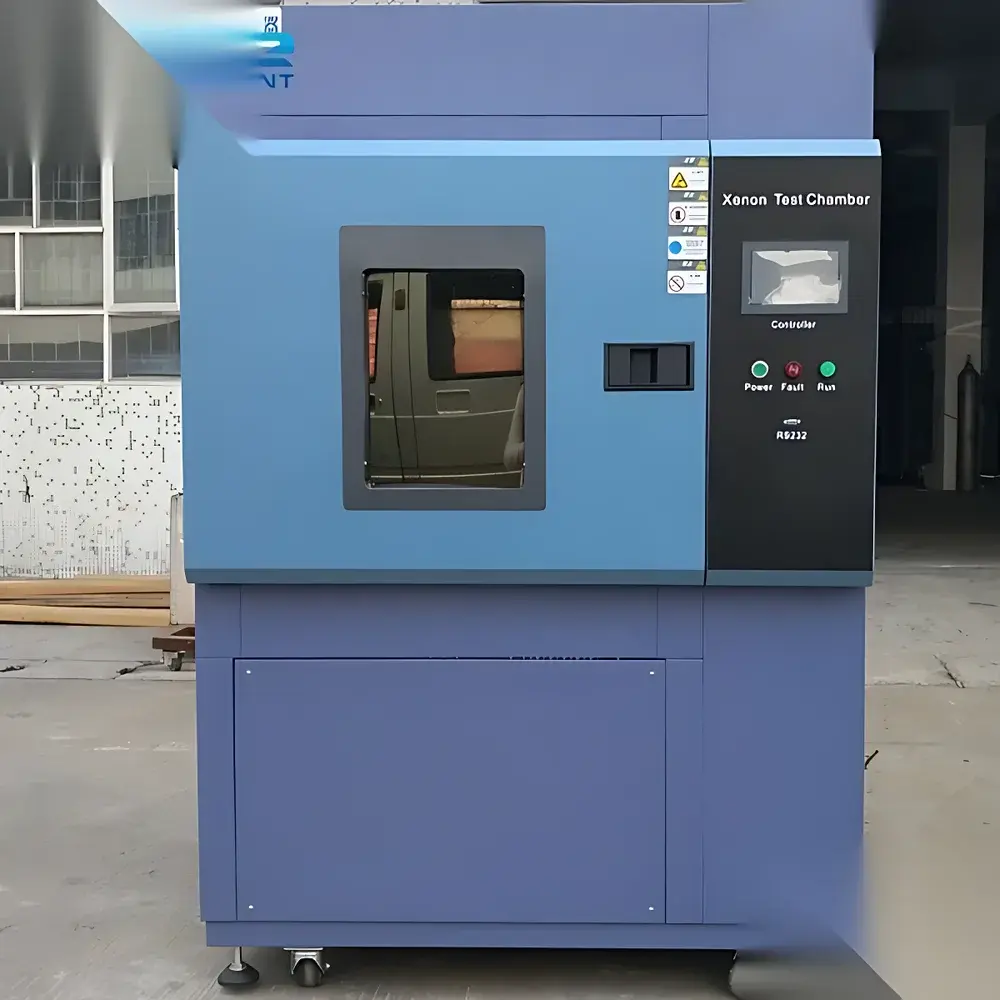
Xenon Arc Weathering Test Chamber OK-XD Series
| Brand | Other Brands |
|---|---|
| Origin | Imported |
| Manufacturer Type | General Distributor |
| Price | USD 5,300 (Reference Only) |
| Chamber Models | OK-XD-100 / OK-XD-225 / OK-XD-500 / OK-XD-1000 |
| Internal Dimensions (W×D×H, cm) | 50×50×40 / 50×75×60 / 80×80×80 / 100×100×100 |
| Temperature Range | 0–150°C (Chamber), 40–85°C (Black Panel) |
| Humidity Range | 20–75% RH (Light Cycle), 20–98% RH (Dark Cycle) |
| Temp. Control Accuracy | ±0.5°C |
| Humidity Control Accuracy | ±2.0% RH |
| Temp./RH Uniformity | ±2.0°C / ±3.0% RH |
| Spectral Range | 300–800 nm (550 W/m² ±10%) and 300–1200 nm (1000 W/m² ±10%) |
| Xenon Lamp Power | 1.8 kW / 2.5 kW / 6 kW |
| Lamp Life | ≈1,500 h |
| Spray Duration | 1–999 min (intermittent or continuous) |
| Spray Pressure | 70–127 kPa |
| Sample Mounting | Dual-layer flat mesh rack or 500 mm diameter rotating turntable (0–3 rpm) |
| Interior Material | SUS304 stainless steel |
| Exterior Material | SUS304 stainless steel or powder-coated steel |
| Power Supply | AC 380 V ±5%, 50 Hz ±0.5 Hz |
Overview
The OK-XD Series Xenon Arc Weathering Test Chamber is an engineered environmental simulation system designed to accelerate material degradation under controlled exposure to full-spectrum solar radiation, temperature, humidity, and moisture cycling. It employs long-arc, air-cooled xenon lamps—filtered to replicate the terrestrial solar spectral power distribution (SPD) from 300 nm to 1200 nm—to deliver photometrically accurate irradiance profiles. Unlike UV fluorescent or metal halide sources, xenon arc technology provides true broadband daylight simulation, enabling evaluation of photochemical, thermal, and hygrothermal aging mechanisms in a single test environment. This principle aligns with ASTM G155, ISO 4892-2, and GB/T 16422.2 methodologies for assessing colorfastness, gloss retention, chalking, cracking, and embrittlement across polymeric, textile, coating, and automotive components.
Key Features
- Full-spectrum xenon arc lamp assembly with precision optical filtering to maintain spectral fidelity across UV, visible, and near-IR bands (300–1200 nm); dual irradiance calibration options: 550 W/m² (300–800 nm) and 1000 W/m² (300–1200 nm), both traceable to NIST-traceable radiometers.
- Independent black panel temperature (BPT) control (40–85°C) and chamber air temperature regulation (0–150°C), each monitored by Class A platinum RTDs and regulated via PID algorithms with ±0.5°C stability.
- Dynamic relative humidity control across light/dark cycles: 20–75% RH during irradiation; 20–98% RH during dark periods—enabled by steam humidification and refrigerated dehumidification subsystems.
- Programmable water spray system delivering calibrated intermittent or continuous mist (1–999 min duration, 70–127 kPa pressure), synchronized with irradiation cycles to simulate dew, rain, and thermal shock effects.
- Flexible sample mounting architecture: configurable dual-layer flat mesh racks for irregular specimens or 500 mm diameter rotating turntables (0–3 rpm) ensuring uniform angular exposure—critical for non-planar automotive trim or lighting housings.
- Robust construction using interior SUS304 stainless steel (electropolished finish) and exterior powder-coated steel or optional full stainless enclosure—designed for long-term corrosion resistance in high-humidity, saline, or acidic test environments.
Sample Compatibility & Compliance
The OK-XD platform accommodates diverse geometries—from fabric swatches and painted panels to molded plastic bumpers and LED headlamp assemblies—without requiring custom fixtures. Its modular internal volume (100 L to 1000 L) supports standardized specimen arrays per ISO 4892-2 Annex A and ASTM D529 Table 1. All models comply with electromagnetic compatibility (EMC) per IEC 61000-6-3 and safety standards per IEC 61010-1. The chamber’s operational parameters meet requirements for GLP-compliant testing when integrated with validated software; it supports audit-ready data logging aligned with FDA 21 CFR Part 11 principles—including electronic signatures, change tracking, and secure user access levels—when paired with optional compliant software packages.
Software & Data Management
Standard controller firmware provides real-time monitoring of irradiance (W/m²), BPT, chamber temperature, RH, spray status, and lamp operating hours via a 7-inch TFT touchscreen HMI. Optional PC-based software enables automated test sequencing (e.g., 102-min light/18-min spray cycles per ISO 11341), trend analysis of degradation kinetics, and export of CSV/Excel reports compatible with L*a*b* color difference (ΔE*ab) correlation tools. Data integrity safeguards include cyclic redundancy check (CRC) validation on stored logs and timestamped event records for all parameter deviations exceeding user-defined thresholds.
Applications
- Textile and leather industries: assessment of lightfastness (GB/T 8427), perspiration-light fastness (GB/T 8430), and color migration under combined UV/humidity stress.
- Automotive OEMs and Tier-1 suppliers: validation of dashboard materials, exterior coatings, and headlamp lenses against SAE J2412 and GMW14124 accelerated weathering protocols.
- Polymer compounders: evaluation of UV stabilizer efficacy in PVC, PP, and ABS formulations under cyclic irradiance and condensation per ISO 4892-2.
- Architectural coatings and roofing membranes: determination of chalk resistance, gloss loss, and tensile property decay per ASTM D4329 and EN 1062-7.
- Research laboratories: mechanistic studies of photo-oxidation pathways via time-resolved FTIR or gel permeation chromatography (GPC) of exposed samples.
FAQ
What standards does the OK-XD Series support out-of-the-box?
The chamber meets core hardware requirements for ISO 4892-2, ASTM G155, GB/T 16422.2, and SAE J2412. Full compliance requires proper sensor calibration, filter maintenance, and adherence to specified specimen loading density and orientation per standard annexes.
Can irradiance be calibrated at multiple wavelengths?
Yes—integrated broadband sensors cover 300–800 nm and 300–1200 nm ranges. Optional add-on narrowband sensors (e.g., 340 nm, 420 nm) are available for spectral irradiance profiling per ASTM G177 reference tables.
How is lamp aging compensated during extended tests?
The controller continuously monitors lamp voltage and current; irradiance feedback loops automatically adjust power output to maintain setpoint intensity within ±10% tolerance over the lamp’s service life (~1500 h).
Is the spray system compatible with corrosive solutions for acid rain simulation?
Standard configuration uses deionized water only. For pH-controlled spray (e.g., ASTM D5894), optional stainless steel spray nozzles and chemical-resistant seals are available upon request.
What maintenance intervals are recommended for filters and lamps?
Front quartz filters require cleaning every 100 h and replacement every 500 h; inner and outer optical filters should be replaced after 1000 h or if spectral deviation exceeds ±5% per annual verification per ISO 4892-2 Clause 7.3.



