
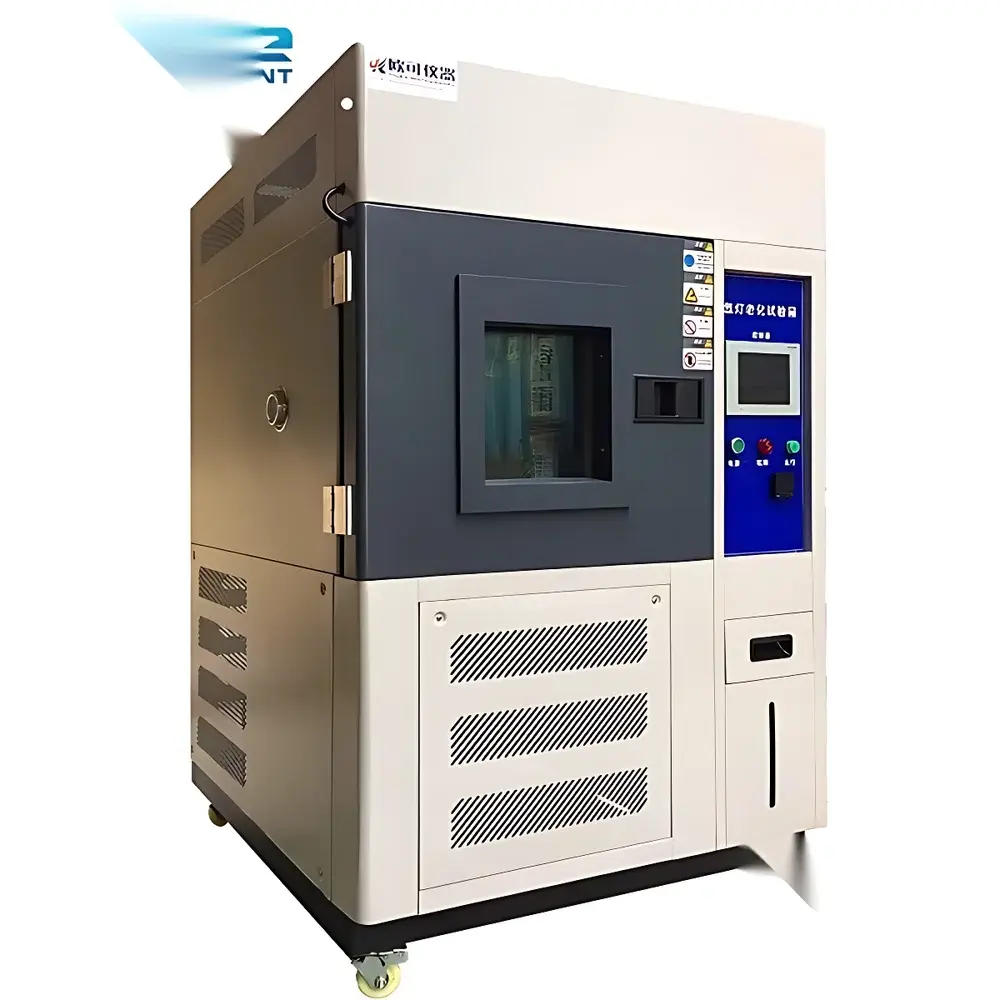
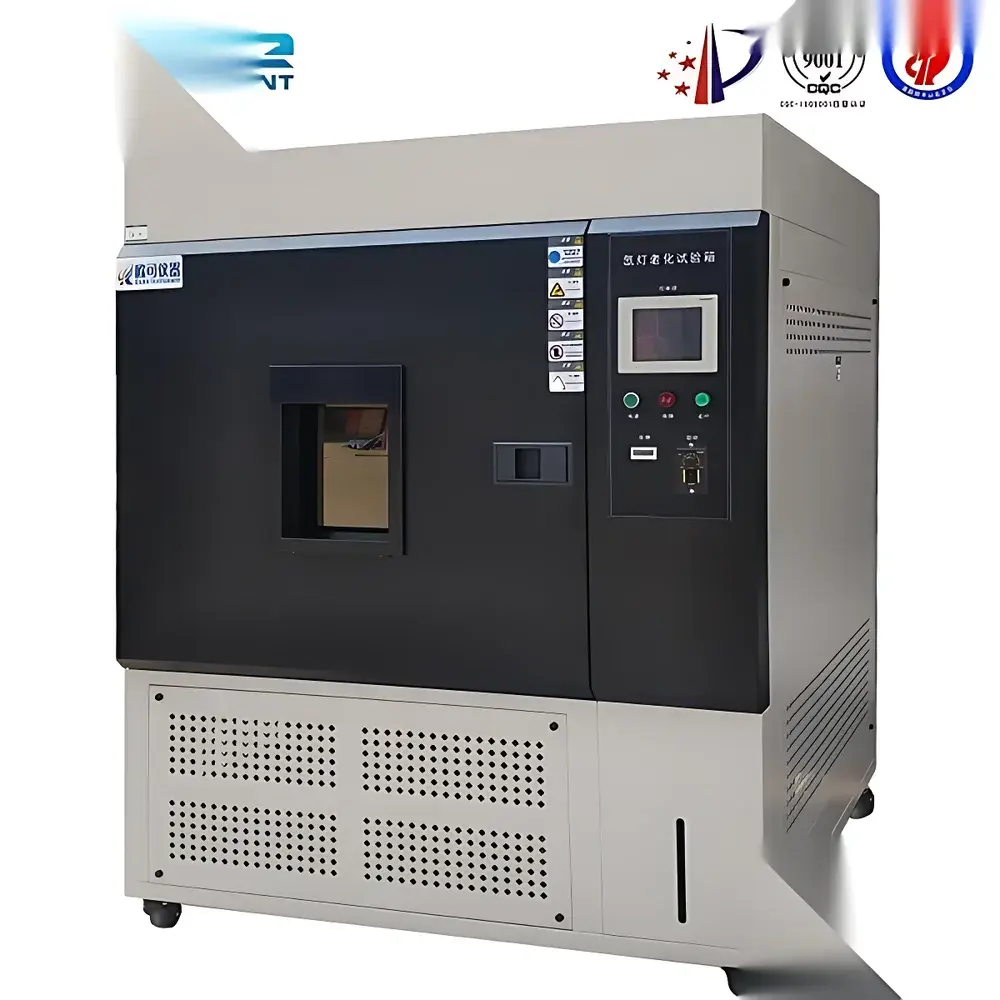
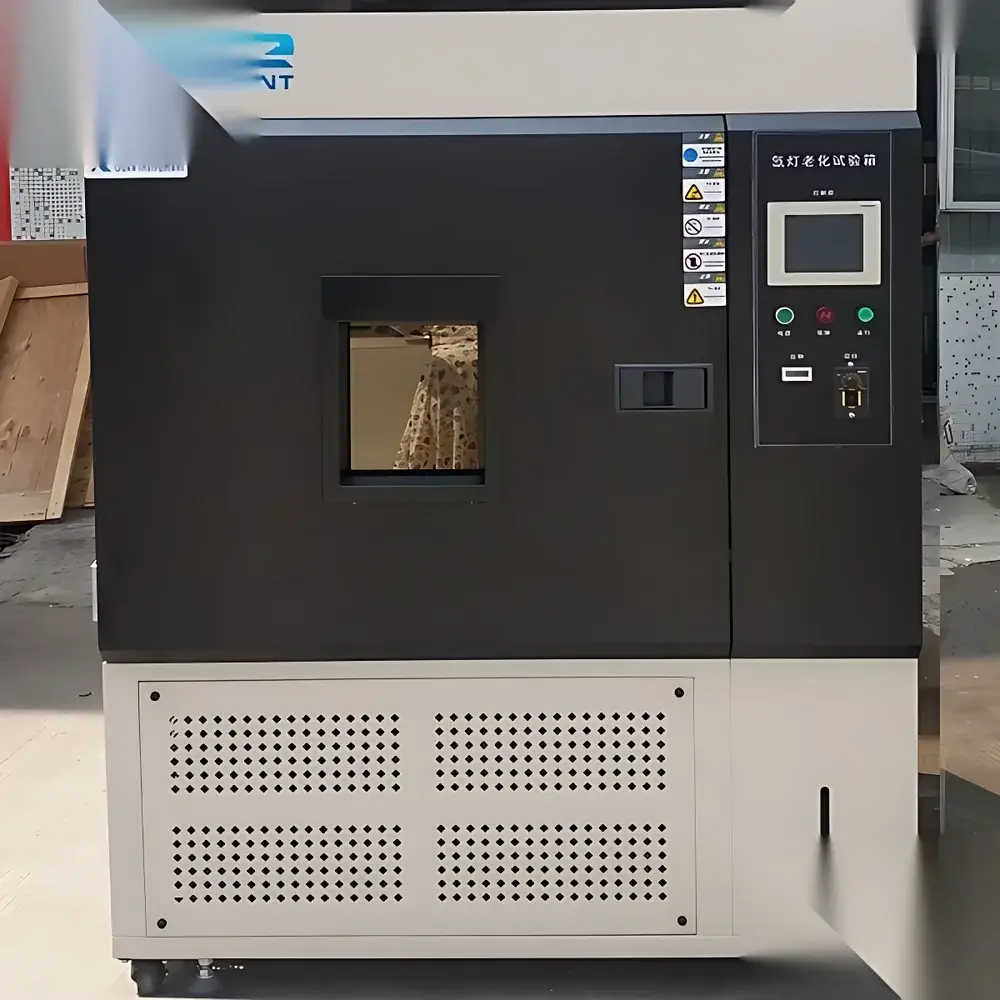
Xenon Arc Weathering Test Chamber OK-XD Series
| Brand | OK |
|---|---|
| Origin | Imported |
| Manufacturer Type | Authorized Distributor |
| Price | USD 5,300–14,800 (FOB) |
| Temperature Range | 0–150°C (Chamber), 40–85°C (Black Panel) |
| Humidity Range | 20–98% RH |
| Irradiance | 550 W/m² ±10% (300–800 nm) / 1000 W/m² ±10% (300–1200 nm) |
| Lamp Power | 1.8 kW / 2.5 kW / 6 kW |
| Lamp Life | ≥1500 h |
| Spray Cycle | 1–999 min (intermittent or continuous) |
| Spray Pressure | 70–127 kPa |
| Sample Mounting | Dual-layer flat mesh rack or 500 mm rotary turntable (0–3 rpm) |
| Construction | Interior – SUS304 stainless steel |
| Compliance | GB/T 8427, GB/T 16422-2, GB/T 8430, ISO 4892-2, ASTM D529, GB/T 14576, GB/T 15102-2006, GB/T 15104-2006 |
Overview
The OK-XD Series Xenon Arc Weathering Test Chamber is an engineered environmental simulation system designed to accelerate material degradation under controlled exposure to full-spectrum solar radiation, thermal cycling, and moisture stress. Based on the principle of xenon arc irradiation—where a high-intensity xenon lamp replicates the spectral distribution (290–2500 nm) and intensity profile of natural sunlight—the chamber enables quantitative assessment of photochemical, thermal, and hygroscopic aging mechanisms. Unlike UV-only or fluorescent lamp-based testers, xenon arc systems provide spectrally accurate irradiance across UV, visible, and near-infrared bands, making them the internationally recognized reference method for evaluating long-term outdoor durability per ISO 4892-2 and ASTM G155. The chamber operates through programmable cycles alternating between irradiation (with precise black panel temperature and relative humidity control) and dark condensation phases (simulating dew formation), thereby reproducing the synergistic effects of sunlight, rain, and nocturnal moisture ingress observed in real-world service environments.
Key Features
- Full-spectrum xenon arc lamp assembly with selectable optical filter configurations (e.g., Daylight, Window Glass, Extended UV) to match specific exposure conditions defined in ISO 4892-2 or ASTM D529.
- Integrated irradiance monitoring and closed-loop feedback control ensuring stable output at 550 W/m² (300–800 nm) or 1000 W/m² (300–1200 nm) within ±10% tolerance over lamp lifetime.
- Independent regulation of chamber air temperature (0–150°C), black panel temperature (40–85°C), and relative humidity (20–98% RH) during both light and dark cycles, with control accuracy of ±0.5°C and ±2.0% RH respectively.
- Programmable spray system delivering calibrated water mist or direct impingement via adjustable nozzles; spray duration, frequency, and pressure (70–127 kPa) are fully configurable to emulate tropical rainfall, coastal fog, or arid dew cycles.
- Dual sample mounting options: rigid dual-tier stainless steel mesh racks for flat specimens or a 500 mm diameter rotating turntable (0–3 rpm) enabling uniform angular exposure for irregularly shaped or three-dimensional components.
- Robust construction using electropolished SUS304 stainless steel for interior surfaces, ensuring corrosion resistance against chlorinated or acidic condensate; exterior finish available in either stainless steel or powder-coated carbon steel.
Sample Compatibility & Compliance
The OK-XD series accommodates diverse specimen geometries—including coatings on metal substrates, polymer films, automotive trim, architectural cladding, textile laminates, and safety glazing—without requiring custom fixtures beyond standard mounting hardware. Its chamber volumes (100 L to 1000 L) support standardized test panels per ISO 1514 and ASTM D610, as well as oversized industrial components up to 100 × 100 × 100 cm. All models comply with international weathering standards including ISO 4892-2 (xenon arc methods), GB/T 16422-2 (China national equivalent), ASTM D529 (textiles), ASTM G155 (non-metallic materials), and GB/T 8427 (colorfastness to artificial light). The system’s temperature and humidity uniformity (±2.0°C / ±3.0% RH) meets the spatial homogeneity requirements specified in ISO 17025-accredited laboratories for reproducible inter-laboratory data transfer.
Software & Data Management
Equipped with a 7-inch industrial touchscreen HMI running embedded Linux firmware, the chamber supports multi-step program scheduling, real-time graphing of irradiance, temperature, humidity, and spray status, and automatic event logging with timestamped CSV export. Optional Ethernet/RS485 interfaces enable integration into centralized laboratory information management systems (LIMS) and support remote monitoring via secure HTTP/HTTPS. Audit trail functionality records all user actions, parameter changes, and alarm events in tamper-resistant format—fully aligned with GLP and FDA 21 CFR Part 11 requirements when paired with optional electronic signature modules. Calibration certificates traceable to NIST or CNAS-accredited metrology labs are provided for irradiance sensors, PT100 temperature probes, and capacitive humidity transducers.
Applications
This instrument serves critical roles across R&D, quality assurance, and regulatory submission workflows. In polymer formulation labs, it quantifies yellowing index (YI), gloss retention, chalking, and tensile property decay under accelerated exposure—informing resin selection and UV stabilizer optimization. Automotive suppliers use it to validate OEM-spec durability of interior trims (SAE J2412), headlamp lenses (SAE J2527), and exterior paint systems (GMW14124). Coating manufacturers rely on its data to substantiate warranty claims for architectural façades (ASTM D4798) and marine-grade finishes (ISO 12944). Additionally, photovoltaic module encapsulants, medical device packaging films, and aerospace composite resins undergo qualification per IEC 61215, ISO 10993-12, and MIL-STD-810H respectively—all leveraging the OK-XD’s ability to decouple and recombine photothermal and hygric stress vectors with metrological rigor.
FAQ
What spectral filters are available, and how do they affect test relevance?
Standard filter sets include Daylight-Q/B (matching terrestrial AM1.5G), Window Glass-C (simulating indoor透过 through double-glazed fenestration), and Extended UV-F (enhancing short-wavelength output for aggressive UV screening). Filter choice directly determines spectral power distribution and must align with end-use exposure conditions defined in the applicable standard.
Can the chamber operate continuously without manual intervention?
Yes—fully autonomous operation is supported for durations up to 9999 hours per test sequence, with automated lamp replacement alerts, self-diagnostic fault reporting, and scheduled maintenance reminders triggered by cumulative irradiance dose or lamp runtime.
Is calibration verification required before each test?
While daily zero-point checks are recommended, formal recalibration of irradiance sensors and environmental probes is required every 6 months or after 1000 h of lamp operation, per ISO/IEC 17025 clause 6.5.3 and internal QA protocols.
How does the spray system differ from condensation-only methods?
Unlike purely humidification-based dew simulation, the OK-XD’s pressurized spray delivers dynamic thermal shock and mechanical erosion effects—critical for assessing coating adhesion loss, blistering, or substrate swelling in wet-dry cycling scenarios per ASTM D7866.
Are custom chamber dimensions available for non-standard samples?
Yes—OK Instruments offers OEM engineering services for bespoke chamber configurations, including extended height chambers, reinforced load-bearing racks, and integrated robotic sample handlers for high-throughput validation programs.



