
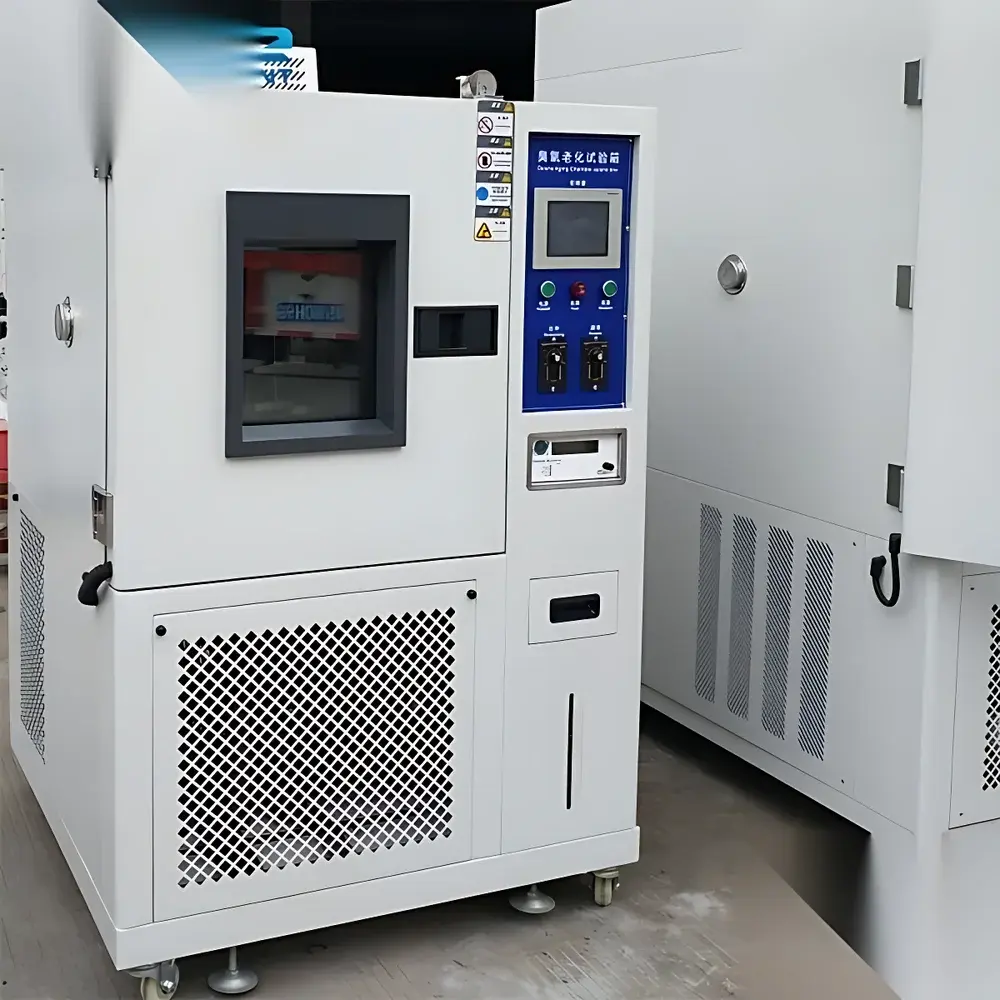
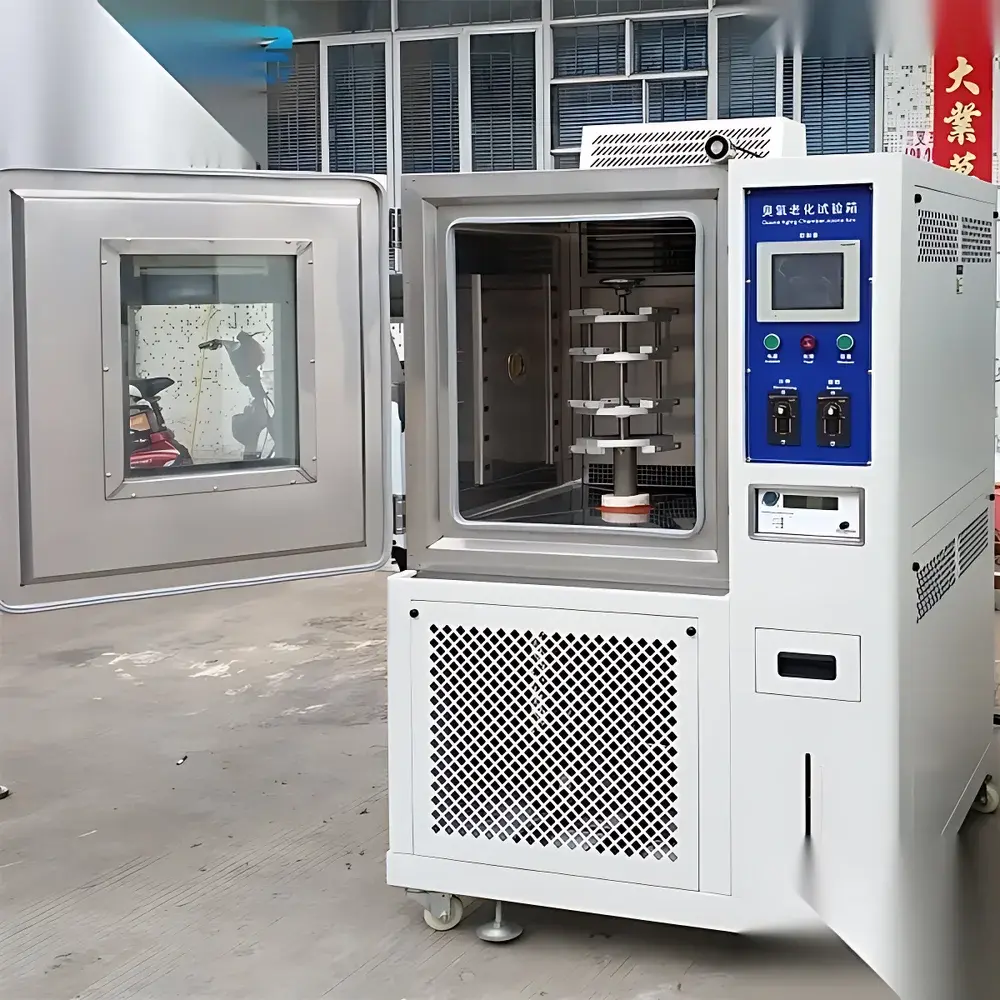
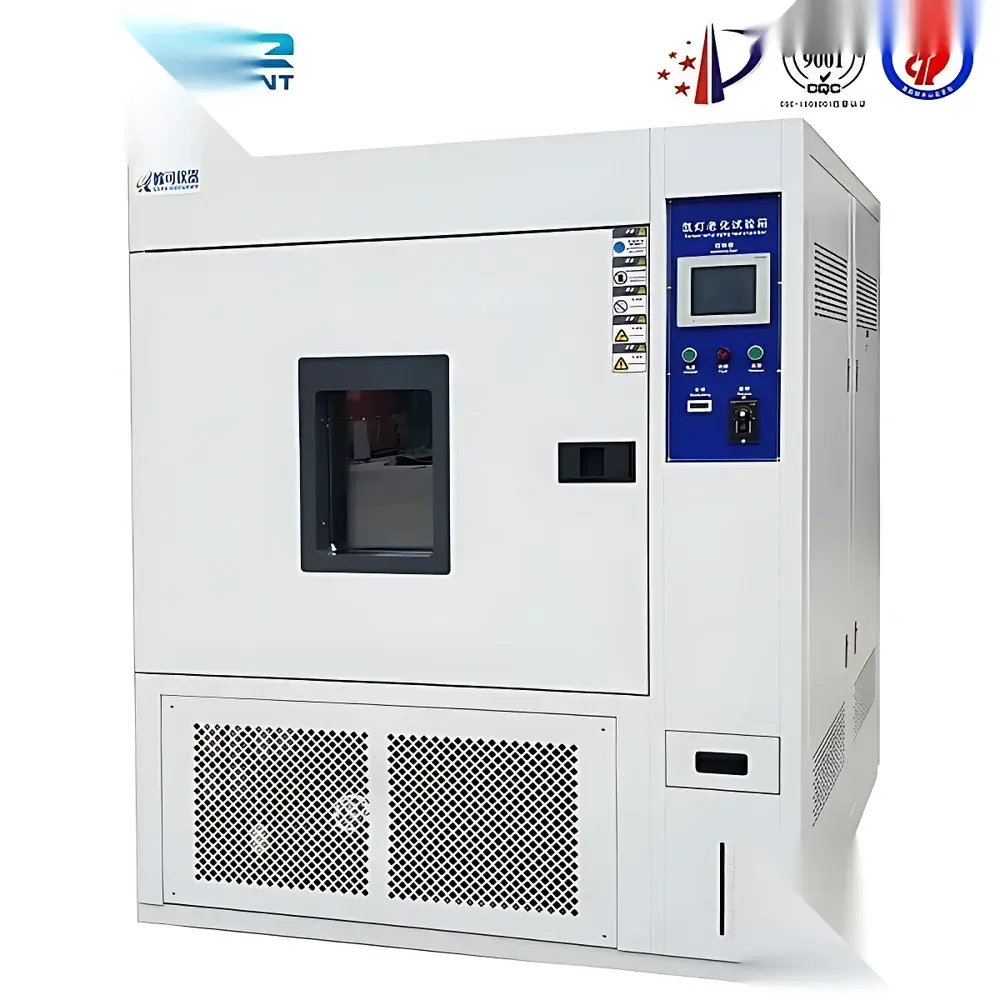
Xenon Arc Weathering Test Chamber OK-XD Series
| Brand | Other Brands |
|---|---|
| Origin | Imported |
| Manufacturer Type | General Distributor |
| Price | USD 5,300 (approx.) |
| Chamber Models | OK-XD-100 / OK-XD-225 / OK-XD-500 / OK-XD-1000 |
| Internal Dimensions (cm) | 50×50×40 / 50×75×60 / 80×80×80 / 100×100×100 |
| Temperature Range | 0–150°C (chamber), 40–85°C (black panel) |
| Humidity Range | 20–75% RH (light cycle), 20–98% RH (dark cycle) |
| Control Accuracy | ±0.5°C / ±2.0% RH |
| Uniformity | ±2.0°C / ±3.0% RH |
| Spectral Range | 300–800 nm (550 W/m² ±10%) and 300–1200 nm (1000 W/m² ±10%) |
| Xenon Lamp Power | 1.8 kW / 2.5 kW / 6 kW |
| Lamp Life | ~1,500 h |
| Spray Duration | 1–999 min (intermittent or continuous) |
| Spray Pressure | 70–127 kPa |
| Sample Mounting | Dual-layer flat mesh rack or 500-mm-diameter rotating turntable (0–3 rpm) |
| Construction | Interior – SUS304 stainless steel |
| Power Supply | AC 380 V ±5%, 50 Hz ±0.5 Hz |
Overview
The OK-XD Series Xenon Arc Weathering Test Chamber is an engineered environmental simulation system designed to replicate the full solar spectrum—including UV, visible, and near-infrared radiation—to accelerate material degradation under controlled climatic conditions. Based on the ASTM G155, ISO 4892-2, and GB/T 16422-2 standards, it employs long-arc, air-cooled xenon lamps with precision optical filtering to deliver spectrally stable irradiance closely matching terrestrial sunlight (AM1.5). Unlike UV fluorescent or metal halide sources, xenon arc technology provides true broadband exposure essential for evaluating photochemical stability, colorfastness, gloss retention, cracking, chalking, and embrittlement in polymeric, textile, coating, and automotive components. The chamber integrates simultaneous control of irradiance, black-panel temperature, chamber air temperature, relative humidity, and cyclic water spray—enabling rigorous simulation of real-world outdoor weathering, including diurnal thermal cycling, solar heating, condensation, and rain erosion.
Key Features
- Full-spectrum xenon arc source with calibrated spectral output (300–1200 nm), filtered to match CIE daylight illuminant D65 or ISO A/B filters per test specification;
- Independent dual-loop climate control: precise regulation of chamber air temperature (0–150°C) and black-panel temperature (40–85°C) with ±0.5°C accuracy;
- Dynamic humidity control across light/dark cycles: 20–75% RH during irradiation, 20–98% RH during dark periods—critical for simulating dew formation and hygrothermal stress;
- Programmable water spray system with adjustable duration (1–999 min), pressure (70–127 kPa), and mode (continuous or intermittent), compliant with ISO 4892-2 spray requirements;
- Flexible sample mounting options: dual-layer flat stainless-steel mesh racks for static testing or a 500-mm-diameter rotating turntable (0–3 rpm) to ensure uniform irradiance distribution per ASTM D7869;
- Robust construction using interior SUS304 stainless steel and exterior powder-coated steel or optional full stainless-steel housing for corrosion resistance and long-term reliability;
- Modular lamp assembly with quick-release mechanism—lamp replacement completed in under 15 minutes without recalibration; typical lamp service life: 1,500 hours at nominal irradiance;
- Integrated high-efficiency optical filter system maintaining spectral fidelity over extended operation, minimizing spectral drift and ensuring repeatability across test campaigns.
Sample Compatibility & Compliance
The OK-XD series accommodates diverse specimen geometries—from flat fabric swatches and painted panels to 3D automotive trim parts—via configurable racks and rotational fixtures. Its design supports standardized test specimens per ISO 105-B02 (textile colorfastness), ASTM D4329 (plastics), ASTM D2244 (gloss/color change), and GB/T 14576 (photostability of dyes). All models are built to meet electromagnetic compatibility (EMC) per IEC 61000-6-3 and safety requirements per IEC 61010-1. The system architecture enables traceable operation under GLP and GMP environments when paired with validated software: audit trails, user access control, and electronic signatures support compliance with FDA 21 CFR Part 11 where required.
Software & Data Management
Equipped with embedded programmable logic controller (PLC) and touchscreen HMI interface, the chamber supports multi-step test profiles—including irradiance ramping, temperature/humidity ramps, spray timing sequences, and dark/light cycling—with up to 100 programmable segments. Real-time data logging records irradiance (W/m²), black-panel temperature, chamber temperature, humidity, and spray status at user-defined intervals (1–60 sec). Exportable CSV files facilitate post-test analysis in MATLAB, Excel, or LIMS platforms. Optional PC-based software provides remote monitoring, historical trend visualization, alarm notification via email/SMS, and automated report generation aligned with ISO/IEC 17025 documentation requirements.
Applications
- Automotive OEMs and Tier-1 suppliers: evaluating dashboard materials, exterior coatings, headlamp lenses, and sealants per SAE J2412 and GMW14124;
- Textile and apparel laboratories: conducting lightfastness and perspiration-lightfastness (ISO 105-B02/B06) testing on dyed fabrics and functional finishes;
- Polymer R&D: quantifying UV-induced chain scission, crosslinking, and carbonyl index development in PE, PP, PVC, and engineering thermoplastics;
- Architectural coatings: validating durability of façade paints, wood stains, and roofing membranes per ASTM D4587 and ISO 11341;
- LED lighting and display manufacturers: assessing yellowing and luminance decay of diffusers, lenses, and encapsulants under accelerated solar loading;
- Government and third-party testing labs: delivering accredited weathering data for CE marking, CCC certification, and regulatory submissions to EPA, EU REACH, and China’s GB standards.
FAQ
What spectral filters are available, and how do they affect test relevance?
Standard configurations include Daylight (ISO A), Window Glass (ISO B), and Extended UV (ISO C) filters. Filter selection determines the UV cutoff and IR transmission profile—directly influencing acceleration factor and failure mode fidelity. Custom spectral shaping is supported upon request.
Can the chamber operate continuously for extended validation studies?
Yes—designed for unattended 24/7 operation with redundant safety interlocks, thermal fuses, lamp overheat protection, and automatic lamp power derating to extend service life during prolonged runs.
Is calibration traceable to national standards?
Irradiance sensors are NIST-traceable; annual calibration certificates (per ISO/IEC 17025) are available through authorized service partners. Black-panel thermocouples are calibrated against PT100 reference probes.
How is uniformity verified across the exposure plane?
Each chamber undergoes factory mapping using a 9-point irradiance grid per ASTM G151 Annex A2. Uniformity (±3% irradiance, ±2°C temperature) is documented in the delivery report and re-verifiable in situ.
Does the system support custom test protocols beyond published standards?
Absolutely—the controller accepts user-defined time-temperature-irradiance-humidity-spray profiles, enabling proprietary aging algorithms, multi-stress synergistic testing, and correlation studies against field exposure data.



