
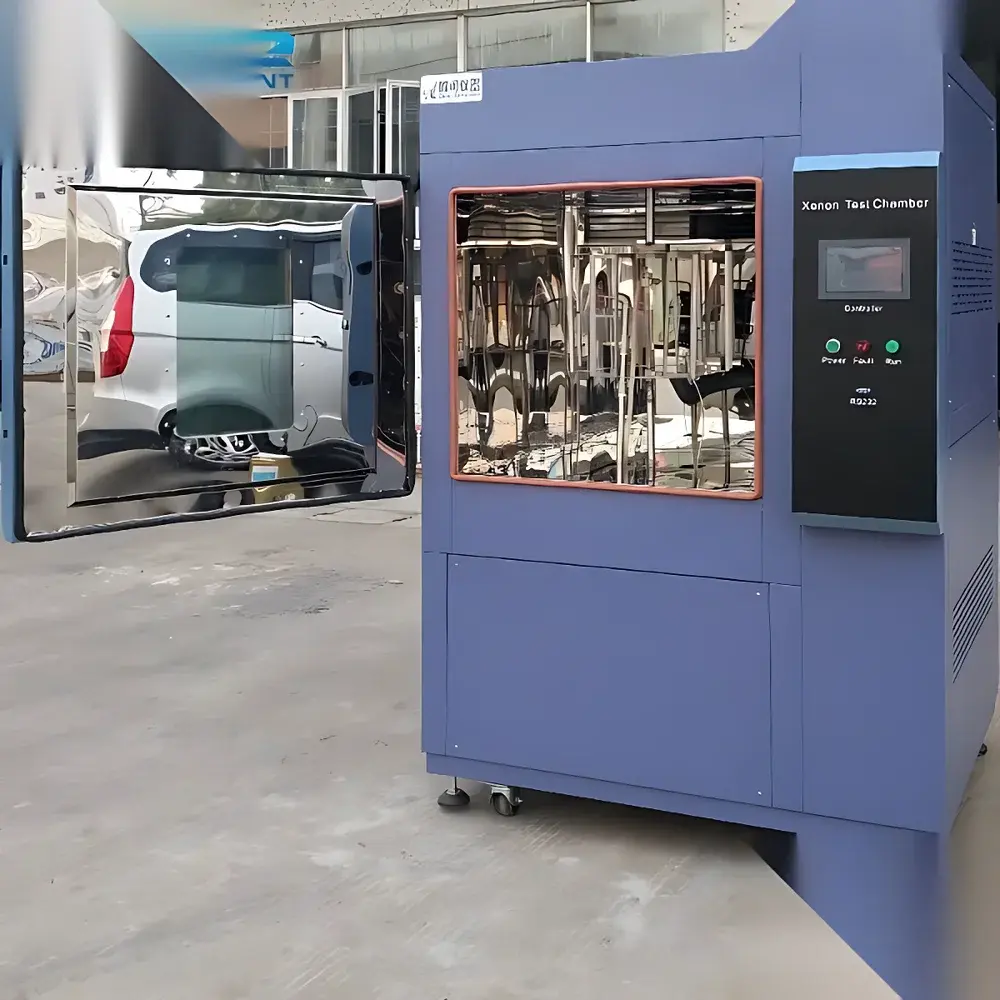
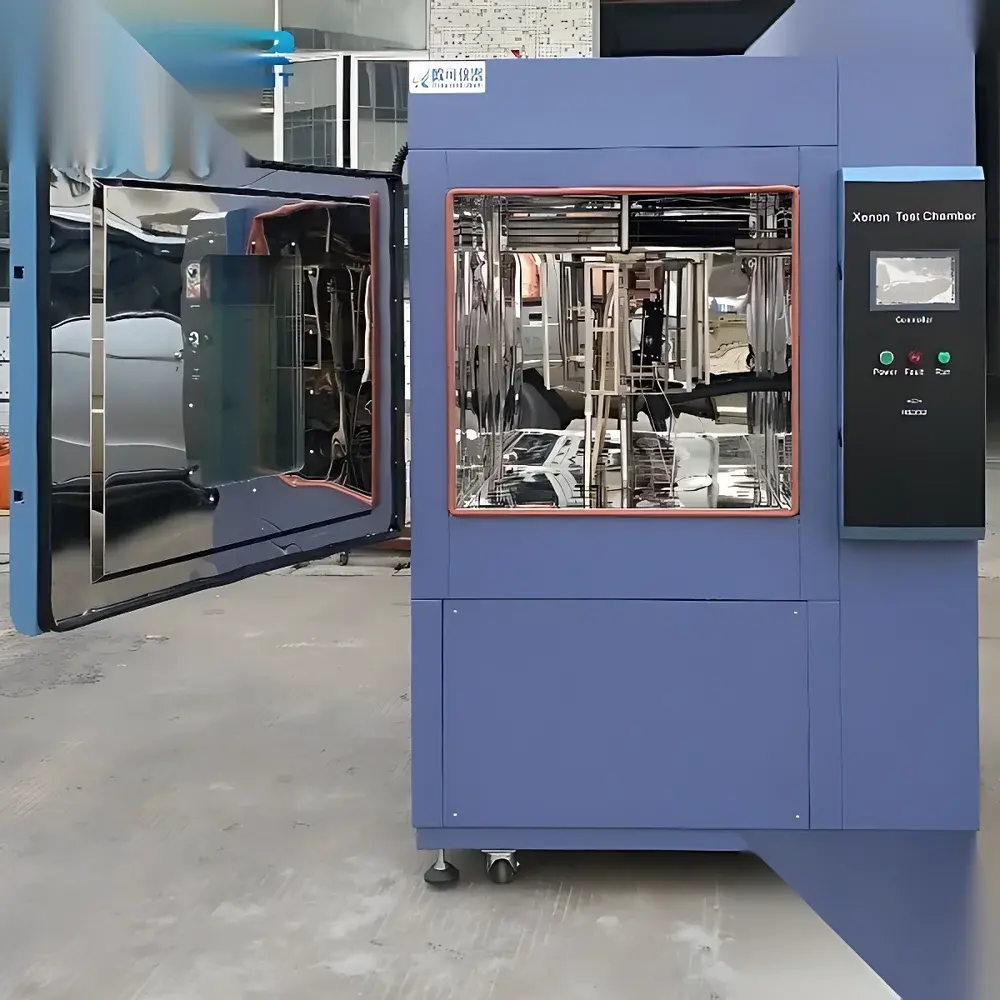
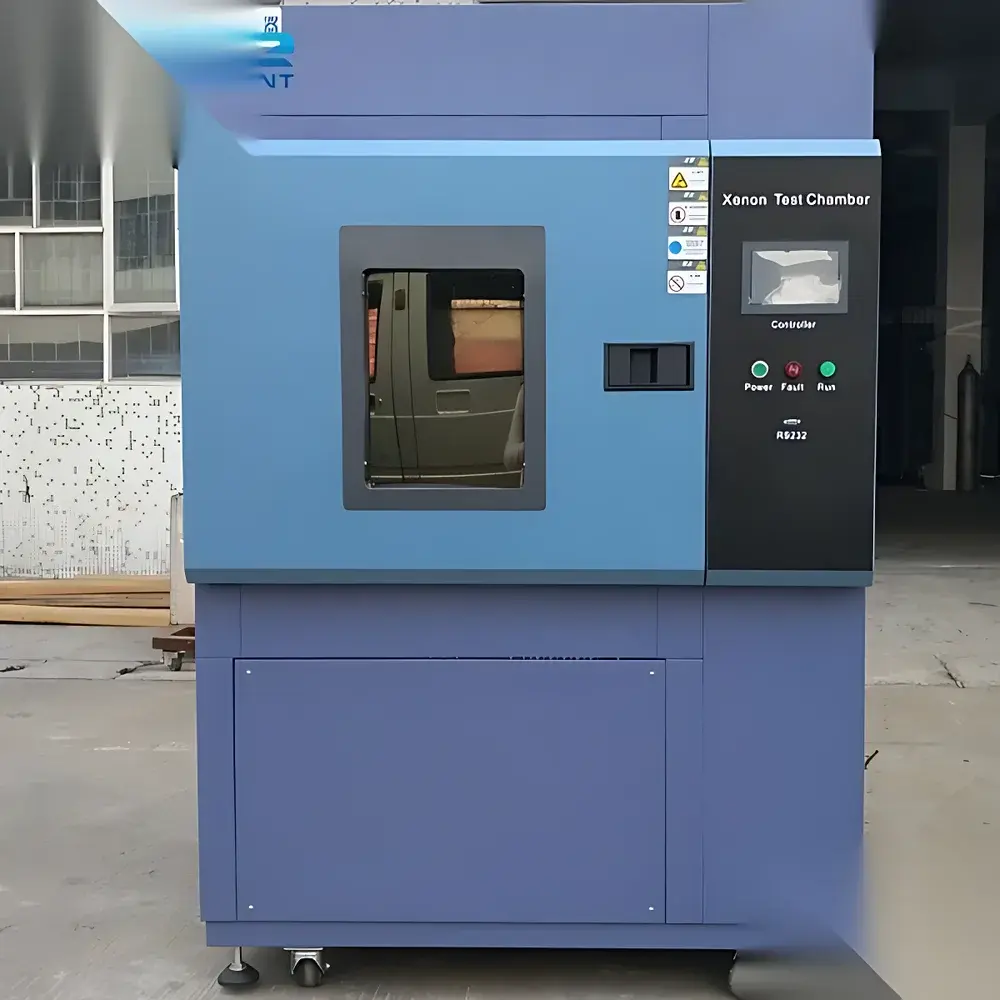
Xenon Arc Weathering Test Chamber – OK-XD Series (Imported, Full-Spectrum Solar Simulation)
| Brand | OK Instruments |
|---|---|
| Origin | Imported |
| Manufacturer Type | Authorized Distributor |
| Price Range | USD 5,200–14,800 (FOB) |
| Chamber Volume Options | 100 L / 225 L / 500 L / 1000 L |
| Temperature Range | 0–150 °C (Chamber), 40–85 °C (Black Panel) |
| Humidity Range | 20–98% RH (Cyclic Control) |
| Irradiance | 550 W/m² ±10% (300–800 nm) or 1000 W/m² ±10% (300–1200 nm) |
| Xenon Lamp Power | 1.8 kW / 2.5 kW / 6 kW |
| Lamp Life | ≥1500 h |
| Spray Cycle | 1–999 min (Intermittent/Continuous) |
| Spray Pressure | 70–127 kPa |
| Sample Mounting | Dual-layer wire mesh tray or 500 mm diameter rotating drum (0–3 rpm) |
| Construction | Interior – SUS304 stainless steel |
| Power Supply | AC 380 V ±5%, 50 Hz ±0.5 Hz |
Overview
The OK-XD Series Xenon Arc Weathering Test Chamber is an imported, precision-engineered environmental test system designed to replicate the full spectrum of terrestrial solar radiation—including UV, visible, and near-infrared wavelengths—under controlled temperature, humidity, and moisture conditions. Based on ASTM G155, ISO 4892-2, and GB/T 16422.2 standards, it employs long-arc, air-cooled xenon lamps with calibrated optical filters to deliver spectrally stable irradiance that closely matches natural sunlight (CIE No. 85 reference). Unlike UV fluorescent or metal halide alternatives, this chamber enables accelerated photodegradation testing with high fidelity to real-world outdoor exposure, making it essential for evaluating lightfastness, color stability, polymer embrittlement, coating chalking, and material fading across industrial R&D and quality assurance workflows.
Key Features
- Full-spectrum xenon arc source: Air-cooled, long-arc lamps with integrated quartz envelope and daylight-balanced optical filters ensure spectral match to CIE Standard Illuminant D65 across 290–2500 nm, with optional cut-on filters for UV-A or UV-B emphasis.
- Multi-mode environmental simulation: Independent control of chamber temperature (0–150 °C), black panel temperature (40–85 °C), relative humidity (20–98% RH in dark cycle; 20–75% RH in light cycle), and programmable water spray (intermittent or continuous, 1–999 min duration, 70–127 kPa pressure).
- Dynamic sample exposure geometry: Configurable mounting options include dual-layer stainless steel mesh trays for flat specimens or a 500 mm diameter rotating drum (0–3 rpm) to ensure uniform irradiance distribution and eliminate shadowing effects.
- High-stability irradiance control: Calibrated broadband radiometer (300–800 nm or 300–1200 nm) with closed-loop feedback maintains ±10% irradiance tolerance; lamp output automatically compensated for aging over ≥1500 h service life.
- Robust chamber architecture: Seamless SUS304 stainless steel interior (electropolished finish), corrosion-resistant exterior (SUS304 or powder-coated carbon steel), and reinforced insulation for thermal/humidity integrity and long-term operational reliability.
- Compliance-ready engineering: Designed to support GLP/GMP-aligned validation protocols, including IQ/OQ documentation packages, calibration traceability to NIST standards, and audit-ready log file generation per FDA 21 CFR Part 11 requirements.
Sample Compatibility & Compliance
The OK-XD series accommodates diverse specimen geometries—from textile swatches and automotive trim panels to coated metal substrates and plastic injection-molded parts—without requiring custom fixtures. Its modular sample carriers accept irregularly shaped components up to 100 cm × 100 cm × 100 cm (OK-XD-1000 model), while the rotating drum option ensures isotropic exposure for cylindrical or asymmetric samples. The system meets or exceeds performance criteria defined in ISO 4892-2, ASTM D529, GB/T 8427 (textile colorfastness), GB/T 14576 (photostability of dyes), and GB/T 15102–2006 (laminate flooring weathering). All models are CE-marked and comply with IEC 61000-6-3 (EMC) and IEC 61000-6-2 (immunity) directives.
Software & Data Management
Equipped with a 7-inch industrial touchscreen HMI running embedded Linux OS, the chamber supports fully programmable test cycles with up to 99 segments per profile—including ramp/soak phases, irradiance setpoints, humidity transitions, and spray activation logic. Real-time data logging records chamber temperature, black panel temperature, relative humidity, irradiance intensity, lamp voltage/current, and spray status at user-defined intervals (1 s–60 min). Export formats include CSV and PDF reports with digital signatures; optional Ethernet/RS485 interface enables integration into LabVantage, SAP QM, or custom MES platforms. Audit trails retain operator ID, timestamp, parameter changes, and alarm history for regulatory review.
Applications
- Evaluation of colorfastness and photostability in textiles, leather, and dyed polymers per ISO 105-B02 and AATCC TM16.
- Accelerated weathering of automotive interior/exterior materials (dashboards, seals, coatings) per SAE J2527 and ISO 20344.
- UV resistance validation of architectural coatings, PVC window profiles, and roofing membranes per ASTM D4329 and EN 927-6.
- Light-induced degradation studies of pharmaceutical packaging films and medical device polymers under ICH Q1B photo-stability guidelines.
- Correlation of laboratory exposure data with field performance using established acceleration factors (e.g., 1 month outdoor = 100–300 h xenon exposure, depending on geographic latitude and spectral weighting).
FAQ
What spectral range does the OK-XD chamber simulate?
It reproduces the full solar spectrum from 290 nm to 2500 nm, with standard filter configurations matching CIE Standard Illuminant D65; optional filters enable UV-A (315–400 nm) or extended UV-B (280–315 nm) emphasis.
How is irradiance calibrated and maintained over time?
A NIST-traceable broadband radiometer continuously monitors irradiance; the control system adjusts lamp power to maintain target intensity within ±10% tolerance, compensating for lamp aging up to 1500 hours.
Can the chamber operate without water spray?
Yes—spray function is fully programmable and may be disabled for dry-heat or UV-only exposure protocols.
Is remote monitoring supported?
Standard Ethernet connectivity enables real-time status viewing, alarm notifications, and historical data retrieval via secure web interface or third-party SCADA systems.
What validation documentation is provided?
Each unit ships with factory calibration certificates, IQ/OQ protocol templates, and a complete set of electrical safety and EMC compliance reports.



