
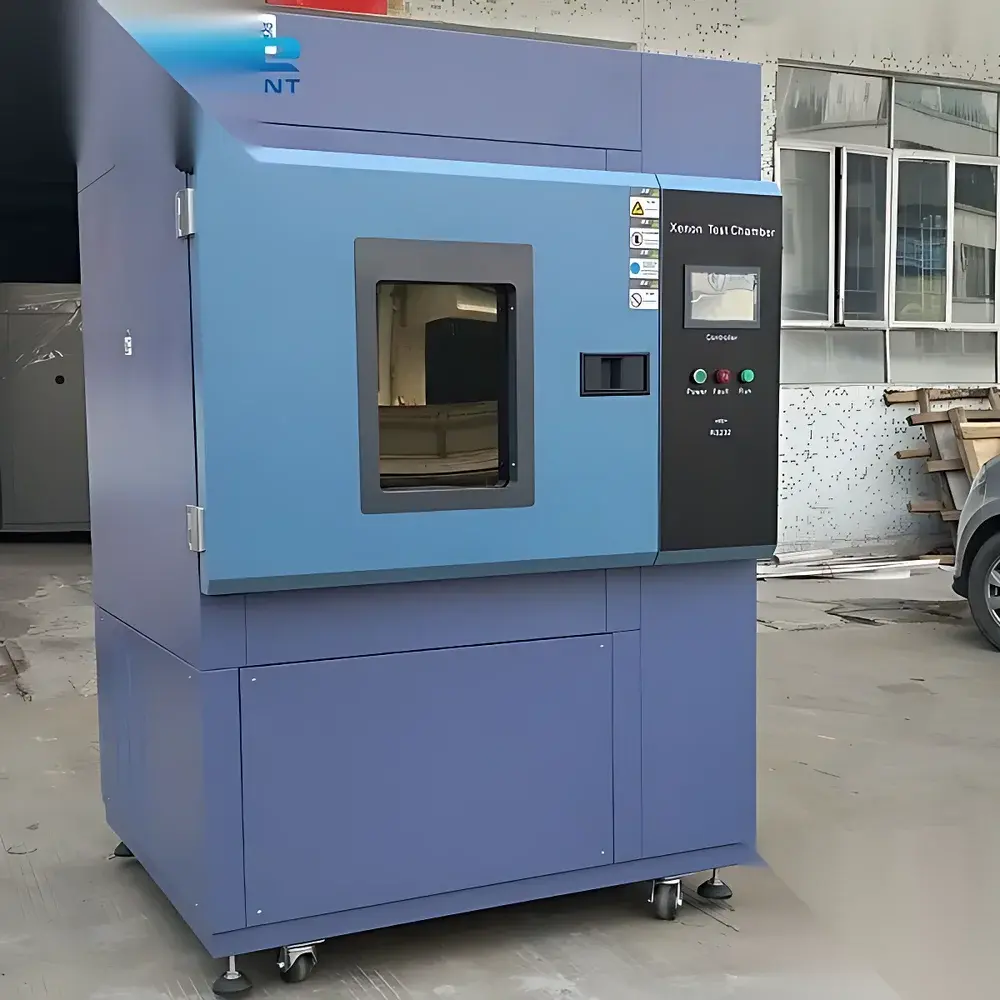
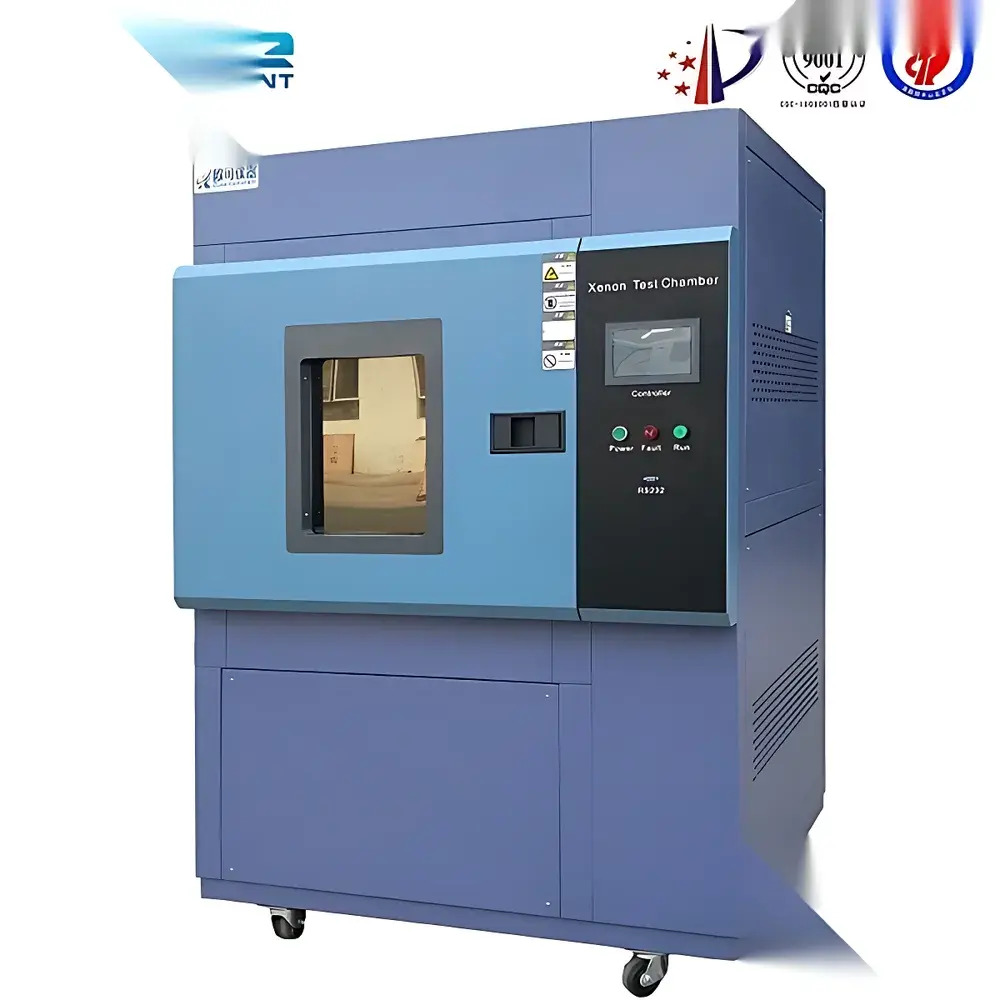
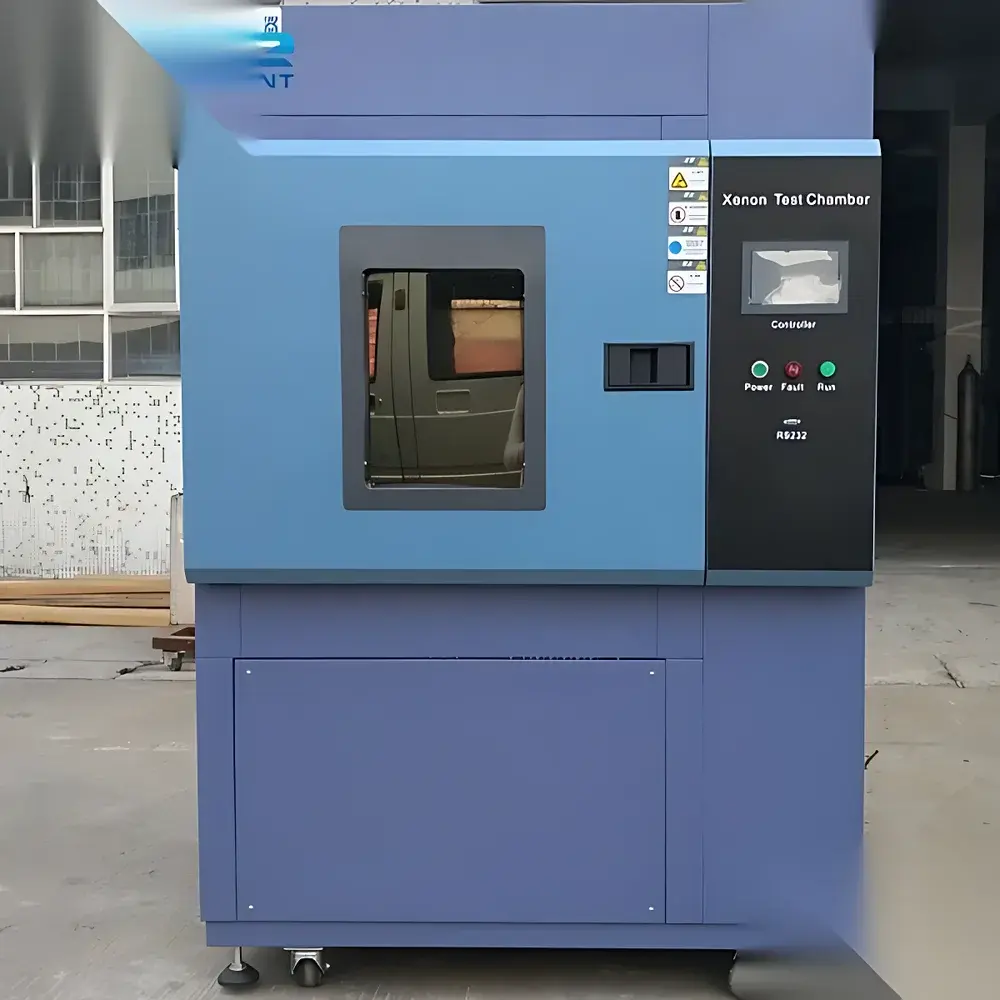
Xenon Arc Weathering Test Chamber – XW-6000 Series
| Key | Lamp Power: 6 kW |
|---|---|
| Spectral Range | 290–800 nm |
| Irradiance Control | 550–1200 W/m² |
| Sample Rotation Speed | ≥1 rpm (infinitely variable) |
| Rainfall Duration | 1–9999 min (adjustable) |
| Rainfall Cycle Interval | 1–240 min (adjustable) |
| Irradiated Area | ~7500 cm² |
| Lamp-to-Sample Distance | 350–380 mm |
| Heating Power | ~3.6 kW |
| Humidification Power | ~3 kW |
| Cooling System | Single-stage hermetic compressor (Tecumseh/Tecumseh France equivalent) with R404A refrigerant |
| Evaporator Layout | Air-forced convection within ducted chamber wall |
| Humidity Control | PID-regulated steam humidification |
| Compliance | Designed to support ASTM G155, ISO 4892-2, SAE J2527, and AATCC TM16 test protocols |
Overview
The Xenon Arc Weathering Test Chamber – XW-6000 Series is an engineered environmental simulation system designed for accelerated weathering evaluation of polymeric, coating, textile, automotive, and aerospace materials under controlled solar-spectrum irradiation. It employs a water-cooled, long-arc xenon lamp emitting a continuous spectrum from 290 nm to 800 nm—closely approximating terrestrial sunlight after atmospheric filtration. This spectral fidelity enables reproducible simulation of UV degradation, thermal aging, moisture-induced hydrolysis, and photo-oxidation mechanisms. The chamber integrates radiometric feedback control, precision humidity regulation, and programmable wet/dry cycling to replicate real-world exposure conditions—including diurnal cycles, seasonal insolation variations, and intermittent rainfall—while maintaining strict compliance with internationally recognized weathering standards.
Key Features
- High-fidelity 6 kW water-cooled xenon arc lamp with nominal 1600-hour service life; lamp spectral output maintained via calibrated optical filters (e.g., Daylight, Window Glass, Extended UV)
- Real-time irradiance monitoring and closed-loop control across 550–1200 W/m² range, traceable to NIST-traceable radiometers
- Programmable water spray system with adjustable duration (1–9999 min) and cycle interval (1–240 min), supporting both continuous and intermittent wetting per ASTM G155 Cycle 1–4
- Rotating sample carousel (≥1 rpm, infinitely variable speed) ensuring uniform irradiance distribution over irregularly shaped specimens up to 7500 cm² total exposure area
- Dual-zone climate control: air temperature regulated via 3.6 kW resistive heating and R404A-based refrigeration (single-stage hermetic compressor); relative humidity maintained at 10–95% RH via PID-controlled steam humidifier (3 kW capacity)
- Optimized thermal management architecture: evaporator embedded in insulated duct walls with forced-air convection; condenser cooled by ambient air circulation
- Modular filter tray system enabling rapid spectral tailoring for specific application requirements (e.g., automotive interior vs. exterior exposure profiles)
Sample Compatibility & Compliance
The XW-6000 accommodates flat panels, molded components, textiles, and multi-material assemblies using customizable specimen holders—including non-planar fixtures and universal clamping rails. Its operational envelope meets the physical and metrological prerequisites of ASTM G155 (Practice for Operating Xenon Arc Light Apparatus for Exposure of Non-Metallic Materials), ISO 4892-2 (Plastics — Methods of Exposure to Laboratory Light Sources — Part 2: Xenon-Arc Lamps), SAE J2527 (Surface Vehicle Standard for Accelerated Exposure of Automotive Exterior Materials), and AATCC TM16 (Colorfastness to Light). All critical parameters—including irradiance setpoint deviation, chamber air temperature uniformity (±2°C), and humidity stability (±3% RH)—are validated during factory calibration and documented in the Certificate of Conformance.
Software & Data Management
The integrated controller features a 7-inch color touchscreen HMI with intuitive test programming interface. Users define multi-step exposure profiles combining irradiance levels, temperature ramps, humidity plateaus, and spray sequences. Real-time data logging records irradiance (W/m²), black panel temperature (BPT), chamber air temperature, relative humidity, and elapsed time at user-defined intervals (1 s to 60 min). Export formats include CSV and PDF reports compliant with GLP documentation requirements. Optional Ethernet connectivity supports remote monitoring, audit trail generation (per FDA 21 CFR Part 11 principles), and integration into centralized LIMS or MES platforms.
Applications
This chamber serves as a primary tool for predictive durability assessment across industries: polymer formulation development (PP, PE, PC, PU), OEM automotive component qualification (dashboards, seals, trim), architectural coating validation (acrylics, fluoropolymers), textile UV resistance testing (apparel, awnings, geotextiles), and photovoltaic encapsulant stability studies. Its ability to decouple UV dose from thermal stress enables mechanistic investigation of degradation pathways—supporting root-cause analysis, material selection, and lifetime modeling under IEC 61215 or UL 1703 accelerated test schedules.
FAQ
What spectral filters are included standard with the XW-6000?
Standard configuration includes daylight-filtered (CIE No. 1) and window-glass-filtered (CIE No. 3) options; extended UV and borosilicate filters are available as optional accessories.
Is lamp replacement a field-serviceable procedure?
Yes—lamp exchange requires no specialized tools and can be completed in under 15 minutes using the front-access service panel and integrated alignment jig.
Does the system support automated pass/fail criteria based on colorimetric or gloss measurements?
While the chamber itself does not perform optical measurements, its digital output interface allows synchronization with external spectrophotometers or gloss meters via TTL or Modbus RTU for automated endpoint detection.
How is irradiance uniformity verified across the exposure plane?
Uniformity is confirmed during commissioning using a 5-point grid measurement per ISO 4892-2 Annex B; typical deviation is ≤±12% across the central 75% of the irradiated area.
Can the unit operate continuously for extended validation campaigns (e.g., >1000 hours)?
Yes—the refrigeration system’s energy modulation design and redundant safety interlocks (overtemperature, low refrigerant pressure, lamp cooling failure) ensure stable unattended operation under full-load conditions.



