
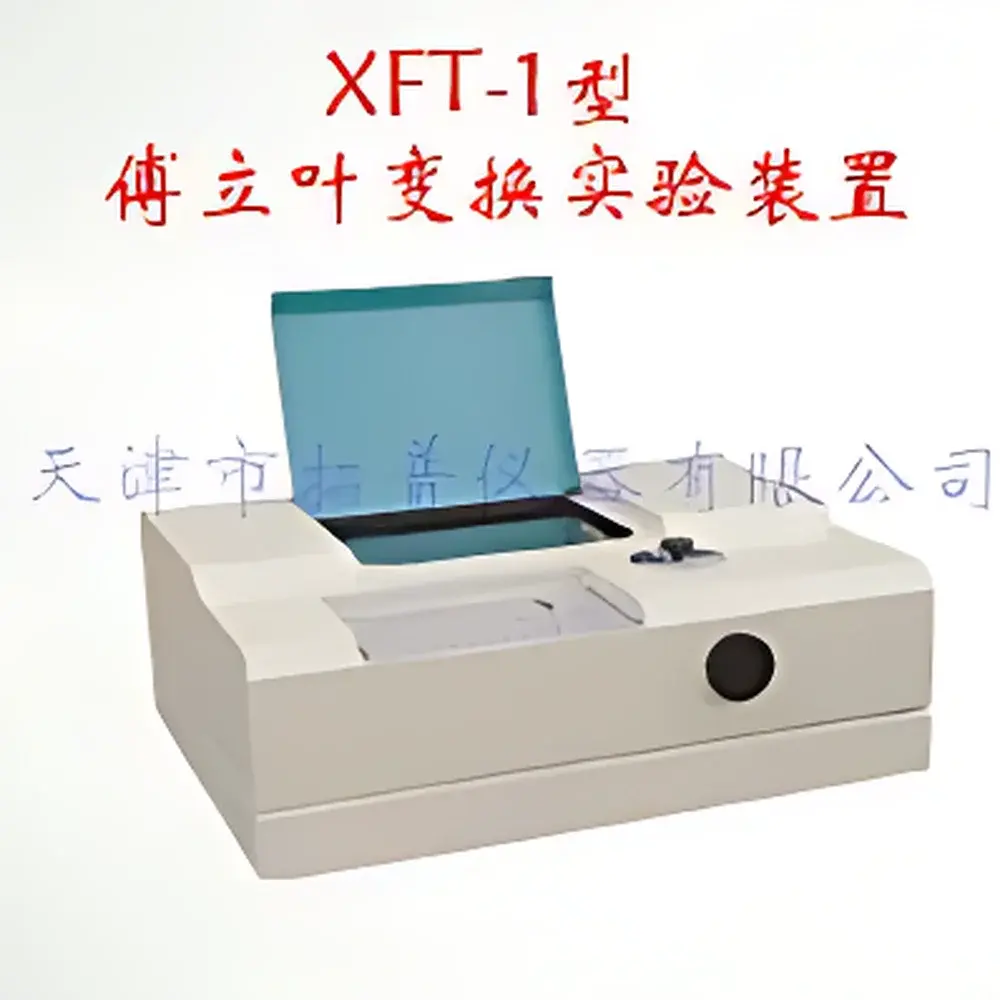
XFT-1 Fourier Transform Educational Demonstrator
| Origin | Tianjin, China |
|---|---|
| Manufacturer Type | Distributor |
| Origin Category | Domestic (China) |
| Model | XFT-1 |
| Price | Upon Request |
| Wavelength Range | 400–800 nm |
| Spectral Bandwidth | 1 nm |
Overview
The XFT-1 Fourier Transform Educational Demonstrator is a purpose-built optical teaching instrument engineered to visualize and experimentally verify the core principles of Fourier optics and interferometric spectral analysis. Based on the Michelson interferometer architecture, it implements the physical realization of the Fourier transform through optical path difference modulation: broadband light from a tunable or fixed-wavelength source is split, recombined after variable delay, and produces an interference pattern (interferogram) whose intensity distribution is the Fourier cosine transform of the source’s spectral irradiance. By scanning the movable mirror and digitizing the resulting interferogram, students reconstruct the original spectrum via discrete Fourier transformation—directly illustrating the mathematical duality between time/frequency or space/wavenumber domains in an optical context. Designed explicitly for undergraduate and graduate-level physics, optics, and engineering laboratories, the XFT-1 bridges theoretical instruction with hands-on measurement, supporting curriculum-aligned experiments in coherence theory, spectral resolution limits, apodization effects, and phase retrieval fundamentals.
Key Features
- Michelson-type interferometer core with precision-machined kinematic mirror mount and piezoelectric-driven linear translation stage for sub-micron path-length control
- Optimized optical layout featuring anti-reflection coated fused silica beam splitters and high-reflectivity dielectric mirrors (R > 99% @ 400–800 nm)
- Integrated silicon photodiode detector with transimpedance amplifier and 16-bit analog-to-digital conversion synchronized to mirror position feedback
- Dedicated real-time acquisition firmware enabling interferogram capture at up to 10 kHz sampling rate with hardware-triggered mirror scan coordination
- Modular design with standardized SM1-threaded optical mounts (1.035″-40) for easy integration of optional filters, polarizers, or external light sources
- Compliance with ISO 10110-7 for surface quality (scratch-dig 60-40) and ISO 9001 manufacturing traceability documentation included
Sample Compatibility & Compliance
The XFT-1 accepts free-space collimated input beams with diameters from 3 mm to 12 mm, accommodating common laboratory sources including halogen lamps, LED arrays, low-power He-Ne lasers, and supercontinuum outputs. It operates exclusively in transmission mode and does not support fiber-coupled inputs without optional adapter kits. All optical components meet RoHS Directive 2011/65/EU material restrictions. The system is classified as Class 1 Laser Product per IEC 60825-1:2014 when used with recommended light sources (<1 mW visible output), eliminating need for laser safety officer oversight in standard academic settings. Calibration certificates traceable to NIM (National Institute of Metrology, China) are provided for wavelength accuracy verification.
Software & Data Management
The XFT-1 ships with cross-platform desktop software (Windows/macOS/Linux) built on Qt framework and Python-based numerical libraries (NumPy, SciPy). It supports raw interferogram export in HDF5 format with embedded metadata (scan velocity, zero-path-difference timestamp, detector gain setting). Fourier magnitude and phase spectra are computed using FFTW3 library with selectable windowing functions (Hamming, Blackman-Harris, triangular). Software includes built-in tools for spectral line identification, FWHM measurement, and comparison against reference NIST atomic emission databases. Audit trails record all parameter changes and processing steps, satisfying GLP-compliant documentation requirements for accredited teaching labs. Data files conform to ASTM E131-22 “Standard Terminology Relating to Molecular Spectroscopy” nomenclature.
Applications
- Undergraduate laboratory courses in physical optics, modern physics, and photonics engineering
- Demonstration of convolution theorem via spatial filtering with programmable SLMs (optional add-on)
- Quantitative study of instrumental line shape (ILS) and its impact on spectral resolution
- Investigation of coherence length estimation from interferogram envelope decay
- Validation of Fourier transform properties: shift theorem, scaling theorem, and Parseval’s theorem using calibrated spectral references
- Preparatory training for advanced FTIR or OCT instrumentation operation in research environments
FAQ
What educational standards does the XFT-1 align with?
It directly supports learning outcomes defined in the AAPT (American Association of Physics Teachers) Curriculum Guidelines for Optics and the European Physical Society’s “Physics Bachelor Degree Benchmark Statement.”
Can the XFT-1 be used for quantitative spectral analysis beyond demonstration?
Yes—when paired with NIST-traceable calibration lamps (e.g., Hg-Ne, low-pressure Na), it achieves ±0.5 nm wavelength accuracy and <0.2 nm repeatability over 8-hour sessions under temperature-stabilized conditions.
Is third-party software integration supported?
MATLAB, Python (via provided API DLL and SWIG bindings), and LabVIEW drivers are available upon request for custom experiment automation.
Does the system require external vibration isolation?
A standard optical table with passive damping (e.g., Newport RS-4000 series) is sufficient; active isolation is unnecessary for pedagogical use cases.
What maintenance is required for long-term stability?
Annual verification of mirror alignment and detector linearity using supplied alignment targets and neutral density filters is recommended; no consumables are involved.



