
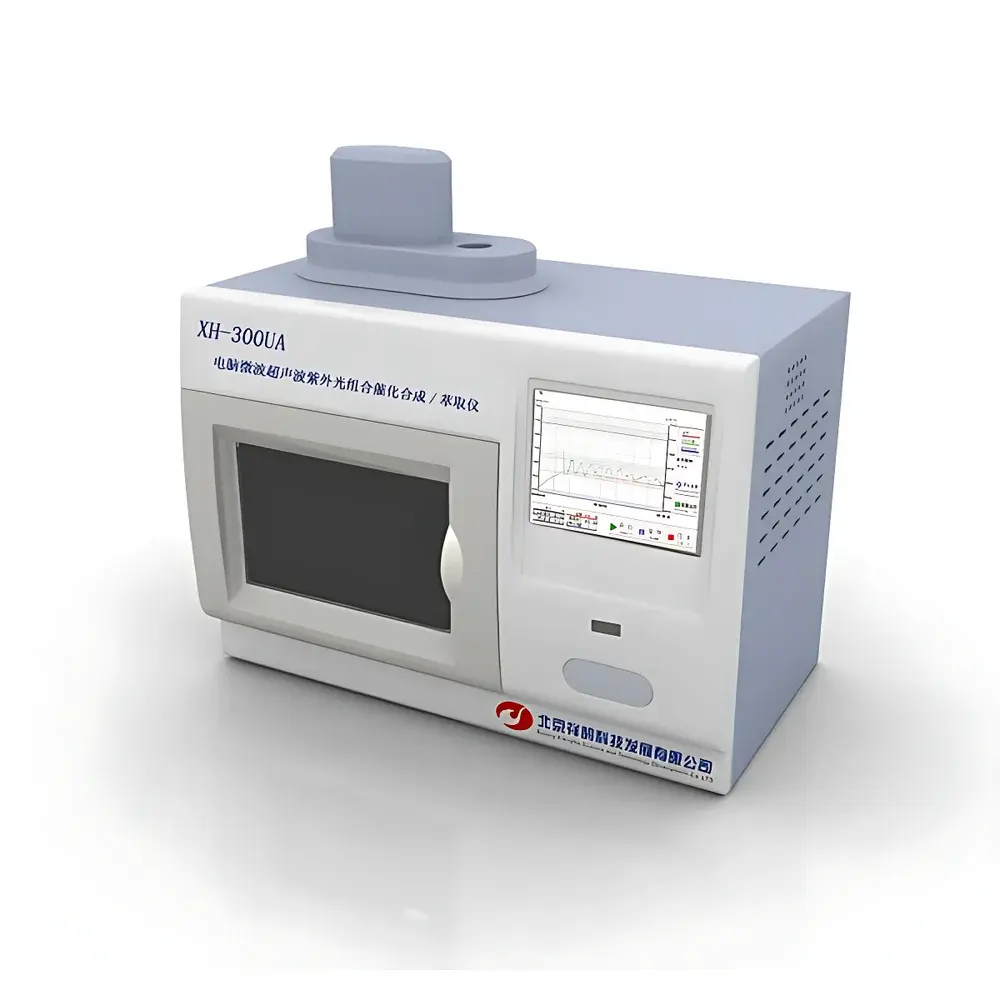
XH-300UA Microwave-Ultrasound-UV Multimodal Synthesis & Extraction System by Xianghu
| Brand | Xianghu |
|---|---|
| Origin | Beijing, China |
| Manufacturer Type | Direct Manufacturer |
| Product Category | Domestic |
| Model | XH-300UA |
| Price Range | USD 14,000–28,000 (FOB) |
| Temperature Range | 0–300 °C |
| Pressure Rating | Ambient (Open-Vessel Configuration) |
| Microwave Power Output | 0–1000 W |
| Microwave Frequency | 2450 MHz |
| Ultrasonic Power Output | 0–1500 W (adjustable) |
| Ultrasonic Frequency | 25 ± 1 kHz |
| UV Wavelength | 365 nm |
| UV Lamp Power | 250 W |
| Reaction Volume Capacity | 10–1000 mL |
| Stirring Method | Magnetic Stirring |
| Cooling | Water-Cooled Ultrasonic Transducer |
| Display | 8-inch Color TFT LCD |
| Control Architecture | 32-bit ARM-based Embedded Multi-Processor System |
| Data Interface | USB 2.0 (for mouse, USB flash drive, data export) |
| Video Monitoring | Integrated HD Camera for Real-Time Cavity Imaging |
| Temperature Sensing | High-Accuracy Contact Thermocouple (±1 °C accuracy) |
| Pulse Modes | Three Adjustable Ultrasonic Burst Intervals |
| Probe Options | Titanium Alloy Probes with Ø8 mm and Ø18 mm Diameters |
| Compliance | Meets GB 10436-2008 (Microwave Leakage Limits) |
Overview
The XH-300UA Microwave-Ultrasound-UV Multimodal Synthesis & Extraction System is an integrated laboratory platform engineered for advanced reaction engineering in synthetic organic chemistry, materials science, and natural product isolation. It uniquely combines three complementary energy-input modalities—microwave dielectric heating, high-intensity ultrasonic cavitation, and near-UV photonic excitation—within a single, open-vessel reaction chamber. This tri-modal architecture enables synergistic activation pathways: microwave irradiation accelerates molecular rotation and bulk thermal kinetics; ultrasonic waves generate localized transient hotspots (>5000 K) and microturbulence via acoustic cavitation; and 365 nm UV photons promote radical formation or photochemical bond cleavage in susceptible substrates. Designed for ambient-pressure operation, the system supports reflux configurations using standard glassware (e.g., condensers, dropping funnels), making it suitable for both closed-loop optimization studies and exploratory reaction screening under non-pressurized conditions.
Key Features
- Triple-energy activation: Simultaneous or sequential control of microwave (2450 MHz, 0–1000 W), ultrasound (25 ± 1 kHz, 0–1500 W, water-cooled transducer), and UV irradiation (365 nm, 250 W mercury lamp)
- Real-time multimodal monitoring: Integrated high-definition cavity camera allows on-the-fly visual assessment of phase behavior, nucleation, emulsification, or precipitate formation during synthesis or extraction
- Precision temperature management: Contact-type thermocouple with ±1 °C accuracy, coupled with adaptive power modulation algorithms that auto-adjust microwave output to maintain setpoint stability across variable load conditions
- Modular probe compatibility: Interchangeable titanium alloy ultrasonic probes (Ø8 mm and Ø18 mm) optimized for different vessel geometries and viscosities—from low-volume vial reactions (10 mL) to large-scale batch extractions (up to 1000 mL)
- Embedded multi-processor control: 32-bit ARM architecture enables concurrent logging of temperature, power, time, and ultrasonic duty cycle at 1-second resolution, with full traceability and timestamped data export
- Open-system flexibility: Standard ground-glass joints accommodate standard Schlenk-line accessories, including reflux condensers, inert gas inlets, and addition funnels—enabling classical organic protocols alongside energy-enhanced methodologies
Sample Compatibility & Compliance
The XH-300UA accommodates a broad range of sample types—including heterogeneous slurries, viscous polymer solutions, plant biomass suspensions, and air-sensitive organometallic mixtures—across volumes from 10 mL to 1000 mL. Reaction vessels are constructed from high-purity quartz glass (supplied in 50/100/250/500 mL capacities) to ensure UV transparency and thermal shock resistance up to 300 °C. All microwave emissions comply with GB 10436-2008 (equivalent to IEC 61000-3-2 for radiated emissions), and the system operates within Class II laser safety limits per GB 7247.1 for the 365 nm UV source. While not certified to ISO/IEC 17025 or GLP for regulated QA/QC environments, its data logging architecture supports audit-ready file structures compatible with internal lab SOPs requiring electronic record retention.
Software & Data Management
The embedded operating system provides a graphical user interface (GUI) with intuitive navigation via touch-responsive 8-inch TFT display. Users define multi-stage reaction protocols—including ramp-hold-cool sequences—with independent parameter sets for microwave power, ultrasonic duty cycle, UV exposure duration, and magnetic stirring speed. All operational parameters are logged synchronously at 1 Hz and stored internally or exported via USB 2.0 to FAT32-formatted drives. Exported datasets include CSV-formatted time-series records (temperature, power, stage ID) and JPEG snapshots from the cavity camera. No proprietary software installation is required for data retrieval; files are natively readable in Excel, Python (pandas), or MATLAB. The system does not support remote network access or FDA 21 CFR Part 11-compliant electronic signatures but meets baseline requirements for raw data integrity under GLP-aligned documentation practices.
Applications
- Accelerated synthesis of heterocycles (e.g., pyrazoles, triazoles) via microwave-assisted cycloadditions under catalytic or solvent-free conditions
- Ultrasound-enhanced solid-liquid extraction of polyphenols, alkaloids, and essential oils from botanical matrices, with real-time turbidity monitoring
- Photo-initiated grafting reactions on polymer surfaces using 365 nm UV in combination with mild thermal activation
- Multi-step one-pot cascade reactions where sequential energy inputs trigger discrete mechanistic steps (e.g., thermal esterification followed by UV-mediated deprotection)
- Reaction optimization studies requiring rapid screening of temperature, power, and irradiation variables across ≥20 parallel conditions per day
- Development of green chemistry protocols reducing solvent volume, catalyst loading, and total reaction time versus conventional oil-bath methods
FAQ
Is the XH-300UA suitable for pressurized reactions?
No—it is designed exclusively for ambient-pressure, open-vessel operation. Sealed-vessel microwave synthesis requires dedicated high-pressure reactors with pressure-rated cavities and safety interlocks.
Can the ultrasonic probe be used continuously at 300 °C?
Yes—the water-cooled transducer and titanium alloy probe assembly are rated for continuous operation up to 300 °C, provided coolant flow rate and temperature meet manufacturer specifications (≥1.5 L/min, inlet ≤25 °C).
What quartz vessel sizes are included as standard?
Four calibrated quartz reaction vessels are supplied: 50 mL, 100 mL, 250 mL, and 500 mL, all with standard Teflon-sealed ground-glass joints (24/40 taper).
Does the system support automated method transfer between instruments?
No—method portability is limited to manual parameter replication. The system lacks network connectivity, LIMS integration, or standardized communication protocols (e.g., OPC UA, Modbus TCP).
How is temperature measured and controlled during UV-only experiments?
A calibrated contact thermocouple inserted directly into the reaction mixture provides feedback for closed-loop thermal regulation, independent of illumination mode. Microwave power is disabled during UV-only runs, but magnetic stirring remains active.



