
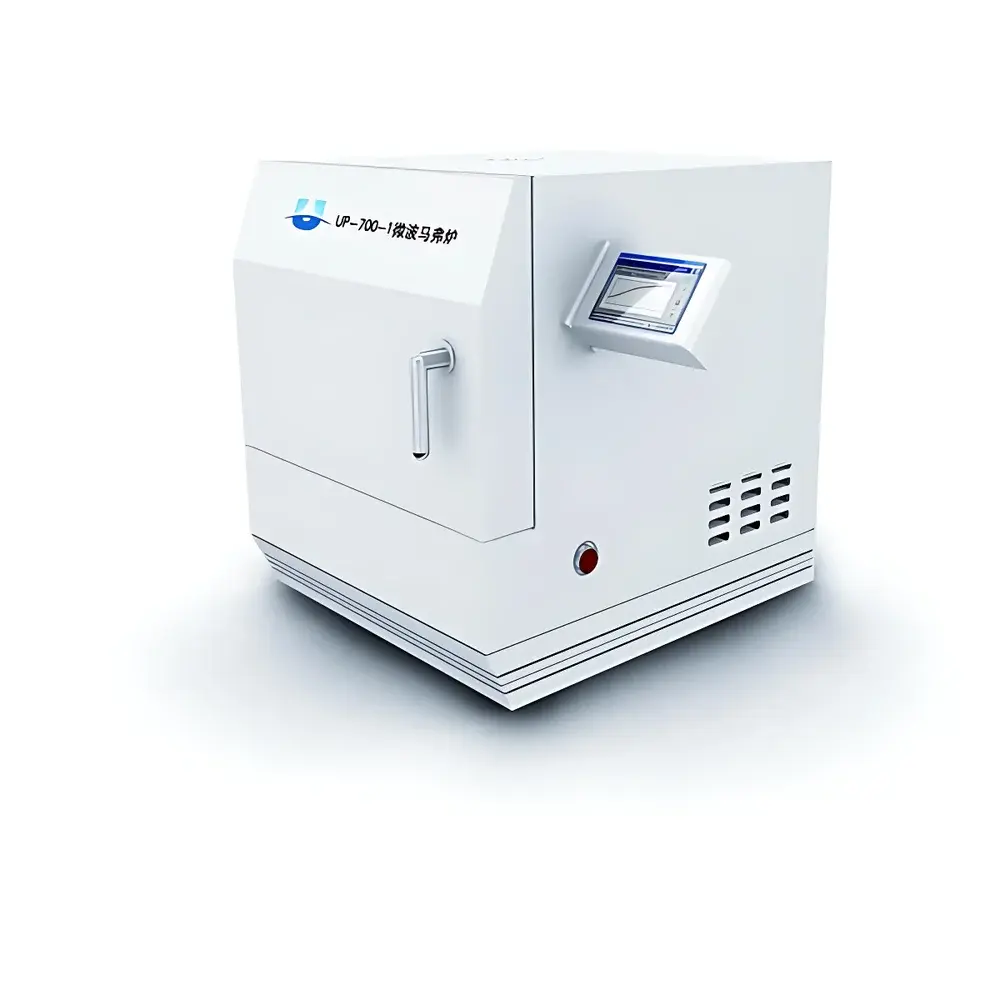
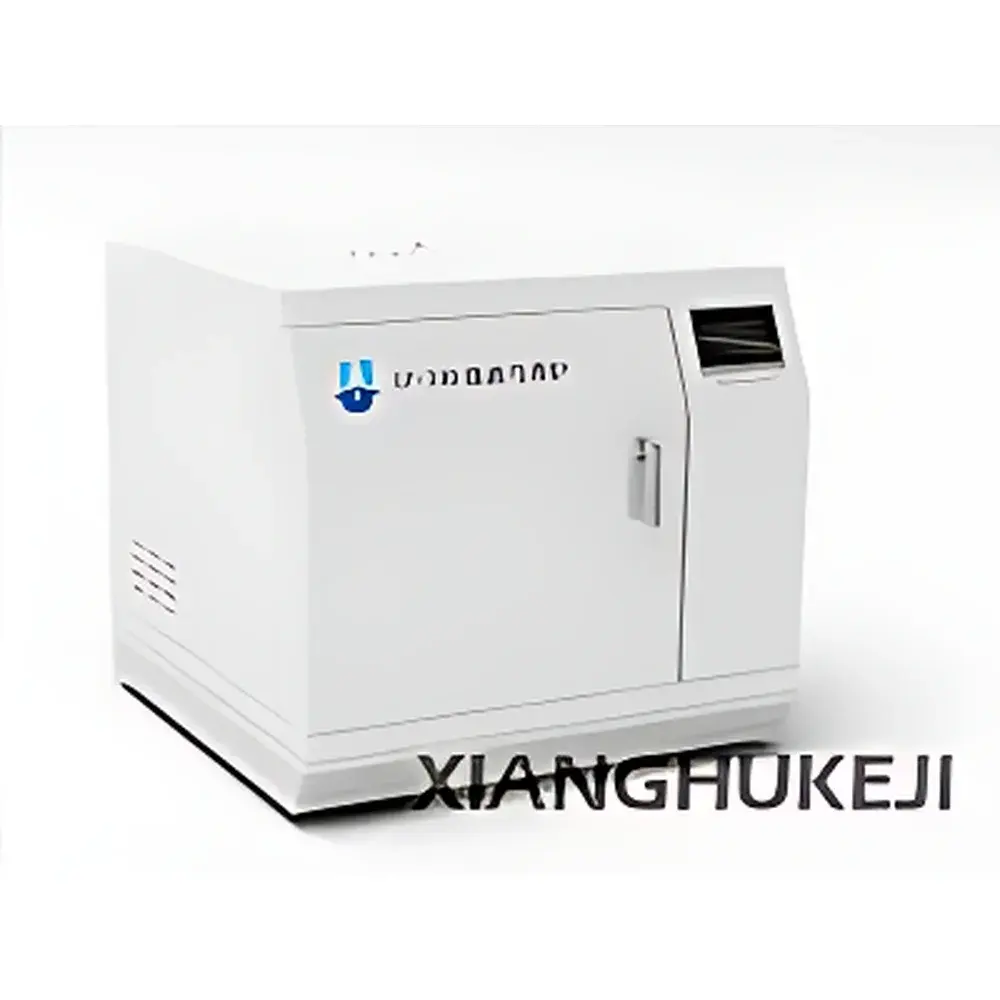
Xianghu UP-700 Microwave Muffle Furnace
| Brand | Xianghu |
|---|---|
| Origin | Beijing, China |
| Manufacturer Type | Direct Manufacturer |
| Product Category | Domestic |
| Model | UP-700 |
| Instrument Type | Box-Type Furnace |
| Max Temperature | 1600 °C |
| Temperature Control Accuracy | ±0.1% of reading |
| Power Range | 0.01–1.40 kW (small) / 0.01–2.80 kW (large) |
| Avg. Heating Rate to Max Temp | ≥20 °C/min |
| Heating Method | Microwave (2450 MHz) |
| Internal Chamber Dimensions | 130×80×70 mm or 140×140×100 mm (L×W×H) |
Overview
The Xianghu UP-700 Microwave Muffle Furnace is an advanced high-temperature thermal processing system engineered for rapid, volumetric, and energy-efficient heating under controlled atmospheres. Unlike conventional resistance-heated muffle furnaces, the UP-700 employs 2450 MHz microwave energy to directly couple with polarizable or conductive materials—enabling selective, internal heating with minimal thermal lag and exceptional temperature uniformity across the sample volume. This principle supports precise kinetic control in solid-state reactions, including synthesis, calcination, sintering, ashing, and thermal decomposition. Designed for laboratory-scale R&D in advanced ceramics, battery materials, and functional oxides, the furnace operates continuously up to 1550 °C (with 1600 °C short-term capability) in air, inert (N₂, Ar), or reducing (H₂/N₂) atmospheres—subject to compatible gas delivery and sealing configurations.
Key Features
- True microwave heating architecture with magnetron-based power generation (2450 MHz), delivering 0.01–1.40 kW (small configuration) or 0.01–2.80 kW (large configuration) in continuous, stepless adjustment
- High-fidelity temperature regulation: thermocouple-based feedback loop with ±0.1% of reading accuracy over 0–1600 °C range; real-time PID control with adaptive tuning
- 40-segment programmable process controller supporting ramp-hold profiles, data logging (timestamped temperature/power/time), and USB export of CSV-formatted experimental records
- Robust safety framework compliant with IEC 61000-3-2 (EMC) and GB 4706.1–2005 (domestic appliance safety): microwave leakage <0.5 mW/cm² at 5 cm distance; dual interlock door switch; over-temperature and over-current cut-off circuits
- Compact chamber design with dual cavity options: 130×80×70 mm (standard) or 140×140×100 mm (expanded), both lined with high-purity alumina fiber insulation and microwave-transparent ceramic support fixtures
- Modular front-panel interface with color LCD display, dynamic curve visualization, and screen-saver mode preserving live thermal trajectory during extended runs
Sample Compatibility & Compliance
The UP-700 accommodates a broad spectrum of inorganic powders, green bodies, and pre-sintered compacts—including dielectric ceramics (e.g., BaTiO₃, SrTiO₃, BST), cathode active materials (LiCoO₂, LiMn₂O₄), phosphors (Y₂O₃:Eu³⁺, ZnS:Cu,Al), ferrites (ZnFe₂O₄, NiZn ferrites), and refractory oxides (Al₂O₃, Y₂O₃, SiO₂). Sample containers must be microwave-compatible (e.g., SiC crucibles, high-purity Al₂O₃ boats, or quartz holders rated for ≥1600 °C). The system meets fundamental requirements for GLP-compliant thermal processing workflows: full audit trail via stored parameter logs, user-accessible calibration offsets, and traceable thermocouple input validation. While not certified to ISO/IEC 17025 as a testing laboratory instrument, its repeatability (±1.5 °C inter-run variance at 1400 °C, n=10) supports method development aligned with ASTM C1161 (flexural strength of advanced ceramics) and ISO 1171 (ash content determination).
Software & Data Management
No proprietary PC software is required; all operational parameters are configured and monitored via the integrated embedded controller. Experimental data—including time-stamped temperature, applied microwave power, and setpoint trajectory—is recorded internally and exportable via USB flash drive in plain-text CSV format. Each record includes metadata: date/time stamp, operator ID (manually entered), model number, firmware version, and total run duration. Data files conform to FAIR principles (Findable, Accessible, Interoperable, Reusable) for integration into LIMS or ELN platforms. For regulatory environments requiring electronic records integrity, optional firmware upgrade enables 21 CFR Part 11–compliant user authentication, electronic signatures, and immutable log archiving—subject to site-specific validation protocols.
Applications
- Rapid synthesis of multiferroic and ferroelectric perovskites with suppressed grain growth and enhanced phase purity
- Low-thermal-budget sintering of Li-ion battery cathodes to preserve stoichiometry and surface oxygen integrity
- Controlled ashing of biological or polymeric precursors for residue-free oxide nanopowder production
- Thermal gravimetric analysis (TGA)-coupled microscale burnout studies under inert flow
- Atmosphere-dependent reaction kinetics mapping for catalyst precursor decomposition (e.g., NiO/Al₂O₃, Co₃O₄)
- Preform densification of transparent ceramics (e.g., spinel, YAG) where conventional heating induces bubble formation
FAQ
What atmosphere options are supported?
The UP-700 is configured for ambient air operation by default. Optional quartz-tube or stainless-steel gas manifold kits enable continuous N₂, Ar, or forming gas (5% H₂/95% N₂) purging—validated up to 1500 °C with appropriate seals and flow controllers.
Is the furnace suitable for vacuum processing?
No. The cavity is not rated for vacuum service; internal pressure must remain at or above atmospheric. Vacuum compatibility requires alternative furnace designs with metal bellows and RF-shielded feedthroughs.
How is temperature calibrated and verified?
Factory calibration uses NIST-traceable Pt/Rh thermocouples. Users may perform field verification using secondary reference thermocouples (Type S or B) inserted through the side port—calibration offset adjustments are accessible in maintenance mode.
Can the UP-700 be integrated into automated lab systems?
Yes. RS-485 Modbus RTU communication port (standard) supports remote start/stop, setpoint override, and real-time data polling—compatible with PLCs, SCADA systems, and custom Python/LabVIEW control interfaces.
What maintenance is required for sustained performance?
Quarterly inspection of waveguide coupling, magnetron cooling fins, and door gasket integrity is recommended. Magnetron lifetime exceeds 5000 hours under nominal load; replacement kits include alignment fixtures and torque specifications.



