
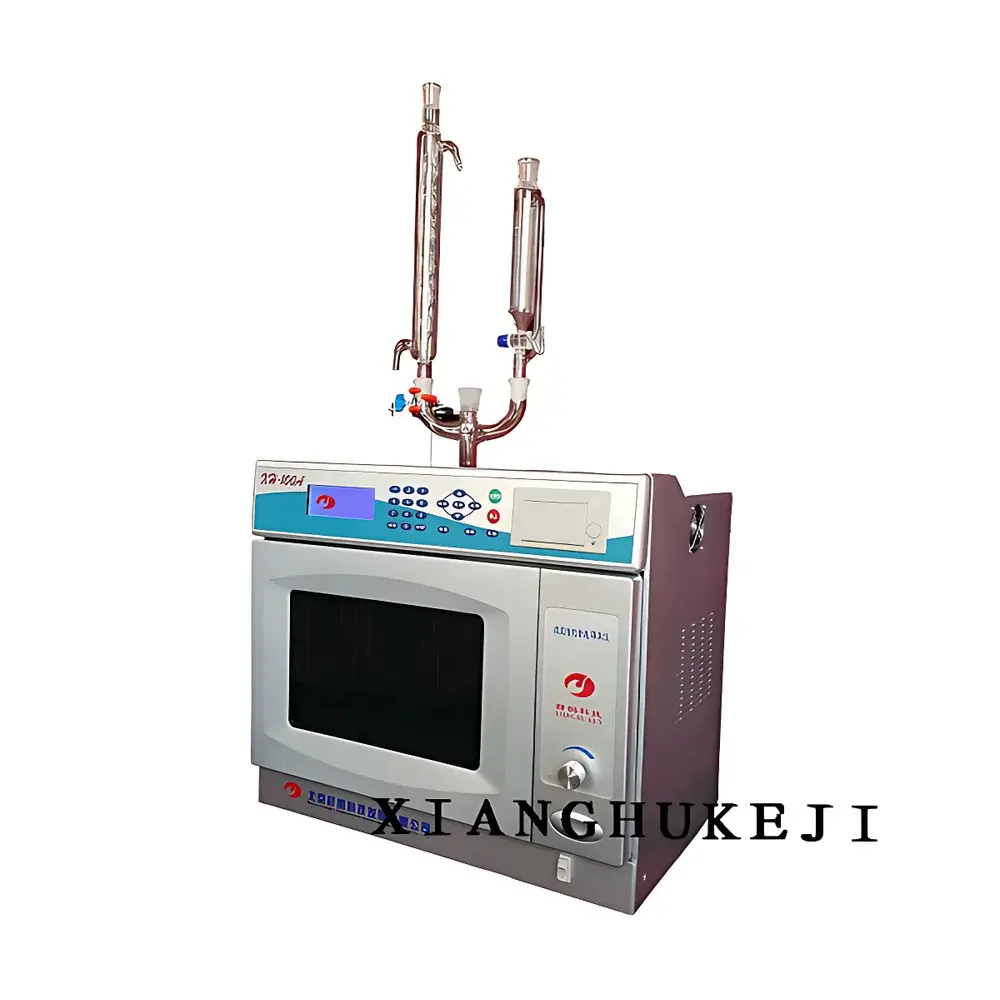
Xianghu XH-100A Computer-Controlled Microwave Synthesizer
| Brand | Xianghu |
|---|---|
| Origin | Beijing, China |
| Manufacturer Type | Direct Manufacturer |
| Product Category | Domestic (PRC-Made) |
| Model | XH-100A |
| Price Range | USD 1,400 – 7,200 |
| Microwave Power Output | 100–1000 W (10-step automatic adjustment) |
| Temperature Monitoring & Control Range | 0–300 °C |
| Temperature Measurement Accuracy | ≤ ±0.2 °C |
| Temperature Control Accuracy | ≤ ±1 °C |
| Cavity Volume | ≥31 L |
| Cavity Material | Austenitic stainless steel (non-magnetic, high microwave reflectivity, corrosion-resistant) |
| Reaction Vessel Capacity | 10–1500 mL |
| Real-time Contact Temperature Sensing | Platinum-plated resistance probe with shielded design |
| Stirring | Variable-speed magnetic stirring integrated |
| Data Storage | 10 programmable reaction protocols |
| Display | LCD with real-time temperature curve and digital/graphics dual-mode interface |
| Output | Integrated thermal printer for post-reaction report generation |
| Safety Compliance | Microwave leakage < 1 mW/cm² (per GB 10436-2008 / IEC 61000-3-2 equivalent) |
Overview
The Xianghu XH-100A Computer-Controlled Microwave Synthesizer is a benchtop, single-mode microwave reactor engineered for precision-controlled chemical synthesis and solvent extraction under non-pressurized, open-vessel conditions. It operates on the principle of dielectric heating—where polar molecules (e.g., solvents, reagents, or substrates) absorb microwave energy and convert it directly into thermal energy via dipole rotation and ionic conduction. Unlike conventional conductive heating, this volumetric energy transfer enables rapid, uniform internal heating—reducing thermal gradients, minimizing side reactions, and significantly accelerating reaction kinetics. The system integrates a high-efficiency magnetron, an austenitic stainless steel resonant cavity (≥31 L), and a contact-based platinum-plated RTD sensor that inserts directly into the reaction mixture for true in-situ temperature measurement. Its architecture supports both catalytic organic transformations (e.g., esterification, condensation, cyclization) and physical processes such as microwave-assisted extraction (MAE) of natural products, food matrices, or environmental samples.
Key Features
- Adjustable microwave output power from 100 to 1000 W across 10 discrete steps, enabling precise energy dosing for scale-sensitive reactions.
- Real-time, contact-based temperature monitoring using a shielded, platinum-coated resistance thermometer—ensuring measurement accuracy ≤ ±0.2 °C and eliminating latency or emissivity-related errors inherent in IR pyrometry.
- Intelligent adaptive temperature control algorithm: the microprocessor continuously analyzes the dynamic temperature profile and autonomously modulates microwave duty cycle to maintain setpoint stability within ±1 °C—even during exothermic transitions or phase changes.
- Austenitic stainless steel cavity (non-magnetic, low carbon, AISI 304-grade equivalent) provides superior microwave reflection, long-term corrosion resistance against acidic, basic, or halogenated media, and structural integrity at sustained temperatures up to 300 °C.
- Open-system configuration compatible with standard reflux apparatus—including condensers, dropping funnels, nitrogen inlet ports, and thermowell adapters—facilitating air- or inert-atmosphere reactions without pressurization.
- Integrated variable-speed magnetic stirrer ensures homogeneous mixing and thermal distribution across vessel volumes ranging from 10 mL to 1500 mL.
- LCD interface with dual-mode visualization (numerical + graphical temperature curve), intuitive scroll-menu navigation, and 10 protocol memory slots for repeatable method deployment.
- Onboard thermal printer delivers immediate hardcopy documentation of time-temperature profiles, power history, and endpoint parameters—supporting audit-ready recordkeeping.
Sample Compatibility & Compliance
The XH-100A accommodates a broad spectrum of sample types and reaction formats: liquid-phase organic syntheses (including Grignard, Suzuki, and Friedel-Crafts reactions), hydrolysis of glycosidic or peptide bonds, polymerization initiations, metal-catalyzed couplings, and solid–liquid extractions of botanicals, soils, or biological tissues. Its open-vessel design complies with ASTM E2879-22 (Standard Guide for Microwave-Assisted Sample Preparation) and aligns with ISO/IEC 17025 requirements for method validation in accredited laboratories. Microwave emission levels are certified to meet GB 10436-2008 (China’s national standard for industrial microwave equipment safety), which corresponds functionally to IEC 61000-3-2 limits for electromagnetic emissions. While not inherently 21 CFR Part 11 compliant out-of-the-box, the instrument’s deterministic control logic, timestamped data logging, and protocol recall capability provide foundational traceability for GLP/GMP-aligned workflows when paired with validated electronic lab notebook (ELN) integration.
Software & Data Management
The XH-100A operates via embedded firmware—not PC-dependent software—ensuring deterministic response times and operational independence from external computing infrastructure. All reaction parameters (power ramping profile, target temperature, hold duration, stirring speed) are stored locally in non-volatile memory. Each run generates a time-stamped dataset comprising second-by-second temperature and power values, archived in ASCII-compatible format readable by spreadsheet or LIMS platforms. The thermal printer output includes calibration verification stamps (sensor ID, date/time, ambient reference), satisfying basic ALCOA+ principles (Attributable, Legible, Contemporaneous, Original, Accurate). For laboratories requiring enhanced data governance, optional RS-232 or USB-to-serial interfaces support automated data export to validated third-party acquisition systems compliant with 21 CFR Part 11 Annex 11 requirements.
Applications
This synthesizer is routinely deployed in academic and industrial R&D settings for: accelerated route scouting in medicinal chemistry (e.g., heterocycle formation, amide coupling); optimization of green extraction protocols for polyphenols, alkaloids, or essential oils; rapid digestion of polymer composites prior to elemental analysis; synthesis of metal–organic frameworks (MOFs) and perovskite precursors; and development of novel catalysts under controlled thermal histories. Its reproducibility and kinetic enhancement—often delivering >100× rate acceleration versus oil-bath heating—make it particularly valuable in high-throughput screening, process intensification studies, and teaching laboratories where safety, speed, and pedagogical clarity are prioritized.
FAQ
Is the XH-100A suitable for closed-vessel high-pressure synthesis?
No. It is designed exclusively for atmospheric-pressure, open-system operation. For sealed-vessel applications requiring pressures >1 bar, a dedicated high-pressure microwave reactor platform is required.
Does the instrument support external temperature probes or third-party sensors?
No. It relies solely on its integrated, calibrated platinum RTD probe. External sensor inputs are not supported.
Can reaction data be exported digitally without using the thermal printer?
Yes—via RS-232 or USB serial interface (optional accessory), enabling direct acquisition into custom or commercial data logging environments.
What maintenance is required for long-term cavity performance?
Routine cleaning of the cavity interior with ethanol or mild detergent; inspection of waveguide cover integrity; and annual verification of temperature sensor calibration using NIST-traceable dry-block calibrators.
Is CE or UL certification available for international shipment?
The unit meets EMC and safety fundamentals per IEC 61010-1; however, formal CE marking or UL listing requires country-specific conformity assessment and cannot be assumed without documented certification reports issued by an EU Notified Body or OSHA-recognized NRTL.



