
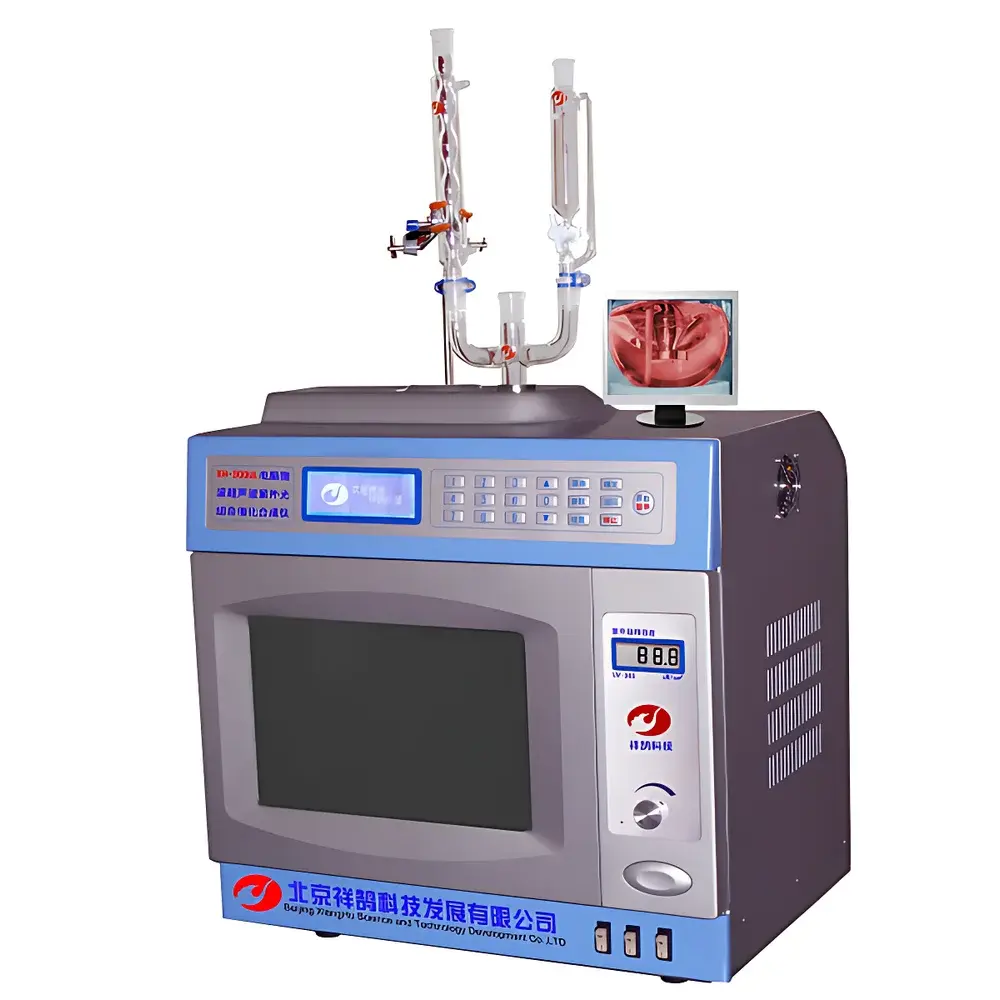
Xianghu XH-300UL-2 Tri-Modal Catalytic Synthesis System (Microwave + Ultrasonic + UV)
| Brand | Xianghu |
|---|---|
| Origin | Beijing, China |
| Manufacturer Type | Direct Manufacturer |
| Country of Origin | China |
| Model | XH-300UL-2 |
| Temperature Range | 0–260 °C |
| Pressure Rating | 6 MPa |
| Microwave Power | 0–1000 W |
| Magnetron Frequency | 2450 MHz |
| Reaction Volumes | 100 mL, 250 mL, 500 mL |
| Ultrasonic Frequencies | 25 ±1 kHz & 40 ±1 kHz |
| UV Wavelength | 365 nm |
| UV Power | 250 W |
| UV Irradiance Range | 0.1–199.9 mW/cm² |
| Temperature Control Accuracy | ±1 °C |
| Temperature Measurement Accuracy | ±0.2 °C |
| Max Continuous Operation | 99 h |
| Stirring Speed | up to 2000 rpm |
Overview
The Xianghu XH-300UL-2 Tri-Modal Catalytic Synthesis System is an engineered platform for advanced reaction acceleration and pathway diversification in synthetic chemistry, materials science, and catalysis research. It integrates three distinct energy modalities—microwave irradiation (2450 MHz), high-intensity ultrasonic cavitation (25/40 kHz), and monochromatic UV photolysis (365 nm)—within a single, rigorously controlled reaction environment. Unlike conventional single-mode reactors, this system enables synergistic activation mechanisms: microwave energy drives both thermal and non-thermal molecular excitation; ultrasonic waves induce transient cavitation collapse, generating localized hotspots (>5000 K) and radical species (e.g., •OH, H•) in solution; and 365 nm UV photons selectively promote n→π* or π→π* transitions in chromophores, enabling bond cleavage or excited-state electron transfer. The system operates under sealed or open-vessel configurations, supporting pressure-rated reactions up to 6 MPa and temperatures from ambient to 260 °C—making it suitable for hydrothermal synthesis, photocatalytic C–H activation, sonochemical nanoparticle nucleation, and microwave-assisted cross-coupling protocols.
Key Features
- Tri-modal operability: Independent or concurrent control of microwave, ultrasonic, and UV irradiation—configurable via 10-segment programmable protocols.
- Dual-frequency ultrasonic subsystem: 25 ±1 kHz and 40 ±1 kHz transducers with auto-tuning via phase-locked loop (PLL) frequency tracking—ensuring resonance stability across variable media viscosity and composition.
- Real-time process monitoring: High-precision Pt100 contact sensor (±0.2 °C measurement accuracy) coupled with closed-loop temperature regulation (±1 °C control accuracy); integrated UV irradiance probe (0.1–199.9 mW/cm² range) with on-screen digital readout.
- Modular reaction architecture: Stainless steel 316L (austenitic, non-magnetic, corrosion-resistant) cavity; inert gas inlet port; standard KF flange interfaces for condenser, dropping funnel, or reflux assembly.
- Intelligent power management: Ultrasonic power limit protection, overtemperature alarm, and adaptive mode switching—e.g., automatic reduction of ultrasonic duty cycle upon reaching setpoint temperature to mitigate self-heating artifacts.
- Optical observation capability: 3.5-inch color LCD with 380 K-pixel camera for real-time visual monitoring of reaction homogeneity, precipitation, or phase separation.
Sample Compatibility & Compliance
The XH-300UL-2 accommodates a broad range of sample types—including heterogeneous slurries, viscous organometallic mixtures, aqueous colloids, and photoactive suspensions—across reaction volumes from 10 mL to 1000 mL. Quartz reaction vessels (50/100/500 mL) ensure full UV transparency and thermal shock resistance. All ultrasonic probes (Φ8 mm and Φ18 mm) are chemically inert titanium alloy, rated for continuous immersion at ≤300 °C. The system meets GB 4706.21–2008 (Chinese national standard for microwave leakage ≤5 mW/cm² at 5 cm), and its sealed vessel design supports reactions compliant with ASTM E2827 (standard guide for microwave-assisted chemical synthesis). For regulated environments, the instrument’s parameter logging, timestamped event records, and user-accessible protocol storage align with GLP documentation requirements; optional audit trail export supports internal QA review.
Software & Data Management
Operation is managed through an embedded microcontroller-based interface with intuitive menu navigation and real-time graphical feedback. Each experiment stores complete metadata—including time-stamped power profiles (microwave/W, ultrasonic/W, UV/mW/cm²), temperature curves, and segment-wise mode assignments. Data export is supported via USB to CSV format for post-acquisition analysis in MATLAB, Origin, or Python. No proprietary software installation is required; all configuration and monitoring occur locally on the unit’s display. The system does not implement FDA 21 CFR Part 11 electronic signature functionality, but raw log files contain sufficient traceability for academic publication or method validation reports.
Applications
- Photocatalytic organic transformations: Selective C–N bond formation under UV-driven Ru(bpy)₃²⁺ or TiO₂-mediated conditions.
- Sonochemical nanomaterial synthesis: Controlled nucleation of Pd, Ag, or Fe₃O₄ nanoparticles without reducing agents.
- Accelerated heterocycle synthesis: Microwave-enhanced [3+2] cycloadditions or Suzuki couplings completed in <15 min vs. hours under reflux.
- Green solvent processing: Degradation of recalcitrant dyes (e.g., methylene blue) via combined UV/ultrasound/O₃ pathways.
- High-pressure hydrothermal synthesis: Crystallization of MOFs or perovskites under 4–6 MPa N₂ atmosphere with simultaneous microwave heating and mechanical agitation.
FAQ
Can the system operate all three energy sources simultaneously?
Yes—the instrument supports fully synchronized microwave, ultrasonic, and UV irradiation, with independent power and timing control per modality.
What safety certifications does the unit hold?
It complies with GB 4706.21–2008 for microwave radiation safety and features dual hardware interlocks, pressure-relief rupture discs, and redundant thermal cutoffs.
Is quartz the only compatible vessel material for UV mode?
Yes—only fused quartz vessels transmit 365 nm UV effectively; borosilicate glass or stainless steel reactors block >99% of incident irradiance.
How is temperature measured during ultrasonic irradiation?
Via direct-contact Pt100 sensor immersed in the reaction medium; the system dynamically compensates for ultrasonic self-heating by modulating pulse duty cycle.
Does the system support external computer control or API integration?
No—it operates as a standalone instrument with local interface only; no RS232, Ethernet, or SDK is provided.



