
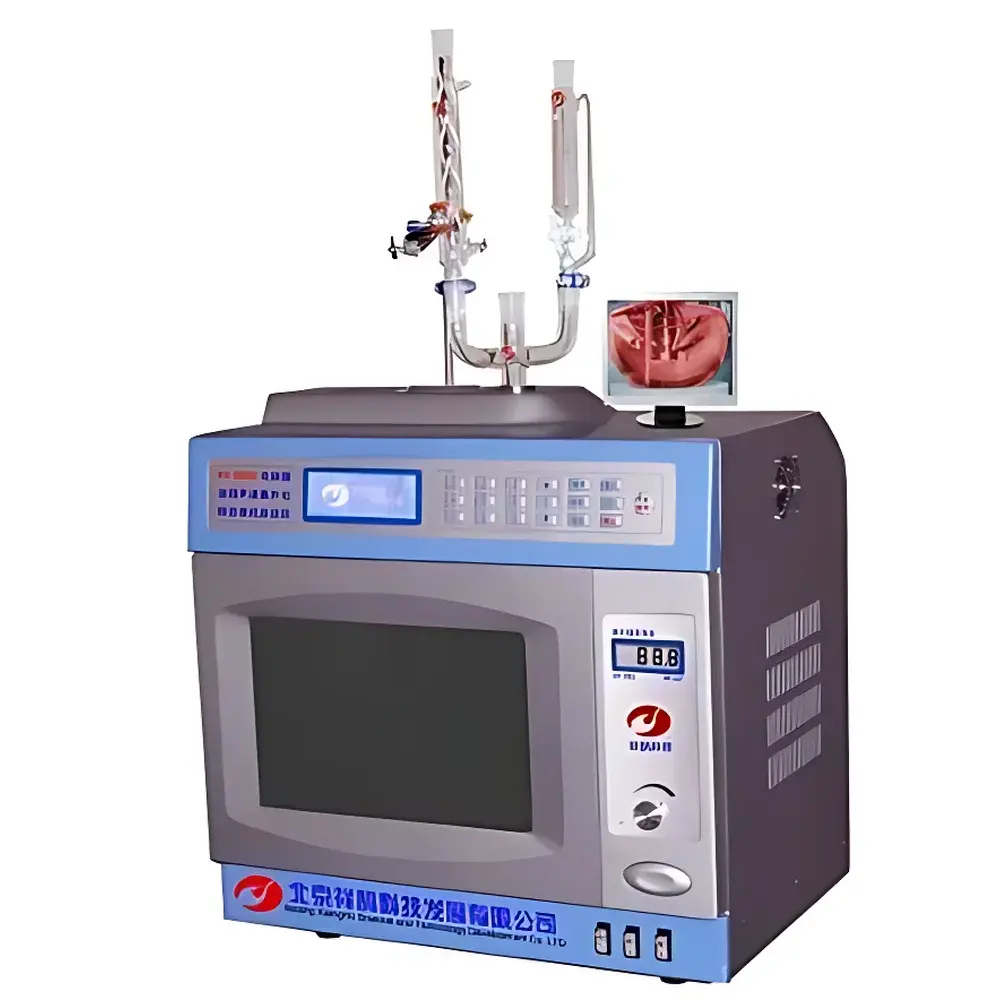
Xianghu XH-300UL Computer-Controlled Microwave-Ultrasound-UV Tri-Mode Synthesis and Extraction System
| Brand | Xianghu |
|---|---|
| Origin | Beijing, China |
| Manufacturer Type | Direct Manufacturer |
| Product Origin | Domestic (China) |
| Model | XH-300UL |
| Microwave Power | 0–1000 W (continuously adjustable) |
| Microwave Frequency | 2450 MHz |
| Temperature Control Range | 0–300 °C |
| Temperature Control Accuracy | ±1 °C |
| Cavity Material | Resonant Microwave Cavity (Austenitic Stainless Steel) |
| Ultrasonic Power | 0–1500 W (continuously adjustable) |
| Ultrasonic Frequency | 25 ± 1 kHz |
| UV Wavelength | 365 nm |
| UV Lamp Power | 250 W |
| UV Irradiance Measurement Range | 0.1–199,900 µW/cm² |
| UV Stray Light (Outside Band) | < 0.02% |
| Reaction Volume Capacity | 10–1000 mL |
| Ultrasonic Probe Diameters | Φ8 mm & Φ18 mm |
| Real-Time Imaging | 3.8-MP Camera Integrated |
| Temperature Sensing Method | High-Precision Contact Sensor |
| Stirring | Variable-Speed Magnetic Stirring |
| Safety Compliance | Microwave Leakage < GB 10436-2008 Limit |
Overview
The Xianghu XH-300UL is a computer-integrated, tri-modal reaction platform engineered for advanced synthetic chemistry, materials science, and natural product extraction workflows. It uniquely combines microwave irradiation, high-intensity ultrasonic cavitation, and monochromatic 365 nm ultraviolet photolysis within a single, unified reaction environment—enabling synergistic activation pathways unattainable with single-mode instruments. Its operation is grounded in three complementary physical mechanisms: dielectric heating via 2450 MHz microwave energy; acoustic cavitation and micro-mixing driven by 25 ± 1 kHz ultrasonic waves; and photochemical bond cleavage or radical generation induced by calibrated 365 nm UV irradiance. Designed for reproducible method development under controlled thermal and energetic conditions, the system supports both open-vessel reflux configurations (with optional condensers and dropping funnels) and sealed high-temperature/pressure reactions. The resonant cavity architecture—constructed from non-magnetic, corrosion-resistant austenitic stainless steel—ensures uniform microwave field distribution and long-term mechanical stability under thermal cycling.
Key Features
- Tri-modal operational flexibility: independent or simultaneous activation of microwave, ultrasound, and UV irradiation—with fully programmable sequence logic across up to 10 user-defined segments.
- Intelligent microwave power regulation via self-learning temperature feedback: dynamically adjusts output to maintain setpoint without overshoot, supporting both constant-power and constant-temperature control strategies.
- High-efficiency ultrasonic subsystem featuring phase-locked loop (PLL) frequency tracking: continuously monitors transducer impedance and auto-tunes drive frequency to sustain resonance—even as reaction viscosity or composition changes—maximizing acoustic energy transfer efficiency.
- Real-time, contact-based temperature monitoring with ±0.2 °C measurement accuracy and ±1 °C closed-loop control precision across 0–300 °C range; integrated thermal compensation prevents ultrasonic self-heating artifacts.
- Dual-diameter titanium alloy ultrasonic probes (Φ8 mm and Φ18 mm) optimized for scalable vessel geometry—from 10 mL vials to 1 L reactors—each rated for continuous operation up to 300 °C.
- Calibrated 365 nm UV source (250 W) with built-in irradiance sensor: displays real-time surface irradiance (0.1–199,900 µW/cm²) and confirms spectral purity (< 0.02% stray light outside 365 ± 10 nm band), critical for quantitative photochemical studies.
- Full-color LCD interface with embedded 3.8-megapixel camera: enables live visual monitoring of reaction homogeneity, bubble dynamics, precipitation onset, or phase separation without interrupting operation.
- Comprehensive safety architecture: fully enclosed transducer mounting, interlocked cavity door, electromagnetic leakage < GB 10436-2008 limit, and dual-redundant over-temperature/over-power shutdown protocols.
Sample Compatibility & Compliance
The XH-300UL accommodates diverse sample matrices—including aqueous, organic, ionic liquid, and heterogeneous suspensions—across volumes from 10 mL to 1000 mL. Its open-system design permits integration of standard laboratory glassware (e.g., round-bottom flasks, reflux condensers, addition funnels), facilitating classical synthetic protocols alongside novel multi-energy-driven transformations. All wetted components comply with ISO 8502-3 for stainless steel passivation and meet RoHS Directive 2011/65/EU material restrictions. While not certified for GMP manufacturing environments, the system’s deterministic parameter logging, audit-trail-capable software, and traceable irradiance/temperature records support GLP-aligned research documentation per OECD Principles of Good Laboratory Practice (GLP) and ASTM E2500-14 guidelines for equipment qualification.
Software & Data Management
Control and data acquisition are managed through proprietary Windows-based software with timestamped parameter logging (microwave power, ultrasonic amplitude, UV irradiance, temperature, time) at user-selectable intervals down to 1 second. Each experiment generates a structured CSV file containing synchronized sensor streams and event markers (e.g., mode transitions, alarm triggers). The software supports method templating, batch execution, and comparative overlay of kinetic profiles across replicate runs. Exported datasets are compatible with MATLAB, Python (Pandas), and industry-standard statistical analysis platforms. Though not FDA 21 CFR Part 11 compliant out-of-the-box, the system provides raw data integrity (non-erasable logs), operator ID fields, and electronic signature-ready export formats—facilitating internal validation for regulated academic or contract research settings.
Applications
- Accelerated synthesis of metal–organic frameworks (MOFs) and covalent organic frameworks (COFs) via microwave-assisted solvothermal routes enhanced by ultrasonic dispersion and UV-initiated ligand coupling.
- Green extraction of polyphenols, alkaloids, and terpenoids from botanical matrices using synergistic microwave-thermal disruption, ultrasonic cell wall fragmentation, and UV-assisted antioxidant stabilization.
- Photocatalytic degradation studies of emerging contaminants (e.g., pharmaceuticals, microplastics) under controlled 365 nm irradiance, with real-time temperature compensation to decouple thermal and photochemical contributions.
- Development of sonochemical nanomaterials (e.g., TiO₂, ZnO quantum dots) where ultrasonic nucleation is spatially and temporally coordinated with microwave drying and UV surface functionalization.
- Reaction mechanism elucidation in homogeneous catalysis—leveraging in situ visual monitoring and multi-parameter correlation to distinguish rate-limiting steps influenced by thermal, mechanical, or photochemical inputs.
FAQ
Can the XH-300UL operate all three energy modes simultaneously during a single reaction step?
Yes—microwave, ultrasound, and UV irradiation can be activated concurrently with independent parameter control (power, duration, pulsing) within any defined segment of a multi-step program.
Is the UV irradiance sensor NIST-traceable?
The integrated irradiance probe is factory-calibrated against a reference spectroradiometer; full NIST-traceable calibration certificates are available as an optional add-on service.
What is the maximum allowable pressure inside the reaction vessel during microwave operation?
The system is designed for ambient-pressure open-vessel use; for sealed high-pressure applications, third-party pressure-rated vessels must be validated separately—the instrument does not include pressure containment hardware.
Does the software support remote monitoring or networked deployment?
Local Ethernet connectivity is provided for LAN-based control and data streaming; remote access requires institutionally managed firewall configuration and is not natively supported via cloud or mobile interfaces.
Are replacement ultrasonic probes and UV lamps available as consumables?
Yes—Φ8 mm and Φ18 mm titanium probes, as well as 365 nm UV lamps (250 W, G25T3 type), are stocked and supplied with documented lifetime specifications and handling instructions.



