
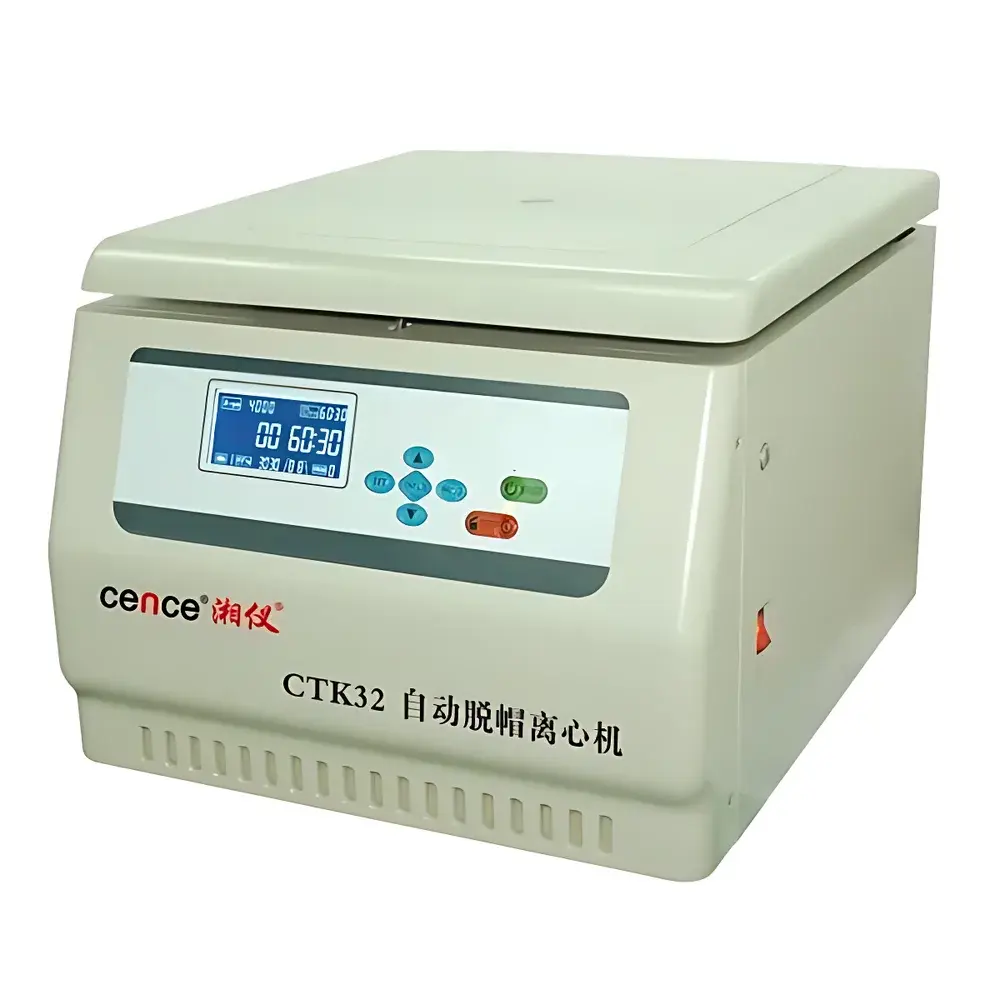
Xiangyi CTK32 Automated Cap-Removal Benchtop Centrifuge
| Brand | Xiangyi |
|---|---|
| Origin | Hunan, China |
| Manufacturer Type | Direct Manufacturer |
| Product Category | Domestic |
| Model | CTK32 |
| Instrument Type | Benchtop Centrifuge |
| Speed Class | Low-Speed Centrifuge (≤4000 rpm) |
| Function | Standard Centrifugation with Integrated Cap Removal |
| Configuration | Horizontal Rotor System |
| Max Capacity | 32 × vacuum blood collection tubes (4×8 configuration) |
| Max Speed | 4000 rpm |
| Max RCF | 2980 × g |
| Dimensions (L×W×H) | 470 × 560 × 380 mm |
| Motor | AC Frequency-Controlled Motor |
| Speed Accuracy | ±30 rpm |
| Timer Range | 1 sec – 99 min 59 sec |
| Noise Level | ≤65 dB(A) |
| Power Supply | AC 220 V ±22 V, 50 Hz, 5 A |
| Power Consumption | 370 W |
| Net Weight | 38 kg |
| Rotor Compatibility | Horizontal rotor body, tube carriers, and adapters for Ø13 × 75 mm / Ø13 × 100 mm vacuum tubes |
Overview
The Xiangyi CTK32 Automated Cap-Removal Benchtop Centrifuge is engineered for high-throughput clinical laboratories where blood sample processing must meet stringent requirements for efficiency, biosafety, and reproducibility. Unlike conventional benchtop centrifuges that require manual cap removal post-centrifugation—a step prone to operator-induced re-mixing of serum/plasma layers and potential aerosol generation—the CTK32 integrates a precision mechanical cap-removal module directly into the centrifugation workflow. It operates on the principle of controlled radial acceleration followed by synchronized axial actuation, enabling consistent, contact-free detachment of rubber or plastic caps from standard vacuum blood collection tubes (e.g., BD Vacutainer®, Greiner Bio-One). Designed specifically for low-speed sedimentation (up to 4000 rpm, 2980 × g), the CTK32 ensures optimal phase separation of whole blood into cellular and supernatant fractions while eliminating manual intervention during decapping—reducing turnaround time and minimizing occupational exposure risks.
Key Features
- Integrated automated cap-removal mechanism with >90% success rate across Ø13 × 75 mm and Ø13 × 100 mm vacuum tubes
- Horizontal rotor system accommodating up to 32 tubes in a 4×8 configuration, optimized for routine clinical batch processing
- AC frequency-controlled motor delivering precise speed control (±30 rpm) and rapid acceleration/deceleration profiles
- Real-time RCF calculation and display, eliminating manual conversion errors between rpm and relative centrifugal force
- Dual-stage vibration suppression system with dynamic auto-balancing and specialized damping mounts for stable operation at rated speeds
- Electronically interlocked safety door: centrifuge remains inert unless fully latched; immediate shutdown upon unauthorized lid opening during operation
- Intuitive touch-panel interface with large LCD screen supporting multilingual menu navigation (English default), timer programming down to 1-second resolution, and error-code diagnostics
Sample Compatibility & Compliance
The CTK32 accepts standard evacuated blood collection tubes compliant with ISO 6710 and CLSI H20-A3 specifications, including EDTA, heparin, citrate, and serum separator tubes (SSTs) with diameters of 13 mm and lengths of either 75 mm or 100 mm. Its rotor geometry and cap-removal kinematics are validated for compatibility with major global tube manufacturers’ dimensional tolerances and cap material properties (e.g., thermoplastic elastomer seals, silicone-coated rubber stoppers). The device conforms to IEC 61010-1:2010 for electrical safety in laboratory equipment and meets EN 61326-1:2013 electromagnetic compatibility requirements. While not certified for GMP environments per se, its design supports GLP-aligned workflows—including audit-ready event logging when paired with optional data export modules—and aligns with core elements of ISO 15189:2022 clause 5.3.2 (pre-analytical process control).
Software & Data Management
The embedded firmware supports timestamped operational logging (start/stop time, set parameters, actual RCF, error events) stored locally in non-volatile memory. Through optional RS-232 or USB-to-serial interfaces, users may export logs in CSV format for integration into LIMS or QA documentation systems. Though the base unit does not include FDA 21 CFR Part 11-compliant electronic signatures or role-based access control, its deterministic behavior, repeatable parameter execution, and hardware-enforced safety interlocks facilitate validation under internal SOPs for regulated clinical testing. Firmware updates are delivered via secure USB key, maintaining traceability of version history per ISO/IEC 17025:2017 clause 7.7.
Applications
- Routine serum and plasma separation in hospital core labs and reference laboratories
- Pre-analytical automation for immunoassay, clinical chemistry, and coagulation testing workflows
- Blood bank sample preparation requiring strict avoidance of hemolysis and layer disturbance
- Research applications involving biobanking of peripheral blood mononuclear cells (PBMCs) where cap integrity and contamination control are critical
- Point-of-care satellite labs needing compact, self-contained centrifugation with minimal operator dependency
FAQ
What tube sizes does the CTK32 support for automatic decapping?
It is validated for Ø13 mm diameter vacuum tubes with lengths of 75 mm and 100 mm—covering most globally standardized blood collection tubes.
Is the rotor autoclavable?
No. The horizontal rotor assembly and tube carriers are constructed from anodized aluminum alloy and are designed for wipe-down disinfection using 70% ethanol or 0.5% sodium hypochlorite solution in accordance with CLSI GP26-A5 guidelines.
Can the CTK32 be integrated into automated lab conveyor systems?
Not natively. It lacks robotic interface ports (e.g., I/O signals, Modbus TCP); however, external PLC-triggered start/stop functionality can be implemented via dry-contact relay inputs on optional accessory modules.
Does it comply with ISO 13485 for medical device manufacturing?
The CTK32 is classified as a Class I laboratory instrument under Chinese NMPA regulations and carries CE marking under the EU Laboratory Equipment Directive (2014/30/EU). Full ISO 13485 certification applies only to Xiangyi’s quality management system—not individual instruments—though technical documentation supports customer-led regulatory submissions.
What maintenance is required to sustain cap-removal reliability?
Monthly visual inspection of cap-gripping jaws and lubrication of linear actuators with food-grade silicone grease is recommended. Annual calibration of speed and timer accuracy against NIST-traceable standards is advised for ISO/IEC 17025-accredited labs.
Related Products



