
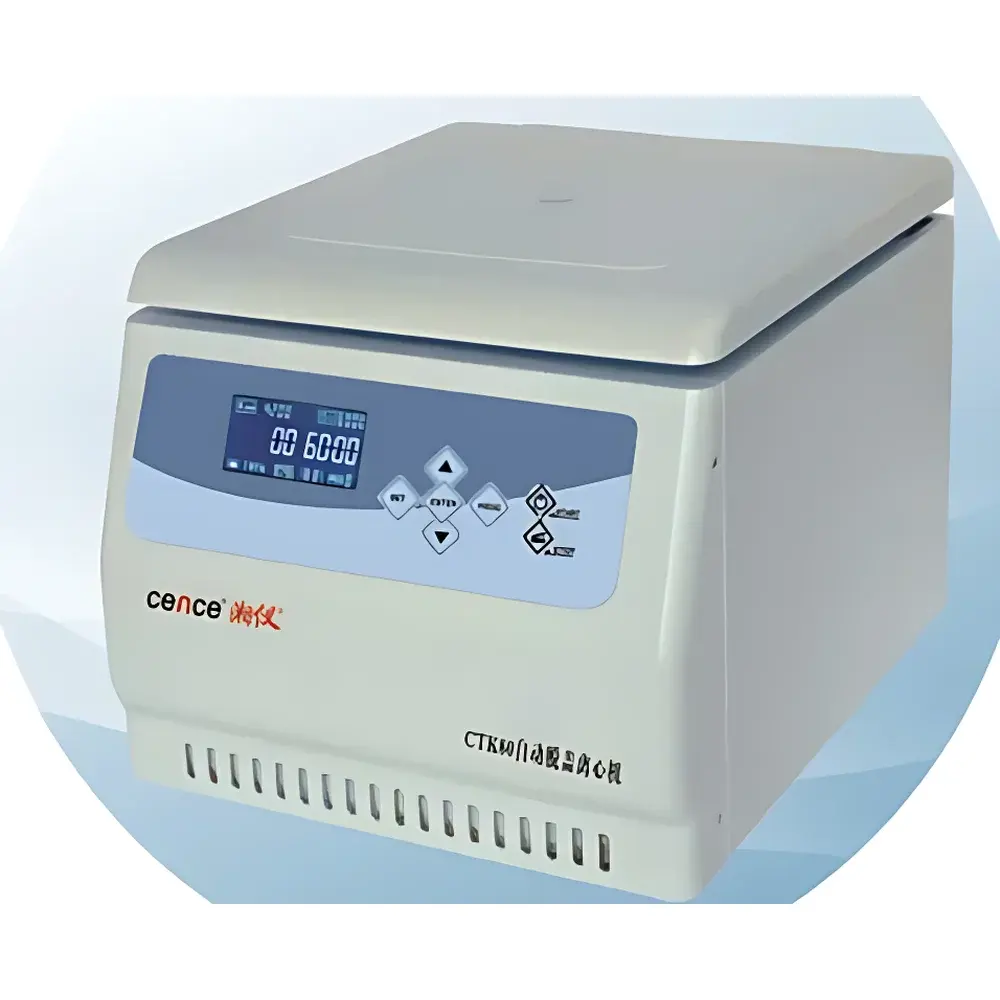
Xiangyi CTK80 Automated Cap-Removal Benchtop Centrifuge
| Brand | Xiangyi |
|---|---|
| Origin | Hunan, China |
| Manufacturer Type | Direct Manufacturer |
| Product Category | Domestic |
| Model | CTK80 |
| Instrument Type | Benchtop Centrifuge |
| Speed Class | Low-Speed Centrifuge (≤4,000 rpm) |
| Configuration | Horizontal Rotor |
| Max Capacity | 80 vacuum blood collection tubes (4 × 20) |
| Max Speed | 4,000 rpm |
| Max RCF | 3,030 × g |
| Dimensions | 470 × 560 × 380 mm |
| Cap-Removal Compatibility | 75 mm and 100 mm tube lengths |
| Cap-Removal Success Rate | >90% |
| Drive System | AC Frequency-Controlled Motor |
| Control Interface | Touch Panel with Large LCD Display |
| Safety Features | Electronic Door Lock, Automatic Rotor Imbalance Detection, Interlocked Lid Safety Switch (prevents start if lid open |
| Vibration Damping | Optimized Passive Damping System with Auto-Balancing Capability |
| RCF Calculation | Real-Time Onboard Computation |
Overview
The Xiangyi CTK80 Automated Cap-Removal Benchtop Centrifuge is an integrated sample processing instrument engineered specifically for clinical laboratories handling high-volume vacuum blood collection tubes. Unlike conventional benchtop centrifuges that require manual cap removal post-centrifugation—introducing risks of sample re-mixing, aerosol generation, operator exposure, and workflow bottlenecks—the CTK80 incorporates a fully automated cap-disengagement mechanism synchronized with the centrifugation cycle. It operates on standard horizontal rotor architecture, utilizing Couette-flow sedimentation principles to separate serum/plasma from cellular components under controlled gravitational force (RCF). Designed for routine hematological and biochemical specimen preparation, the CTK80 supports ISO 15189-compliant laboratory workflows by minimizing human intervention in pre-analytical steps—a critical factor in reducing total testing error per CLSI EP23-A guidelines.
Key Features
- Automated cap removal system with >90% success rate across two standardized vacuum tube lengths (75 mm and 100 mm), eliminating manual decapping and associated biosafety hazards
- AC frequency-controlled motor enabling precise speed regulation (0–4,000 rpm), rapid acceleration/deceleration profiles, and consistent torque delivery across load variations
- Integrated real-time RCF calculation engine—automatically updates displayed relative centrifugal force based on selected rotor radius and current rotational speed
- Touch-panel interface with large backlit LCD display supporting multilingual menu navigation (English default), intuitive parameter entry, and run history recall
- Passive vibration-damping architecture with dynamically tuned elastomeric isolators and auto-balancing detection—ensures stable operation even with minor tube weight asymmetry (±5%)
- Electronically interlocked safety door system: prevents initiation when lid is unlatched; triggers immediate rotor halt and brake engagement if lid is forcibly opened during operation
- Compliance-ready design: meets IEC 61010-1 (Safety Requirements for Electrical Equipment for Measurement, Control, and Laboratory Use) and EN 61326-1 (EMC for Laboratory Instruments)
Sample Compatibility & Compliance
The CTK80 accommodates standard 13 × 75 mm and 13 × 100 mm vacuum blood collection tubes—including EDTA, heparin, citrate, and serum separator tubes (SST)—without adapter requirements. Its horizontal swing-out rotor accepts four 20-position buckets (total 80-tube capacity), each rated for continuous operation at 4,000 rpm and 3,030 × g. All wetted components are constructed from medical-grade stainless steel (AISI 304) and autoclavable polymer housings compliant with ISO 10993-5 (cytotoxicity) and USP Class VI biocompatibility testing. The device supports GLP/GMP-aligned documentation practices through timestamped operational logs stored locally (non-volatile memory) and exportable via USB port—facilitating audit readiness for CAP, COLA, or JCI-accredited facilities.
Software & Data Management
While the CTK80 operates as a standalone instrument without network connectivity, its embedded firmware provides traceable data governance features essential for regulated environments. Each centrifugation cycle records: date/time stamp, selected speed (rpm), runtime duration, final RCF, cap-removal status per bucket (pass/fail), and any triggered safety events (e.g., imbalance alert, door interruption). These logs are retained for ≥1,000 cycles and exportable in CSV format for integration into LIMS or QMS platforms. No proprietary software installation is required—data retrieval uses standard USB mass-storage protocol. Firmware updates are performed offline via encrypted firmware image files, maintaining integrity verification prior to installation.
Applications
- Routine serum and plasma separation in hospital core labs and reference laboratories processing >200 vacuum tubes per shift
- Pre-analytical automation in clinical trials requiring strict adherence to SOP-defined centrifugation parameters and cap-handling protocols
- Blood bank quality control workflows where hemolysis minimization and clot retraction consistency are critical
- Point-of-care testing sites seeking CE-IVD-compatible instrumentation with minimal training overhead
- Research laboratories performing longitudinal biomarker studies dependent on reproducible phase separation kinetics
FAQ
What tube types and sizes does the CTK80 support for automated cap removal?
The CTK80 is validated for standard vacuum blood collection tubes measuring either 75 mm or 100 mm in length, including all major anticoagulant and separator formulations (EDTA K2/K3, lithium heparin, sodium citrate, SST, PST).
Does the instrument comply with FDA 21 CFR Part 11 requirements?
As a Class I exempt general-purpose laboratory device, the CTK80 does not fall under Part 11 electronic record/signature mandates; however, its audit-trail-capable firmware supports ALCOA+ data integrity principles and aligns with Annex 11 (EU GMP) expectations for electronic data capture.
Can the rotor be sterilized between runs?
Yes—the swing-out buckets and adapters are autoclavable at 121 °C for 20 minutes; rotor body cleaning follows manufacturer-recommended disinfectant protocols compatible with stainless steel surfaces.
Is remote monitoring or Ethernet connectivity available?
No. The CTK80 is designed as a closed-system, single-user instrument with local-only operation to ensure electromagnetic compatibility in dense diagnostic equipment environments.
What maintenance intervals are recommended?
Annual calibration of speed and RCF accuracy is advised using NIST-traceable tachometry; routine inspection of cap-removal actuators and door lock solenoids should occur every 6 months or after 5,000 cycles, whichever comes first.



