
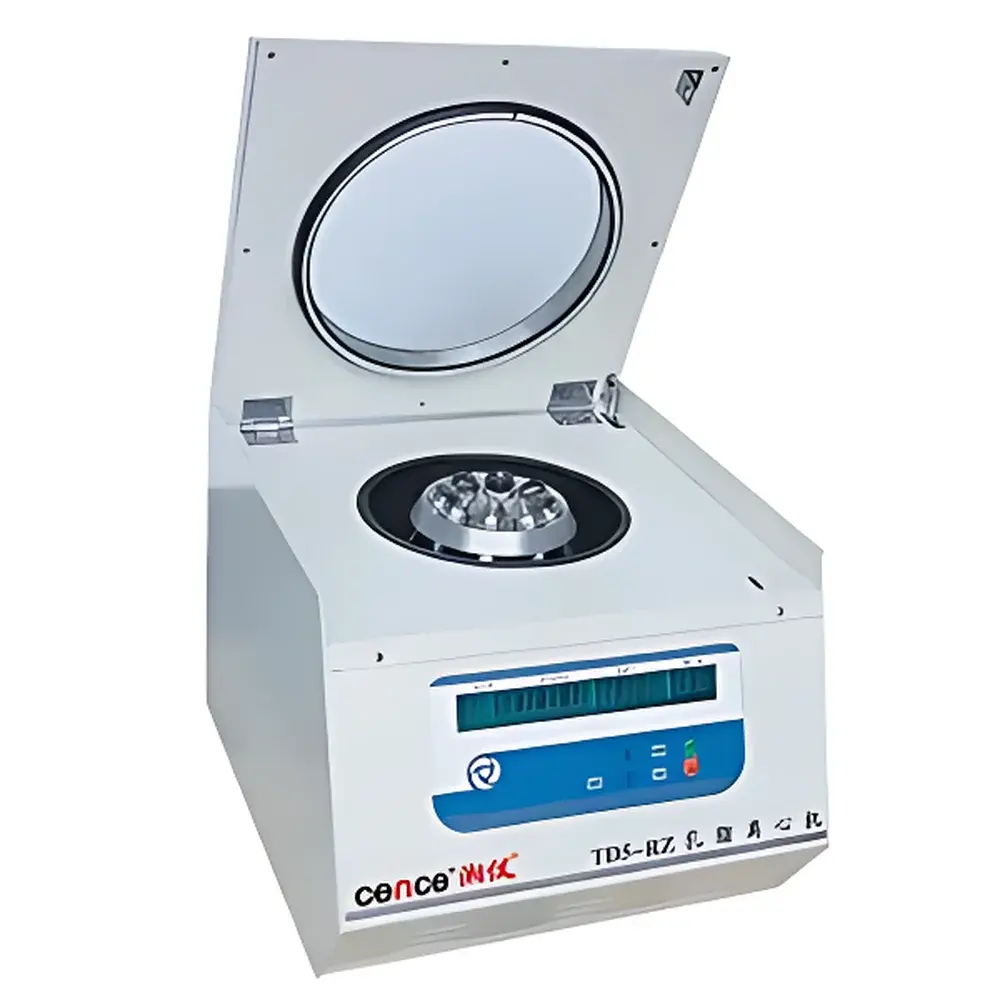
Xiangyi D5-RZ Gerber Centrifuge for Milk Fat Analysis
| Brand | Xiangyi |
|---|---|
| Origin | Hunan, China |
| Manufacturer Type | Manufacturer |
| Origin Category | Domestic |
| Model | D5-RZ |
| Price Range | USD 150–15,000 (FOB) |
| Max Speed | 3000 rpm |
| Total Power | 1.5 kW |
| Max RCF | 3500 × g |
| Voltage/Frequency | AC 220 V, 50 Hz, 10 A |
| Max Capacity | 4 × 50 mL |
| Noise Level | ≤60 dB(A) |
| Speed Accuracy | ±30 rpm |
| Net Weight | 150 kg |
| Temp. Range | Ambient +10°C to 65°C |
| Acceleration/Deceleration Time | Programmable |
| Door Lock | Mechanical Interlock |
| Timer Range | 0–99 min |
| Rotor Chamber Diameter | 450 mm |
| Drive System | AC Frequency-Controlled Direct Drive |
| Display | Digital LED Panel |
| Memory Function | Yes |
| Chamber Ambient Temp. Range | Ambient +15°C to 70°C |
| Dimensions (L×W×H) | 590 × 710 × 1140 mm |
| Packing Dimensions | 1410 × 920 × 730 mm |
Overview
The Xiangyi D5-RZ Gerber Centrifuge is a purpose-built, high-reliability centrifugal instrument engineered specifically for standardized fat determination in milk and dairy products according to internationally recognized methods—including the Gerber method (ISO 1735:2008), the Babcock method (AOAC 920.125), and related national standards (e.g., GB 5413.3–2010). It operates on the principle of differential sedimentation under controlled centrifugal force: when milk or cream samples are treated with sulfuric acid and amyl alcohol (Gerber reagents), fat globules coalesce and separate into a distinct upper layer within calibrated butyrometers. The D5-RZ delivers precise, repeatable acceleration profiles and thermal stability to ensure consistent phase separation—critical for achieving traceable, inter-laboratory comparable results in quality control laboratories, dairy processing plants, and regulatory testing facilities.
Key Features
- Optimized Gerber workflow integration: Dedicated rotor geometry accommodates standard 50 mL Gerber butyrometers (ISO-compliant glassware) across four positions, enabling parallel processing without cross-contamination.
- Programmable acceleration and deceleration profiles: Enables fine-tuned control over ramp-up and coast-down phases—minimizing emulsion disturbance and preserving fat column integrity during braking.
- Stable temperature management: Independent heating system maintains chamber temperature between ambient +10°C and 65°C, supporting method-specific thermal conditioning (e.g., pre-warming butyrometers per ISO 1735 Annex A).
- Rugged mechanical door interlock: Ensures operational safety by preventing lid opening during rotation and enforcing mandatory rotor stop before access—compliant with IEC 61010-2-020 safety requirements for centrifuges.
- Direct-drive AC frequency-controlled motor: Eliminates belt wear, reduces vibration, and ensures long-term speed stability and torque consistency at 3000 rpm (RCF up to 3500 × g).
- Digital LED interface with memory function: Stores up to 10 user-defined protocols—including time, speed, temperature, and ramp settings—for rapid recall and GLP-aligned procedural reproducibility.
Sample Compatibility & Compliance
The D5-RZ is validated for use with standard Gerber-type butyrometers (50 mL capacity, conical calibration), as well as Babcock flasks and alternative fat-testing glassware conforming to ISO 1735, AOAC Official Method 920.125, and national dairy standards. Its mechanical design and thermal performance support full compliance with routine QC testing in ISO/IEC 17025-accredited laboratories. While the unit itself does not carry CE or UL certification out-of-the-box, its electrical architecture (220 V, 50 Hz, Class I protection) and safety interlocks meet baseline requirements for integration into GMP-aligned dairy QA environments. Documentation packages—including factory calibration records, material declarations, and test reports—can be supplied upon request to support internal audit readiness.
Software & Data Management
The D5-RZ operates via an embedded microcontroller-based control system with no external PC dependency. All operational parameters—including run time, speed setpoint, actual RCF, chamber temperature, and cycle completion status—are displayed in real time on the front-panel LED screen. Protocol memory supports traceable method execution without manual transcription; however, raw data export (e.g., CSV logs or USB transfer) is not natively supported. For laboratories requiring electronic recordkeeping under FDA 21 CFR Part 11 or EU Annex 11, integration with third-party LIMS or ELN systems can be achieved via optional RS-232 or analog output modules (available as accessories). Audit trail functionality must be implemented externally, as the device lacks built-in electronic signature or user-level access control.
Applications
- Routine fat quantification in raw milk, pasteurized milk, UHT milk, cream, whey, and recombined dairy products.
- Verification of fat content claims for labeling compliance (e.g., “whole milk”, “low-fat”, “skim” categories per Codex Alimentarius STAN 206–1999).
- In-process monitoring in dairy manufacturing lines—enabling rapid feedback for homogenization, standardization, and blending adjustments.
- Reference method validation against instrumental alternatives (e.g., mid-IR spectroscopy, NMR) in method comparison studies.
- Training and proficiency testing in food science education programs where standardized, hands-on fat analysis remains pedagogically essential.
FAQ
What standards does the D5-RZ comply with for milk fat analysis?
It is designed to execute ISO 1735:2008 (Gerber method) and AOAC 920.125 (Babcock method) with full adherence to sample volume, reagent ratio, centrifugation time, and temperature specifications.
Can the D5-RZ be used for non-dairy samples such as plant-based beverages?
While primarily validated for mammalian milk matrices, limited adaptation for soy, almond, or oat milks is possible—but requires method verification due to differences in fat globule size, emulsifier content, and acid stability.
Is temperature calibration traceable to national standards?
Factory calibration uses NIST-traceable reference thermometers; users may perform periodic verification using accredited PT100 probes inserted into designated chamber ports.
Does the unit include rotor imbalance detection?
No—imbalance sensing is not integrated. Operators must manually balance butyrometer loads to within ±0.5 g per position to prevent excessive vibration or premature bearing wear.
What maintenance intervals are recommended for long-term reliability?
Lubrication-free direct drive eliminates motor servicing; biannual inspection of door latch mechanism, chamber gasket integrity, and display firmware version is advised per the maintenance log provided in the operator manual.





