
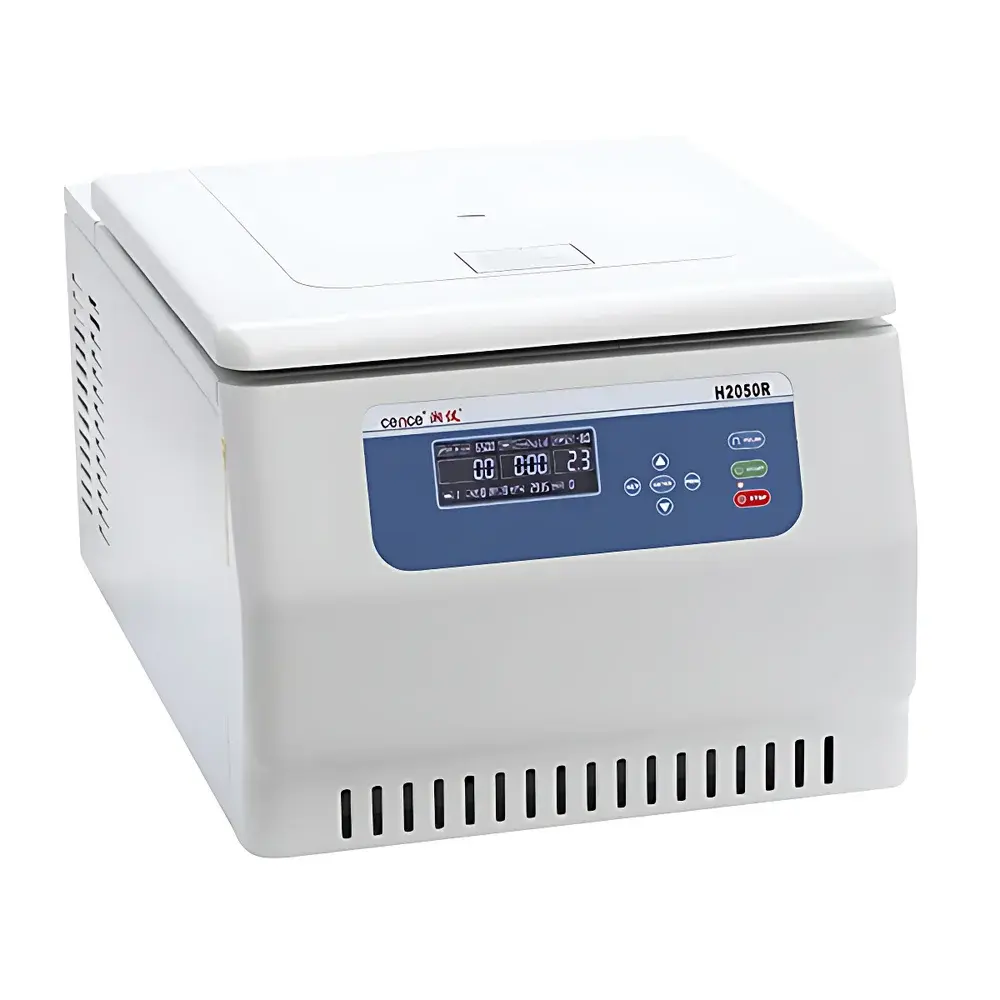
Xiangyi H2050R Benchtop High-Speed Refrigerated Centrifuge
| Brand | Xiangyi |
|---|---|
| Origin | Hunan, China |
| Manufacturer Type | Direct Manufacturer |
| Product Category | Domestic |
| Model | H2050R |
| Instrument Type | Benchtop Centrifuge |
| Speed Range | 20,500 rpm |
| Max RCF | 29,200 × g |
| Max Capacity | 4 × 750 mL |
| Temperature Range | −20 °C to +40 °C (operational stability ≤ −4 °C at max speed) |
| Dimensions (W×D×H) | 560 × 800 × 440 mm |
| Rotor Compatibility | 12 interchangeable rotors (including horizontal, fixed-angle, and high-speed vertical configurations) |
| Drive System | Microprocessor-controlled AC brushless frequency-converter motor |
| Control Interface | Touchscreen LCD with programmable protocols |
| Acceleration/Deceleration Profiles | 9 acceleration + 10 deceleration curves (including free-coast option) |
| Safety Features | Automatic rotor recognition, overspeed protection, lid interlock, triple-layer safety containment, stainless-steel chamber, real-time temperature monitoring, and dual-stage overtemperature cutoff |
Overview
The Xiangyi H2050R Benchtop High-Speed Refrigerated Centrifuge is engineered for precision separation of biological macromolecules—including nucleic acids, proteins, subcellular organelles, and viral particles—under controlled thermal conditions. Operating on the principle of sedimentation force generation via rotational acceleration, it delivers reproducible RCF (Relative Centrifugal Force) up to 29,200 × g at a maximum rotational speed of 20,500 rpm. Its compact benchtop footprint (560 × 800 × 440 mm) integrates industrial-grade refrigeration capable of maintaining chamber temperatures at or below −4 °C even at peak rotational velocity—a critical requirement for thermolabile sample integrity during prolonged high-speed runs. Designed for laboratories requiring both high throughput and high-resolution fractionation, the H2050R bridges the functional gap between floor-standing preparative centrifuges and entry-level microcentrifuges, offering scalable performance without sacrificing spatial efficiency.
Key Features
- Microprocessor-based control system with intuitive touchscreen interface and backlit LCD display for real-time parameter monitoring and protocol storage.
- Direct-drive AC brushless frequency-converter motor delivering high torque, low vibration, and extended service life (>20,000 hours MTBF).
- Twelve interchangeable rotor configurations—including four 750 mL horizontal carriers, fixed-angle rotors for rapid pelleting, and high-speed vertical rotors optimized for density gradient separations—enabling method flexibility across molecular biology, clinical diagnostics, and bioprocessing workflows.
- Programmable acceleration and deceleration profiles (9 acceleration / 10 deceleration curves), including zero-force coast-down mode, minimizing shear-induced sample disruption during braking.
- Triple-stage mechanical damping system combined with dynamically balanced rotor assemblies ensures operational stability at full speed, reducing noise (<65 dB(A)) and structural fatigue.
- Comprehensive safety architecture: automatic rotor ID recognition, lid interlock with force-sensing mechanism, real-time overspeed detection, dual independent temperature sensors, and stainless-steel inner chamber with corrosion-resistant coating.
Sample Compatibility & Compliance
The H2050R supports standard ANSI/ISO-compliant centrifuge tubes (e.g., 15 mL, 50 mL conical, 250 mL bottles, and 750 mL buckets) as well as custom adapters for specialized vessels. Its temperature control system meets IEC 61010-2-020 requirements for laboratory equipment safety, while refrigerant selection (R134a or equivalent low-GWP alternative) complies with EU F-Gas Regulation and EPA SNAP guidelines. The instrument’s firmware architecture supports audit-trail-capable operation when integrated into GLP/GMP environments—though native 21 CFR Part 11 compliance requires optional software validation package and networked server deployment.
Software & Data Management
The embedded operating system enables storage of up to 100 user-defined protocols with timestamped run logs, including speed, time, temperature, RCF, and rotor-specific parameters. Data export is supported via USB 2.0 port in CSV format for downstream analysis in Excel, GraphPad Prism, or LIMS platforms. Optional PC-based Xiangyi CentriControl Suite (v3.2+) provides remote monitoring, batch report generation, electronic signature support, and automated calibration logging—facilitating alignment with ISO/IEC 17025 documentation standards for accredited testing laboratories.
Applications
- Purification of plasmid DNA, genomic DNA, and RNA from bacterial lysates and mammalian cell cultures.
- Isolation of mitochondria, lysosomes, and synaptic vesicles via differential and density-gradient ultracentrifugation (with compatible high-speed rotors).
- Clinical specimen processing: serum/plasma separation from whole blood; exosome enrichment from biofluids.
- Vaccine development: clarification of viral vector suspensions and removal of host-cell debris post-transfection.
- Quality control in biomanufacturing: particulate analysis, aggregate quantification, and buffer exchange validation.
FAQ
What is the minimum temperature achievable at maximum speed?
The unit maintains ≤ −4 °C inside the rotor chamber during continuous operation at 20,500 rpm, verified per ISO 13720 thermal stability test protocol.
Does the H2050R support regulatory-compliant data integrity?
Yes—when configured with validated CentriControl Suite and external audit-server infrastructure, it supports ALCOA+ principles (Attributable, Legible, Contemporaneous, Original, Accurate) for electronic records.
Are rotors certified for long-term use under cyclic loading?
All 12 rotors carry individual serial-numbered certificates of conformity, with fatigue life validated to ≥50,000 cycles at rated RCF per ISO 15527 Annex B.
Can the centrifuge be integrated into a building management system (BMS)?
An optional RS485 Modbus RTU interface module enables status polling (door state, temperature, error codes) and basic start/stop commands for centralized lab monitoring.
What maintenance intervals are recommended for optimal performance?
Routine inspection every 6 months includes rotor bore measurement, refrigerant pressure verification, and brake pad wear assessment—full service manual available upon request with valid serial number registration.



