
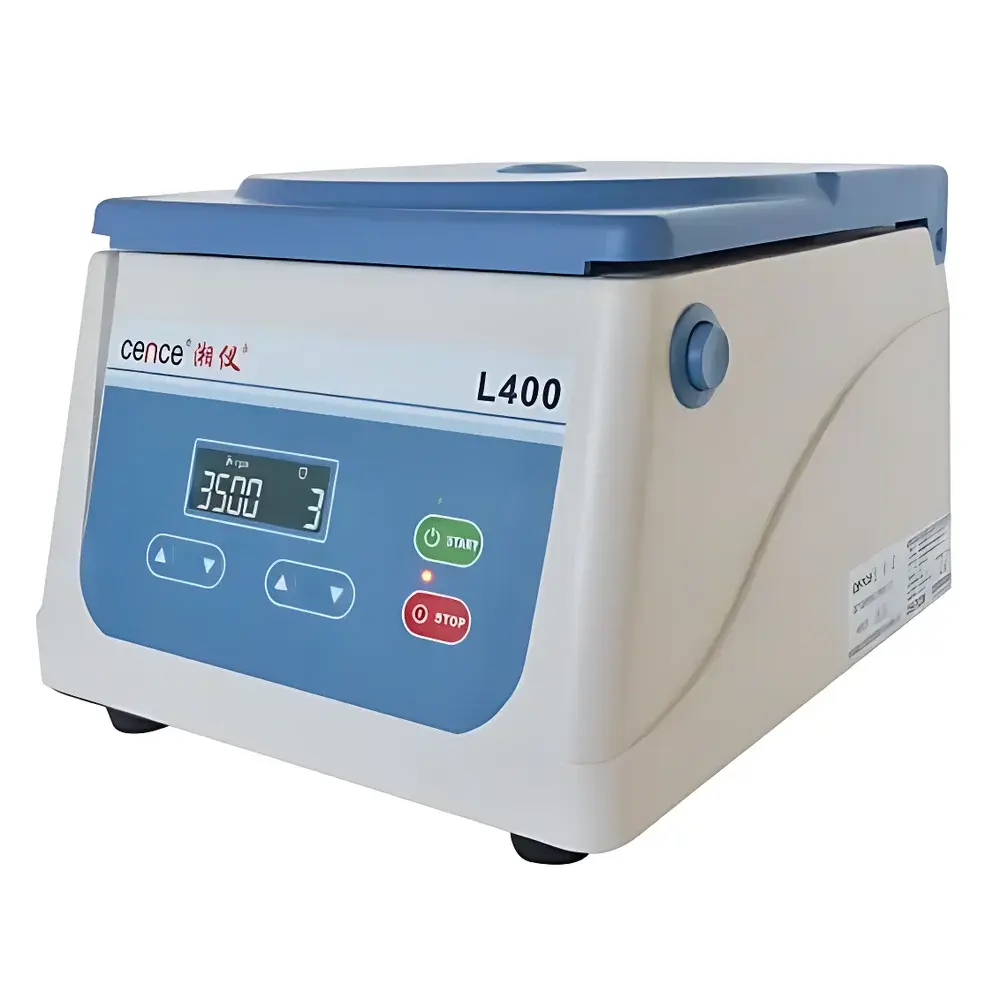
Xiangyi L400 Benchtop Low-Speed Centrifuge
| Brand | Xiangyi |
|---|---|
| Origin | Hunan, China |
| Manufacturer Type | Direct Manufacturer |
| Product Category | Domestic |
| Model | L400 |
| Instrument Type | Benchtop Centrifuge |
| Speed Class | Low-Speed Centrifuge (max. 4000 rpm) |
| Function | General-Purpose Centrifuge |
| Rotor Configuration | Fixed-Angle Rotor |
| Max Capacity | 6 × 15 mL |
| Max Speed | 4000 rpm |
| Max RCF | 1980 × g |
| Dimensions (L×W×H) | 265 × 305 × 205 mm |
| Speed Accuracy | ±30 rpm |
| Timer Range | 1–99 min |
| Noise Level | <62 dB(A) |
| Power Supply | AC 220 V ±22 V, 50/60 Hz, 2 A |
| Power Consumption | 100 W |
| Net Weight | 7.5 kg |
Overview
The Xiangyi L400 Benchtop Low-Speed Centrifuge is an engineered solution for routine sedimentation and phase separation tasks in clinical, academic, and quality control laboratories. Designed around a robust all-steel chassis and driven by a brushless DC motor, the L400 delivers stable rotational performance with minimal mechanical wear and thermal drift. Its operating principle relies on centrifugal force generation via fixed-angle rotor geometry, enabling efficient pelleting of cells, precipitates, and particulates from suspensions at moderate g-forces—ideal for applications where high-speed shear stress or thermal sensitivity must be avoided. With a maximum relative centrifugal force (RCF) of 1980 × g and a top speed of 4000 rpm, the L400 falls within the ISO 15195-defined low-speed centrifuge classification (≤5000 rpm), making it suitable for blood component separation, urine sediment analysis, enzyme assay preparation, and basic nucleic acid or protein pellet recovery.
Key Features
- All-steel structural frame ensures long-term mechanical stability and vibration damping under continuous operation.
- Microprocessor-controlled system with brushless DC motor provides precise speed regulation (±30 rpm accuracy) and eliminates carbon brush maintenance.
- Intuitive touch-panel interface with LED numeric display enables real-time monitoring of speed, RCF, time, and operational status.
- Dynamic parameter adjustment: users may modify speed, time, or RCF during active runs without requiring rotor deceleration or stoppage.
- Dedicated RCF key allows instant conversion between rpm and g-force values based on rotor radius—critical for method transfer and SOP compliance.
- Smart countdown logic: when remaining time drops below 60 seconds, display switches to second-level resolution for fine-grained timing control.
- Integrated self-diagnostic system continuously monitors rotor speed integrity and detects anomalies including overspeed, speed loss, or imbalance—triggering immediate deceleration and safe shutdown.
- Acoustically optimized design achieves <62 dB(A) noise emission at rated load, supporting placement in shared lab environments without dedicated acoustic enclosures.
Sample Compatibility & Compliance
The L400 accommodates standard conical-bottom polypropylene tubes (15 mL capacity) in its fixed-angle rotor (model L400809001), with optional adapters for 10 mL and 5 mL tubes included. Tube compatibility adheres to IEC 61010-1 safety standards for laboratory equipment, and rotor balance tolerances meet ISO 21501-4 specifications for particle-based separation reproducibility. While not certified for biosafety level (BSL)-3 containment or aerosol-tight operation, the unit complies with general-purpose centrifuge requirements under CLSI GP35-A4 guidelines for clinical specimen processing. It supports GLP-aligned workflows through traceable parameter logging (via optional external data capture) and is compatible with laboratory information management systems (LIMS) that accept ASCII-formatted run metadata.
Software & Data Management
The L400 operates as a standalone instrument with embedded firmware—no proprietary PC software is required for basic operation. However, its digital interface outputs time-stamped operational logs (start time, set parameters, final RCF, elapsed duration) via serial communication (RS-232 port optional upon request), enabling integration into validated data acquisition platforms. For regulated environments (e.g., pharmaceutical QC labs), users may configure external recording devices to capture timestamped parameter changes, satisfying FDA 21 CFR Part 11 audit-trail requirements when paired with appropriate electronic signature controls. Firmware updates are delivered via USB flash drive and retain full backward compatibility with existing rotor calibration profiles.
Applications
- Clinical hematology: separation of whole blood into serum/plasma and cellular fractions using standard 15 mL collection tubes.
- Microbiology: harvesting bacterial pellets post-culture for Gram staining or antibiotic susceptibility testing.
- Environmental testing: concentration of suspended solids from water samples prior to gravimetric or spectrophotometric analysis.
- Food & beverage QA: clarification of juice, milk, or fermentation broths for turbidity or fat content assessment.
- Academic teaching labs: introducing centrifugation principles with repeatable, low-risk operation for undergraduate instruction.
- Pharmaceutical raw material screening: isolation of insoluble excipients or degradation products from formulation suspensions.
FAQ
What is the maximum tube volume supported by the standard rotor?
The L400’s fixed-angle rotor (L400809001) holds six 15 mL conical tubes; optional adapters allow use of 10 mL or 5 mL tubes without compromising balance or RCF uniformity.
Does the L400 support refrigerated operation?
No—the L400 is a non-refrigerated benchtop model designed for ambient-temperature separations only. For temperature-sensitive samples, users should pre-chill specimens and minimize run duration.
Can the centrifuge be validated for GMP-compliant processes?
Yes—while the base unit lacks factory-installed 21 CFR Part 11 features, its parameter stability, diagnostic logging capability, and mechanical repeatability support IQ/OQ protocols when combined with third-party validation documentation and external data capture tools.
Is rotor calibration required before first use?
The rotor is pre-calibrated at the factory; however, users should verify speed accuracy annually using a NIST-traceable tachometer as part of preventive maintenance planning.
What safety certifications does the L400 carry?
It conforms to IEC 61010-1:2010 for electrical safety and EN 61326-1:2013 for electromagnetic compatibility (EMC); CE marking applies to the EU market under the Low Voltage Directive (2014/35/EU).



