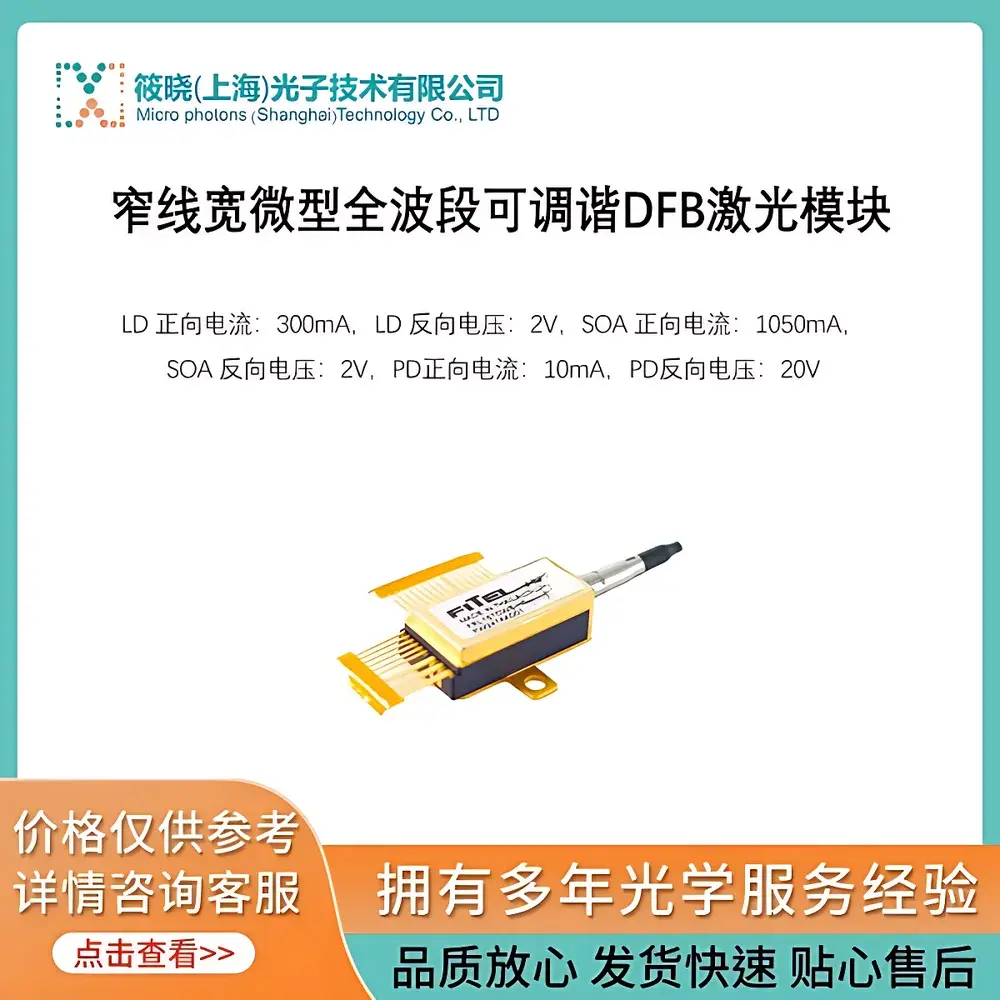
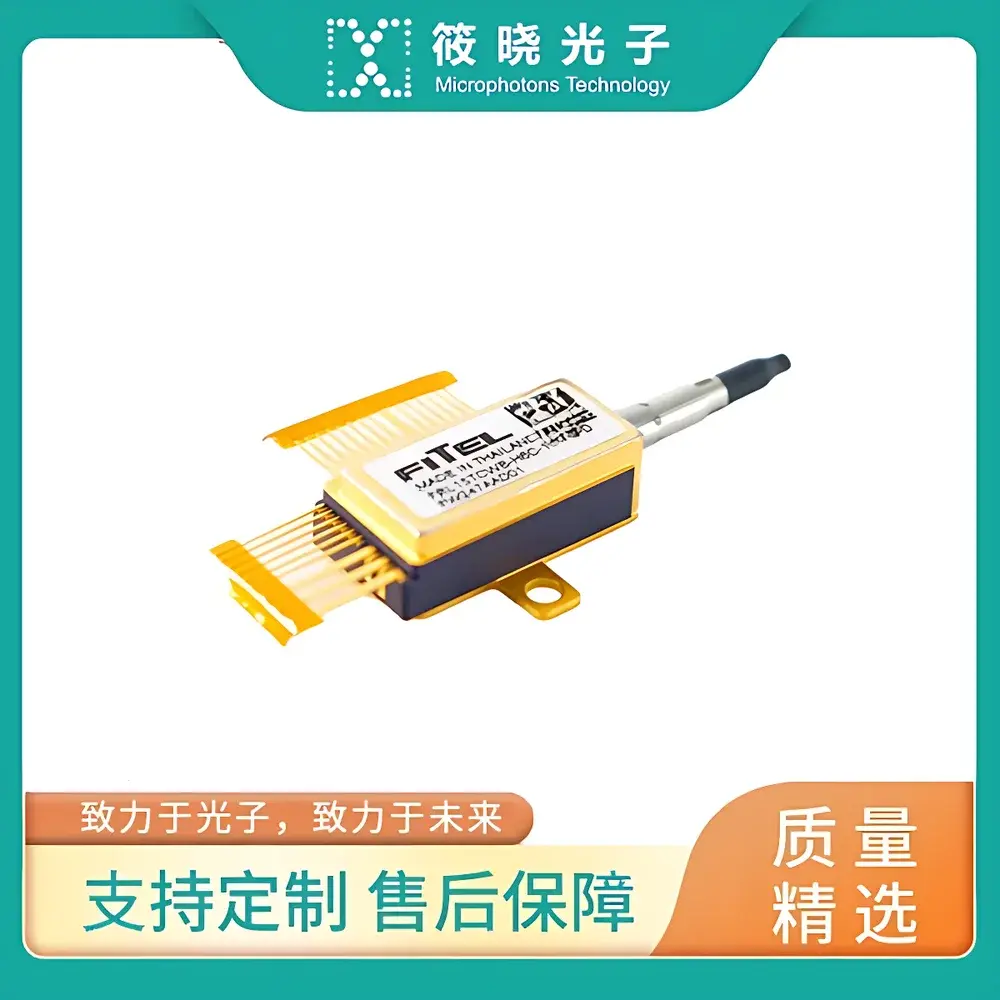
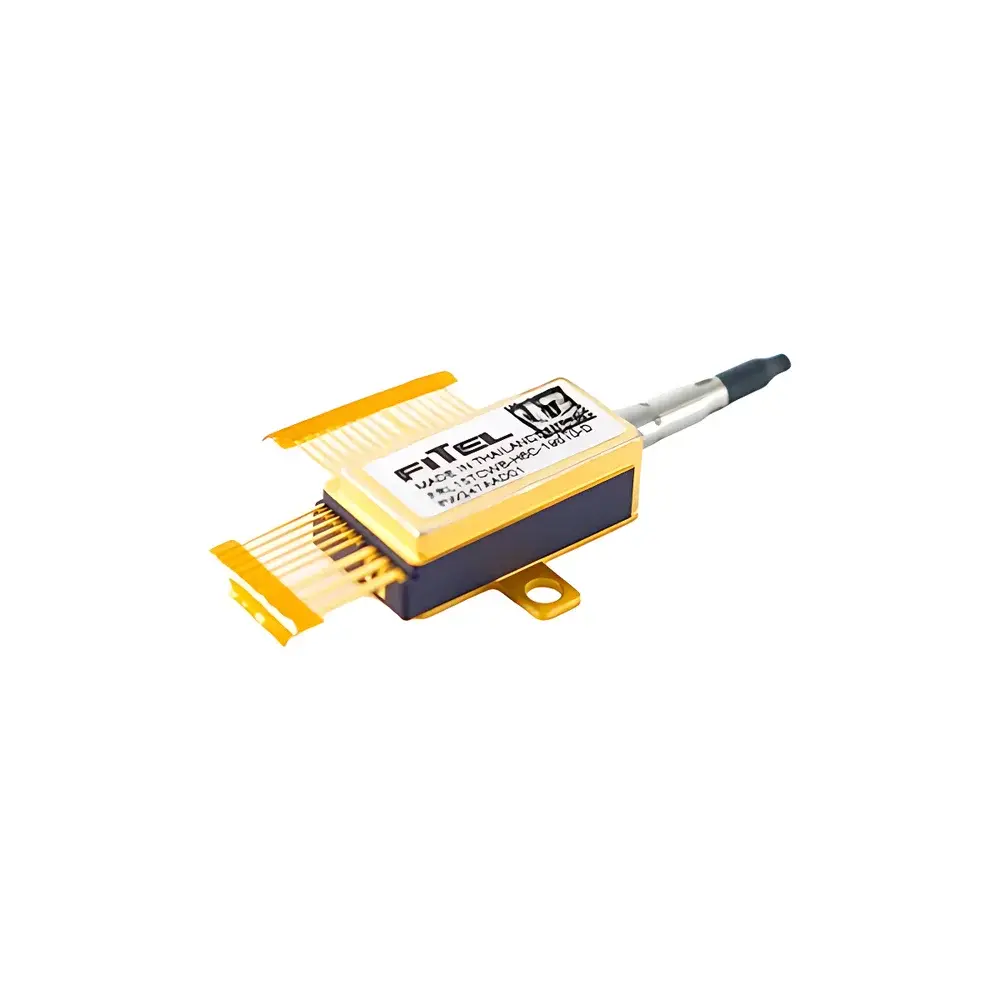
Xiaomiao Photonics FRL15TCWB-H6C-19610-D Narrow-Linewidth Miniature Full-Band Tunable DFB Laser Module
| Brand | Xiaomiao Photonics (Microphotons) |
|---|---|
| Origin | Shanghai, China |
| Manufacturer Type | OEM Manufacturer |
| Product Origin | Domestic (China) |
| Model | FRL15TCWB-H6C-19610-D |
| Price | Upon Request |
| Center Wavelength Range | 1528.773–1566.723 nm |
| Output Power | 10 mW (CW) |
| Spectral Linewidth (−20 dB) | ≤ 500 kHz |
| SMSR | ≥ 40 dB |
| Optical Isolation | ≥ 25 dB |
| RIN | ≤ −135 dB/Hz @ 10 MHz |
| TEC-Controlled Temperature Range (LD) | 18–62 °C |
| Filter Temperature Range | 30–62.5 °C |
| Tuning Capture Range | −14.0 to +36.0 GHz |
| FSR | 50 GHz |
| Grid Spacing | 50 GHz |
| Fiber Type | SMF-28 |
| Connector Options | SC/PC or FC/APC |
Overview
The Xiaomiao Photonics FRL15TCWB-H6C-19610-D is a high-stability, narrow-linewidth, miniature tunable distributed feedback (DFB) laser module engineered for precision optical testing and characterization of semiconductor devices, photonic integrated circuits (PICs), and fiber-optic components. Based on Fujitsu-sourced DFB laser diodes and integrated with dual-stage thermoelectric cooling (TEC), this module delivers full-band wavelength tuning across the C-band (1528.773–1566.723 nm) with sub-GHz spectral purity. Its operation relies on monolithic DFB grating structures combined with external cavity filtering and active thermal stabilization—enabling precise control of longitudinal mode emission without mode hops. Designed explicitly for integration into automated semiconductor curve tracers and optical parameter analyzers, the module supports rigorous compliance requirements in R&D labs and production test environments where traceable wavelength accuracy, low relative intensity noise (RIN), and high side-mode suppression ratio (SMSR) are critical.
Key Features
- Ultra-narrow intrinsic linewidth ≤ 500 kHz (−20 dB full width), enabling high-resolution spectroscopic interrogation and coherent detection applications
- Full C-band tunability via independent thermal control of both laser diode (TLD: 18–62 °C) and integrated filter (Tf: 30–62.5 °C), achieving continuous, mode-hop-free scanning over >37 nm
- Dual-TEC architecture with separate current/voltage control (ITEC1 ≤ 1.2 A, VTEC1 ≤ 3.47 V; ITEC2 ≤ 0.7 A, VTEC2 ≤ 1.9 V) ensures long-term wavelength stability and repeatability
- High optical isolation ≥ 25 dB minimizes back-reflection sensitivity—essential for stable operation in open-loop test configurations
- Integrated monitor photodiode with linear current output (Im = 8–1200 µA at VrPD = 5 V) enables real-time power feedback for closed-loop intensity regulation
- Compliant with ITU-T G.694.1 50 GHz grid spacing and capture range specifications (−14.0 to +36.0 GHz), supporting DWDM component validation and channel alignment
- Robust mechanical packaging optimized for OEM integration: compact footprint, SMF-28 pigtail with SC/PC or FC/APC connector options, and operational humidity tolerance (5–85% RH, non-condensing)
Sample Compatibility & Compliance
The FRL15TCWB-H6C-19610-D is qualified for use in semiconductor device curve tracing systems, particularly for characterizing optoelectronic devices including laser diodes, EMLs, SOAs, and photodetectors under DC and pulsed bias conditions. Its stable single-longitudinal-mode (SLM) output meets the spectral fidelity requirements of IEEE 802.3, Telcordia GR-468-CORE, and IEC 61280-2-9 test methodologies. While not certified to specific ISO/IEC 17025 calibration standards out-of-box, the module’s inherent wavelength stability (±3 GHz over −5 to +75 °C ambient) and factory-traceable center wavelength allow direct correlation to NIST-traceable wavemeters during system-level qualification. The device operates within GLP-compliant environmental limits (storage: −40 to +85 °C; operation: −5 to +75 °C), and its electrical safety design conforms to IEC 61010-1 for measurement equipment.
Software & Data Management
The module interfaces via analog control inputs (LD current, TEC setpoints, monitor PD voltage) and supports digital command protocols through optional USB-to-TTL or RS-485 interface modules (sold separately). When integrated into automated test systems, it enables synchronized sweep acquisition with source-measure units (SMUs) and optical spectrum analyzers (OSAs). All operational parameters—including real-time temperature telemetry, output power monitoring, and fault flagging (e.g., TEC overcurrent, LD overvoltage)—are accessible for logging and audit trail generation. For regulated environments, the system architecture supports 21 CFR Part 11-compliant data integrity when paired with validated host software featuring electronic signatures, change history, and user-access controls.
Applications
- Automated semiconductor curve tracing of laser diodes and electro-absorption modulated lasers (EMLs)
- Wavelength-dependent loss (WDL) and polarization-dependent loss (PDL) measurements on passive DWDM filters and AWGs
- Coherent receiver characterization and local oscillator (LO) source provisioning in lab-based 400G/800G optical transceiver validation
- Optical frequency domain reflectometry (OFDR) and high-resolution interferometric sensing
- Calibration reference source for optical spectrum analyzers and wavelength meters requiring C-band coverage and sub-MHz linewidth
- Research-grade spectroscopy in atomic physics setups requiring tunable, low-noise near-IR sources
FAQ
What is the guaranteed wavelength accuracy across temperature and lifetime?
The module is specified for initial wavelength accuracy of ±0.02 nm (BOL) at Tc = 35 °C. Over the full operating temperature range (−5 to +75 °C), wavelength drift is bounded by ±3 GHz relative to the nominal ITU channel, as verified per Fujitsu’s test methodology.
Can this module be used in a feedback-controlled wavelength lock system?
Yes—the integrated monitor photodiode and dual-TEC actuation channels support external PID loop implementation using standard lab controllers (e.g., Thorlabs Kinesis, National Instruments PXI). Reference signals from a stabilized etalon or gas absorption cell may be used for absolute lock.
Is optical isolation sufficient for direct coupling into reflective DUTs like FBGs or resonant cavities?
With ≥25 dB built-in isolation, the module can operate directly into moderately reflective devices (<−30 dB return loss). For highly reflective interfaces (e.g., cleaved fiber ends or uncoated mirrors), an external isolator (≥40 dB) is recommended to prevent instability.
Does the module comply with laser safety Class 1 requirements?
When fully enclosed in an OEM instrument housing with interlocked access and beam termination, the system meets IEC 60825-1 Class 1. As a standalone module, it is classified as Class 3B (10 mW visible/NIR output); appropriate laser safety protocols must be followed during benchtop use.
What is the expected lifetime under continuous CW operation at rated power?
Based on Fujitsu DFB reliability data and accelerated life testing (5000 h @ 60 °C, 100% drive current), the module demonstrates >100,000 hours MTTF under typical operating conditions (Tc = 25–45 °C, IfLD ≤ 250 mA).